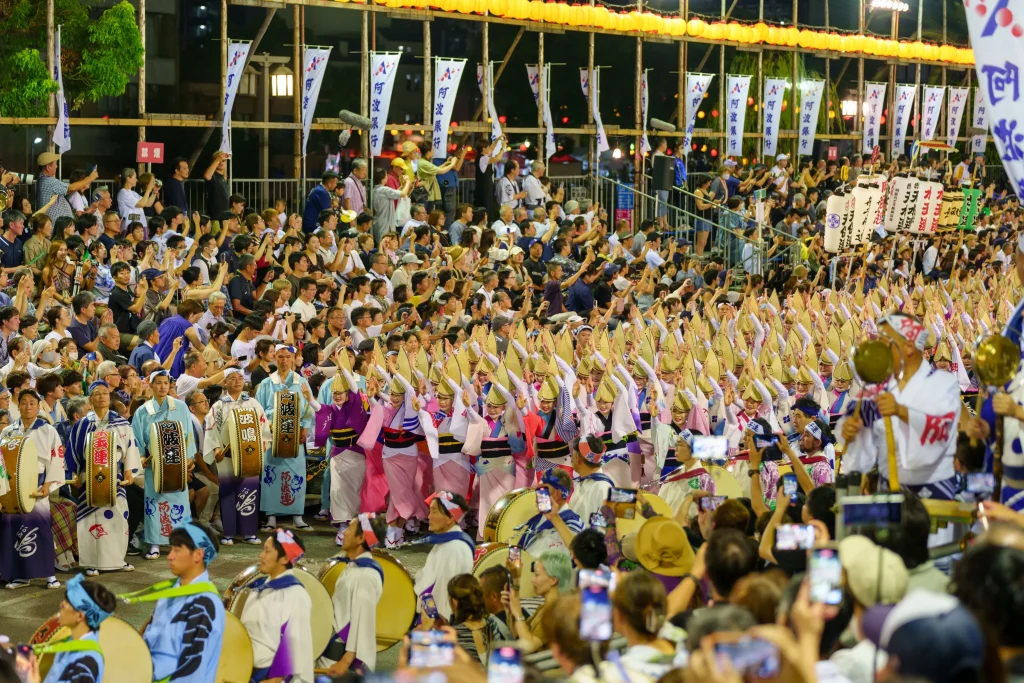
Awa Odori is a dance that actively invites the audience to stop watching and start moving, built around a chant that translates roughly to “dancers are fools, watchers are fools, so you might as well dance.” Each August, this becomes literal in Tokushima City on the island of Shikoku, where more than a million visitors watch over 1,000 dance troupes move through streets closed off for the occasion, and where a first-time visitor can, with almost no preparation, join in. This guide covers what Awa Odori actually is, where to see it in Tokushima and Tokyo, and how to dance in it rather than simply watch from the sidelines.
What Is Awa Odori?
Awa Odori is a regional style of Bon Odori, the folk dances performed across Japan during Obon, the mid-August period when ancestral spirits are traditionally believed to return to the living, and communities dance as a form of welcome. “Awa” was the historical name for Tokushima Prefecture before Japan’s Meiji-era prefectural reorganization, and “odori” simply means dance, making the festival’s name a direct statement of its origin.
The dance’s precise beginnings are debated among at least two competing accounts. One theory ties it to 1586, when Awa Odori is said to have begun as a celebration marking the completion of Tokushima Castle under feudal lord Hachisuka Iemasa; another connects its movements to furyu odori, an older performing art considered a precursor to Noh theater. Either way, the tradition is documented as more than 400 years old, and its reputation in earlier centuries as a raucous, informally drunken street celebration has softened over time into the highly organized, still spirited festival visitors see today.
When and Where: Tokushima vs. Tokyo’s Koenji
Tokushima City hosts the original and by far the largest Awa Odori, with 2026’s street dancing running the four nights of August 12 through 15, following the festival’s traditional mid-August schedule tied to Obon; August 11 serves as an indoor-only preview night. For travelers who cannot reach Shikoku, Tokyo’s Suginami Ward hosts the Koenji Awa Odori Festival, held on a different late-August weekend (August 29 and 30 in 2026), making it possible in some years to catch both the Tokushima original and its Tokyo counterpart within roughly two weeks of each other.
The two events differ meaningfully beyond scale. Tokushima’s version unfolds across an entire city center shut down for four consecutive nights, with dancing continuing from 18:00 to around 22:30 each evening; Koenji compresses a comparable atmosphere into two days along the neighborhood’s shopping streets, reachable by a roughly 20-minute train ride from Shinjuku Station rather than a flight or long train journey to Shikoku. Neither is objectively the “better” choice: Tokushima offers the tradition at its original scale and setting, while Koenji offers most of the same energy without leaving Tokyo.
The Dance Itself: Meaning, Style, and the Chant
Awa Odori divides into two distinct styles performed simultaneously within the same ren, or dance troupe: men dance in a low, crouching stance with wide, stomping footwork, while women dance on tiptoe in a more upright, restrained posture, often wearing the distinctive amigasa, a half-moon-shaped woven hat that shadows the upper half of the face. Both styles move to the same live musical ensemble, shamisen (a three-stringed lute), taiko drums, and fue (bamboo flutes), driving a hypnotic two-beat rhythm that dancers and musicians follow together rather than to a separately choreographed track.
Every ren wears a unified costume in its own color palette, so that a full troupe moving in formation reads as a single block of color, bright pink, sea blue, or saffron yellow among the more common choices, against the otherwise uniform backdrop of the closed-off street. Throughout the dance, performers repeat the festival’s signature chant: “Odoru ahou ni miru ahou, onaji ahou nara odoranya son son,” meaning “those who dance are fools, those who watch are fools; if both are fools, you might as well dance.” The line is not incidental decoration but the festival’s stated philosophy, repeated specifically to draw spectators past simple observation and into the dance itself.
Tokushima’s Awa Odori: Japan’s Largest Dance Festival
Tokushima’s festival draws over a million visitors across its four nights to watch more than 1,000 registered ren, ranging from veteran troupes that rehearse year-round to groups assembled from friends just days before the event. Viewing options split clearly into paid and free: reserved seating is available at several enbujo, or theater stages, including locations at the Tokushima Municipal Office, Aibahama Park, Konyamachi, and Minamiuchi-machi, with tickets released through a June presale and general sale beginning July 1 via Ticket Pia’s English-language site; free, open viewing without reservation is available along streets including Ryogoku Honmachi, Shinmachibashi, and Motomachi, though arriving well before the evening’s dancing begins is necessary to secure a clear sightline at the more popular free spots.
Because street dancing runs only from August 12 through 15 (the 11th is an indoor preview performance only), travelers building a trip specifically around the outdoor street dancing should confirm their dates fall within that four-night window rather than assuming the entire festival period involves street parades.
Koenji Awa Odori: The Tokyo Alternative
Koenji’s version of the festival began in 1957, when local residents launched a summer event to revitalize their shopping district and enlisted a Tokushima native living in the neighborhood as a dance mentor, a modest civic initiative that has since grown into a festival drawing roughly 10,000 dancers and about one million spectators over two days. One of the neighborhood’s best-known troupes, Tengu-ren, is frequently highlighted for the visible skill gap between its practiced formations and the more casual groups dancing alongside them, particularly as the tempo accelerates toward each performance’s climax.
For a traveler with limited time in Japan who still wants to see Awa Odori firsthand, Koenji removes nearly every logistical barrier that a Tokushima trip requires: no flight or long-distance train, no multi-night hotel booking in a smaller city during its single busiest week of the year, and a festival still large enough (a million visitors is not a modest crowd by any standard) to deliver the same immersive street atmosphere in miniature.
How to Actually Dance: Joining a Niwaka-Ren
For visitors who want to move past watching entirely, Tokushima’s niwaka-ren, or “sudden troupe,” is specifically designed for this: anyone can join, dancing at the Tokushima Ekimae Dance Plaza and Motomachi-odori Dance Plaza between roughly 18:30 and 20:30, with no prior registration, rehearsal, or dance experience required. This stands in direct contrast to the choreographed dancing held in front of Tokushima Station itself, which is reserved exclusively for registered, rehearsed groups and does not accept day-of participants.
For travelers whose real interest in Awa Odori is less about photographing the spectacle and more about being able to say they danced in it, moving inside the same rhythm and color and crowd noise rather than observing it from a curb, the niwaka-ren is the mechanism that makes that possible without months of advance planning. Year-round, the Awa Odori Kaikan hall near the foot of Mount Bizan, about a 10-minute walk from Tokushima Station, also offers regular performances and hands-on lessons for visitors arriving outside the festival’s August dates entirely.
Why Awa Odori Feels Different From Standard Sightseeing
Much of what draws first-time visitors specifically to Awa Odori, rather than another item on a Kyoto or Tokyo itinerary, is the festival’s structural refusal to separate performer from audience. Temples, museums, and even most other festivals are built around a clear line between what is displayed and who is watching; Awa Odori’s central chant exists specifically to dissolve that line, and the niwaka-ren makes the invitation literal rather than rhetorical. A visitor who dances for even twenty minutes in a niwaka-ren has participated in a 400-year-old tradition in a way that no amount of observation, however attentive, can replicate.
This distinction matters for travelers weighing Awa Odori against Japan’s more heavily photographed destinations. A crowded viewing platform at a famous temple produces a photograph; a night spent moving through Tokushima’s closed-off streets inside a ren, chanting the same line thousands of dancers have chanted before, produces a specific, personal claim to having experienced something rather than simply seen it.
Crowds, Heat, and Where to Stay
Tokushima in mid-August combines the festival’s peak crowds with the Obon travel week, one of the busiest periods on Japan’s domestic travel calendar, and with typical daytime temperatures in the low-to-mid 30s°C (90s°F) and high humidity. Booking accommodation in Tokushima City itself well before July, rather than assuming rooms will be available closer to the date, is the single most important piece of planning advice for this festival specifically; many visitors who book late end up staying in neighboring cities and commuting in for the evening dancing, adding travel time on top of an already long, hot day.
None of this makes the festival impractical; it simply rewards early booking over spontaneity. Staying hydrated, planning for evening rather than daytime viewing (the dancing itself runs 18:00 to 22:30, avoiding the worst of the afternoon heat), and accepting that the most popular free viewing spots require arriving early are the three adjustments that make the difference between an uncomfortable evening and a genuinely enjoyable one.
However you experience it, dancing in Tokushima’s niwaka-ren, watching from a reserved Koenji sidewalk, or simply following the chant’s advice at either event, Awa Odori rewards showing up ready to move rather than simply to look, so pick your city, check that year’s exact dates against the official festival calendar, and plan to leave the sidelines at least once.