Noh and Kabuki offer two distinct ways to experience Japan’s traditional theatre. Nôgaku, which includes Noh and Kyogen, uses restrained movement, chant and masks to suggest emotion. Kabuki brings stories to life through costumes, music, expressive acting and stagecraft. Bunraku adds narrated drama, shamisen music and puppetry. All three are inscribed on UNESCO’s Representative List of the Intangible Cultural Heritage of Humanity. This guide helps you choose a considered cultural evening that fits naturally into your journey.
Origins: How Noh and Kabuki Grew from Different Worlds
Noh, Kabuki and Bunraku developed in different social worlds. Noh was refined under shogunal patronage, Kabuki grew with urban audiences, and Bunraku developed through Osaka’s culture of narration and puppetry. Their origins still shape the experience of watching them today.
Noh: An Art Refined Through Shogunal Patronage
Noh developed in the 14th century. It was refined by performers such as Kan’ami and his son Zeami, and gradually gained the support of samurai leaders and aristocrats.
Because of this background, Noh became a highly formal art. Performances followed strict rules, and the focus shifted toward elegance, restraint, and emotional depth. Rather than trying to impress through action, Noh aimed to express ideas like impermanence, memory, and inner suffering.
This is why Noh can feel quiet, slow, and almost meditative. The goal was never realism, but emotional truth. By reducing movement and decoration, Noh allows the audience to focus on feeling rather than story, creating a shared, quiet space between performer and viewer.
Noh took its present form in the fourteenth and fifteenth centuries. Kan’ami and his son Zeami refined earlier performance traditions with the support of Ashikaga Yoshimitsu, the Muromachi shogun. Their work gave Noh a formal language of chant, dance and stylised gesture. Noh developed close to the shogun’s court, where ceremony and artistic discipline mattered.
This history helps explain Noh’s restraint. It does not depend on rapid action or changing scenery to carry a story. Instead, a limited number of movements, sounds and visual signs suggest a character’s memory or feeling. Noh asks the audience to look closely.
Kabuki:Popular Theatre Shaped by Urban Life
Kabuki began in Kyoto in 1603, when Izumo no Okuni performed kabuki odori, or “kabuki dances”. Her performances attracted public attention near the Kamo River, where theatres soon gathered. Kabuki grew with the lively culture of the early Edo period.
Its audience came largely from the townspeople of Japan’s expanding cities. Kabuki therefore developed as public theatre, with stories, actors and stage effects designed to hold a large audience’s attention. Its urban origins still give Kabuki an open and shared energy.
Bunraku:Narrative Theatre from Osaka
Bunraku, originally called ningyō jōruri, formed around 1600. It brought together narrative chant, shamisen music and puppetry. In Osaka, the narrator Takemoto Gidayū and the playwright Chikamatsu Monzaemon helped establish the form recognised today.
Bunraku’s stories and performers later influenced Kabuki, but it has its own dramatic language. The narrator tells the story and voices its characters, the shamisen shapes its emotional rhythm, and puppeteers give it visible movement. Bunraku makes storytelling itself the centre of the stage.
These three traditions began in different settings: the shogun’s court, the city theatre and Osaka’s storytelling world. That difference remains visible in every performance.
Faces on Stage:Suggesting Emotion or Making It Visible
Noh, Kabuki and Bunraku each give a character a different kind of face. Noh asks the audience to read small changes in a mask. Kabuki makes character clear through makeup and costume, while Bunraku creates expression through the coordinated work of puppeteers.
Noh:Emotion Suggested Through a Mask
Noh uses omote, carved and painted wooden masks. The main character wears one in most plays, especially when portraying a god, spirit, demon, woman or elderly person. Different masks suit different roles, so they are not simply neutral faces.
A slight change in angle can alter the expression. When the actor raises the mask slightly, known as terasu, it may seem brighter. When the actor lowers it in kumorasu, it can appear clouded by sorrow. Noh invites the audience to notice these small changes rather than expect a fixed facial expression.
Kabuki: Character Made Clear Through Makeup
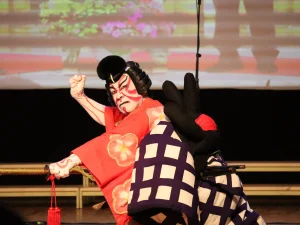
Kabuki often makes a character’s nature visible before the actor speaks. One distinctive style is kumadori, makeup made with coloured lines across the face. Its colour and pattern change according to the role.
Red can suggest youth, justice, anger or forceful strength. Indigo may mark a villain or evil spirit, while brown can indicate a demon or ghost. Kumadori is especially associated with aragoto, a bold acting style, and does not appear in every Kabuki play. It is a visual code, not a simple sign of good or evil.
Bunraku: Expression Created by Three Puppeteers
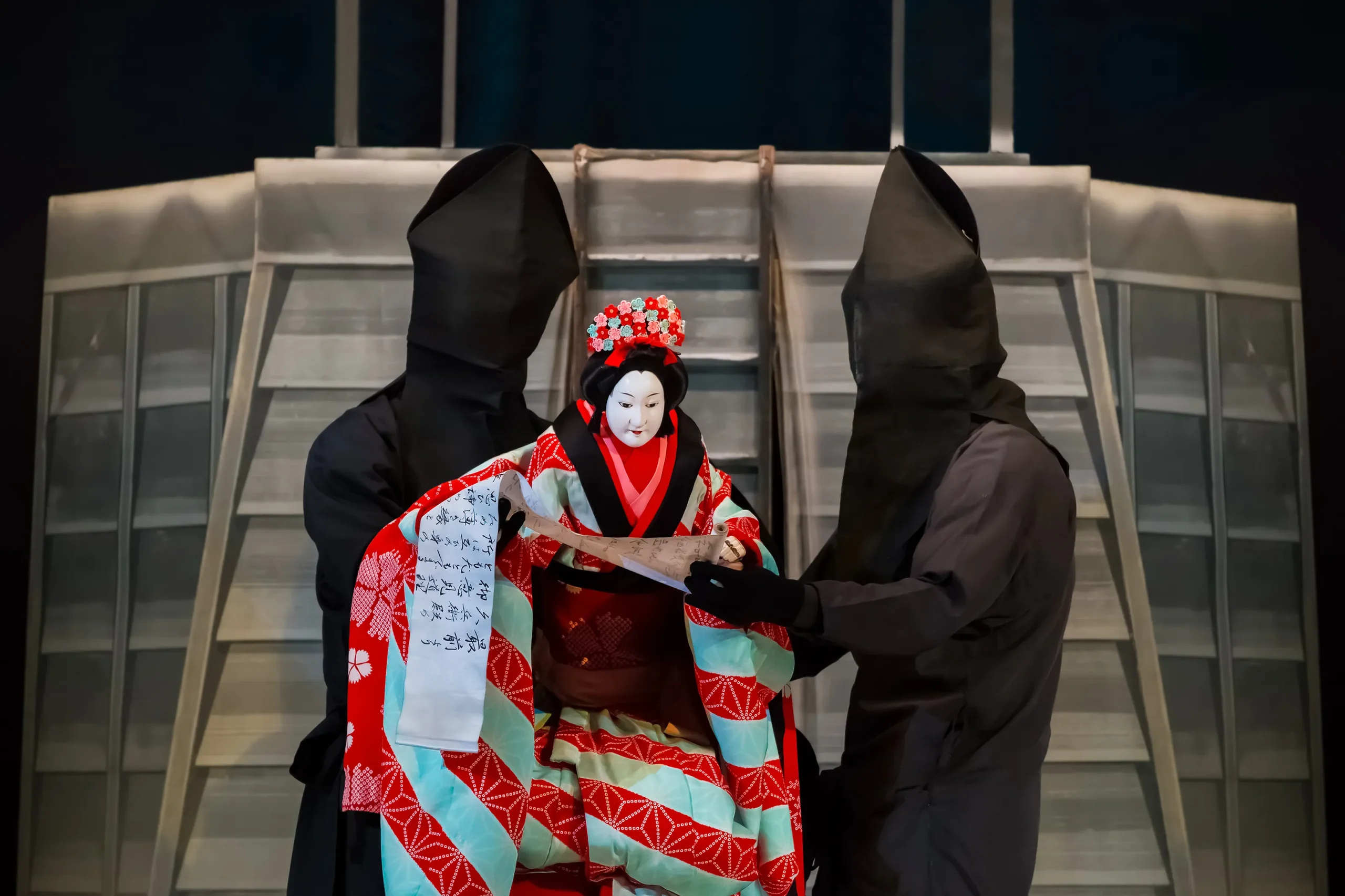
Bunraku centres on a wood-carved puppet operated by three puppeteers. The main puppeteer controls the head, body and right hand. Two assistants move the left hand and feet. Their silent coordination gives one puppet a clear physical presence.
Bunraku does not copy every human movement. It uses stylised poses that can show strength, restraint or grief. The puppeteers may remain visible, but their work becomes part of the performance rather than a distraction.
Noh asks the audience to read a changing mask. Kabuki gives it a clear visual signal. Bunraku reveals the skill that gives a puppet its emotion.
Movement, Music, and Stage: Stillness or Spectacle
Noh, Kabuki and Bunraku create rhythm in different ways. Noh concentrates attention through controlled movement and a fixed stage. Kabuki expands the action across the theatre, while Bunraku joins narration, music and puppetry in one rhythm.
Noh:A Focused Stage Where Every Movement Matters
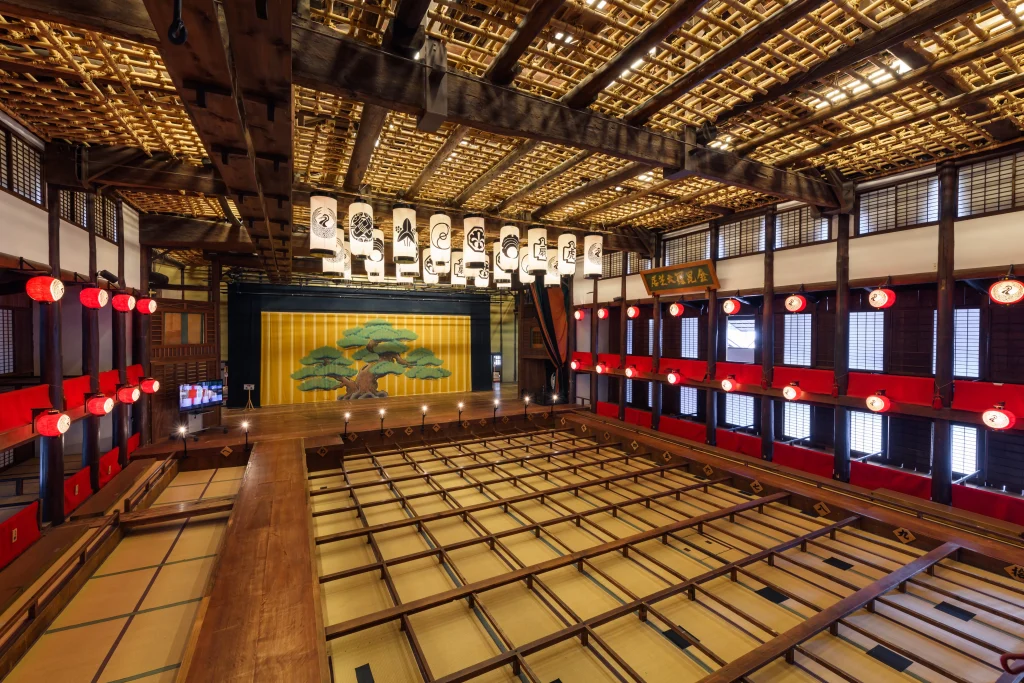
A Noh stage has a roof, four pillars and a painted pine tree at the back. There is no curtain between the audience and the stage, and large changing sets are not part of the form. This open space keeps attention on the performer.
Actors use hakobi, a gliding walk in which the soles stay close to the floor. A few measured steps or a still hand can suggest a journey or a change in feeling. Utai, the chant of actors and chorus, works with hayashi, an ensemble of flute and three drums. Their sound creates tension rather than simple background music.
Kabuki: A Theatre Built for Movement and Surprise
Kabuki uses movement, sound and stagecraft to direct the eye. At a crucial moment, an actor may hold a mie, a stylised pose that captures heightened emotion. The sharp sound of tsuke—wooden blocks struck against a board—can underline the pause.
The hanamichi, a raised walkway through the audience, brings actors into the auditorium. A revolving stage, called a mawari butai, and lifts known as seri can transform scenes or create a dramatic entrance. Kabuki makes the wider theatre part of the performance.
Bunraku:Voice, Music and Puppetry in One Rhythm
Bunraku depends on close collaboration. The tayū, or narrative chanter, describes the setting and voices every character. The shamisen player shapes the mood, while three puppeteers move each puppet in time with the narration.
The narrator and musician remain visible, as do the puppeteers. Bunraku therefore lets the audience see how sound and movement create emotion together.
Noh makes a fixed stage feel full of meaning. Kabuki turns the theatre into a changing world, while Bunraku makes voice, music and puppetry move as one.
Stories and Themes: Spirits,Memory and Human Conflict
Stories reveal another difference between Noh, Kabuki and Bunraku. Noh often returns to memory and the unseen. Kabuki places human desire and social pressure in the foreground, while Bunraku gives similar conflicts a distinctive narrative form.
Noh stories: When the Past Returns
Noh plays include gods, warriors, women, varied figures and demons. In many mugen Noh, or dream plays, a traveller meets a stranger connected to the past. The figure later appears as a spirit, and chant, music and dance give its memory form. Noh asks what remains after loss.
Kabuki stories: Duty and Desire
Kabuki offers two useful story worlds. Jidai-mono, historical plays, draw on samurai and court society and explore loyalty, revenge and duty. Sewa-mono, domestic plays, follow townspeople facing love, debt and family pressure. Their conflicts often set ninjo, personal feeling, against giri, social obligation.
Bunraku:Shared Stories, Told Differently
Many classic Japanese stories, including tragic love tales and stories of loyalty, first appeared in Bunraku before moving to Kabuki.
This makes Bunraku an important link between the quiet world of Noh and the emotional intensity of Kabuki.
Bunraku shares many of these human themes. Chikamatsu Monzaemon was central to the development of sewa-mono in ningyō jōruri, puppet narrative theatre. Several successful puppet plays later entered the Kabuki repertoire. Bunraku remains essential to stories of love, loyalty and consequence.
Noh looks towards a past that will not disappear. Kabuki brings human choices into view, and Bunraku lets narration, shamisen and puppetry carry their cost.
For First-Time Visitors: Which One Fits Your Travel Style?
There is no single best introduction to Japanese theatre. Choose the form that suits the kind of evening you want: visual drama, quiet concentration or detailed storytelling.
Choose Kabuki for Visual Drama
Kabuki suits travellers drawn to costume, movement and theatrical scale. Makeup, poses, music and stage effects offer visual clues before every word is understood. At Tokyo’s Kabukiza Theatre, single-act tickets are available for selected scenes, so visitors may not need to commit to a full programme. English caption services may also be offered, depending on the performance.
Choose Noh for Stillness and Suggestion
Noh may appeal to those who value controlled movement, masks and symbolic storytelling. Reading a short synopsis beforehand helps visitors notice the meaning of repeated gestures, music and images. The National Noh Theatre in Tokyo has regular performances, but caption and language support vary by programme. Check the official listing before booking.
Consider Bunraku for Story and Craft
Bunraku is well suited to travellers interested in narrative, music and skilled handwork. A tayū, or narrative chanter, tells the story, while shamisen music and three puppeteers give each figure movement. The National Bunraku Theatre in Osaka makes it a natural choice for a Kansai itinerary. English audio guides are available for some performances only.
The best choice is not the “easiest” form, but the one whose pace and visual language suit your interests. With a little preparation, a theatre visit can become a considered part of a journey through Japan.
Practical Snapshot: Time, Budget, and What to Expect
A little planning makes a theatre visit easier to place within a wider itinerary. Running times, ticket prices and language support vary by programme, so check the official performance page before booking.
Time and Budget
Noh performances often last one to two hours.
Kabuki full programs can take half a day, but single acts often run about an hour.
Bunraku programs usually last three to four hours including breaks.
Noh may include both Noh and Kyogen, a comic classical theatre form. For example, a May 2026 National Noh Theatre programme ran from 6:30 to 8:45 pm, with seats from ¥3,500 to ¥5,800.
At Kabukiza in Tokyo, full Kabuki programmes usually last three to four hours, including intervals. Single-act seats provide a shorter alternative: recent acts ranged from 17 to 87 minutes, with fourth-floor tickets from ¥1,000 to ¥2,500. Times, prices and available acts change each month.
Bunraku is often presented in separate parts. An autumn 2026 programme at Osaka’s National Bunraku Theatre scheduled parts lasting about two and a half hours, each priced at ¥6,500. A discounted ticket covered all three parts.
Language and Theatre Etiquette
Major urban theatres increasingly offer English subtitles or audio guides, though availability depends on the performance.
English support is performance-specific. Kabukiza provides English or simplified Chinese captioning, while the National Noh Theatre offers seat-back subtitles for most of its own productions. Some Bunraku programmes provide an English synopsis. Confirm these services when reserving.
Formal dress is not required at Kabukiza; smart, comfortable clothing is suitable. Arrive early, switch off devices and do not photograph, film or record during the performance. These small preparations allow the theatre, rather than the logistics, to hold your attention.
From One Night at the Theatre to a Deeper Cultural Journey
A traditional theatre performance can become more than one evening on an itinerary. Pair it with a museum, a historic neighbourhood or a carefully chosen meal, and it offers a different way to understand the city around it.
Let the performance calendar guide the route. Kabuki at Tokyo’s Kabukiza, Noh at the National Noh Theatre, and Bunraku in Osaka can each anchor a different day, but programmes and venues change throughout the year. Check confirmed dates before arranging intercity travel.
For travellers who prefer this cultural thread to feel effortless, ENJYU JAPAN’s Tailor-Made Tour can shape an itinerary around your interests, pace and selected performances. Its bespoke approach brings theatre, transport and local experiences into one considered journey.
A well-chosen performance does not require complete understanding of every word. The measured entrance of Noh, Kabuki’s sudden energy, or Bunraku’s union of voice, shamisen and puppetry can give a journey a deeper sense of place.