If horseback archery has caught your imagination, a little understanding will help you choose where to see it—and what to notice.
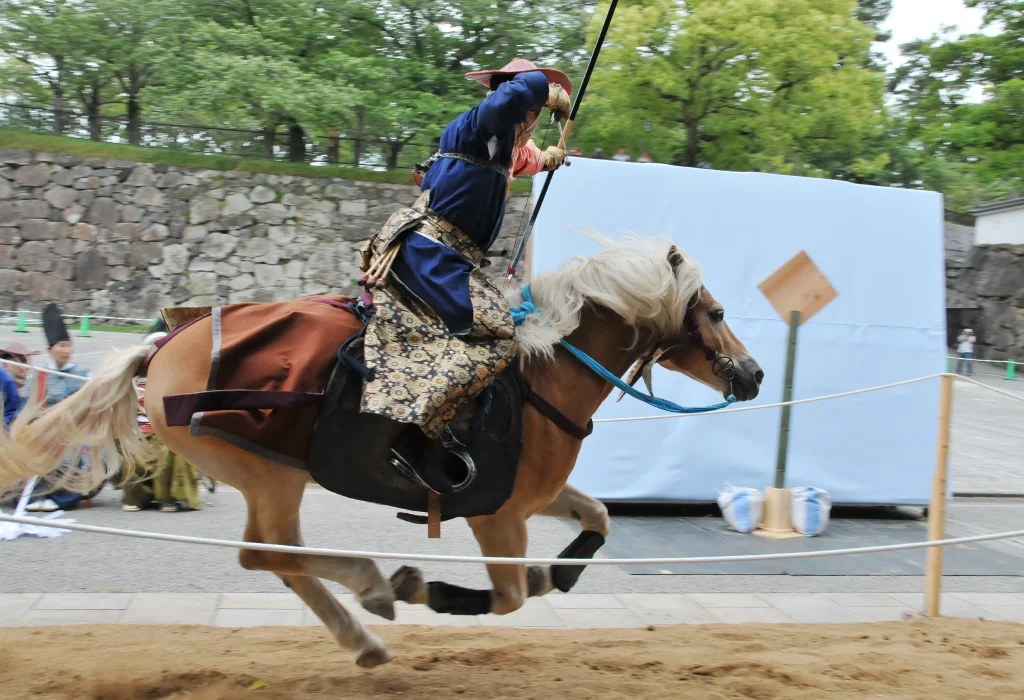
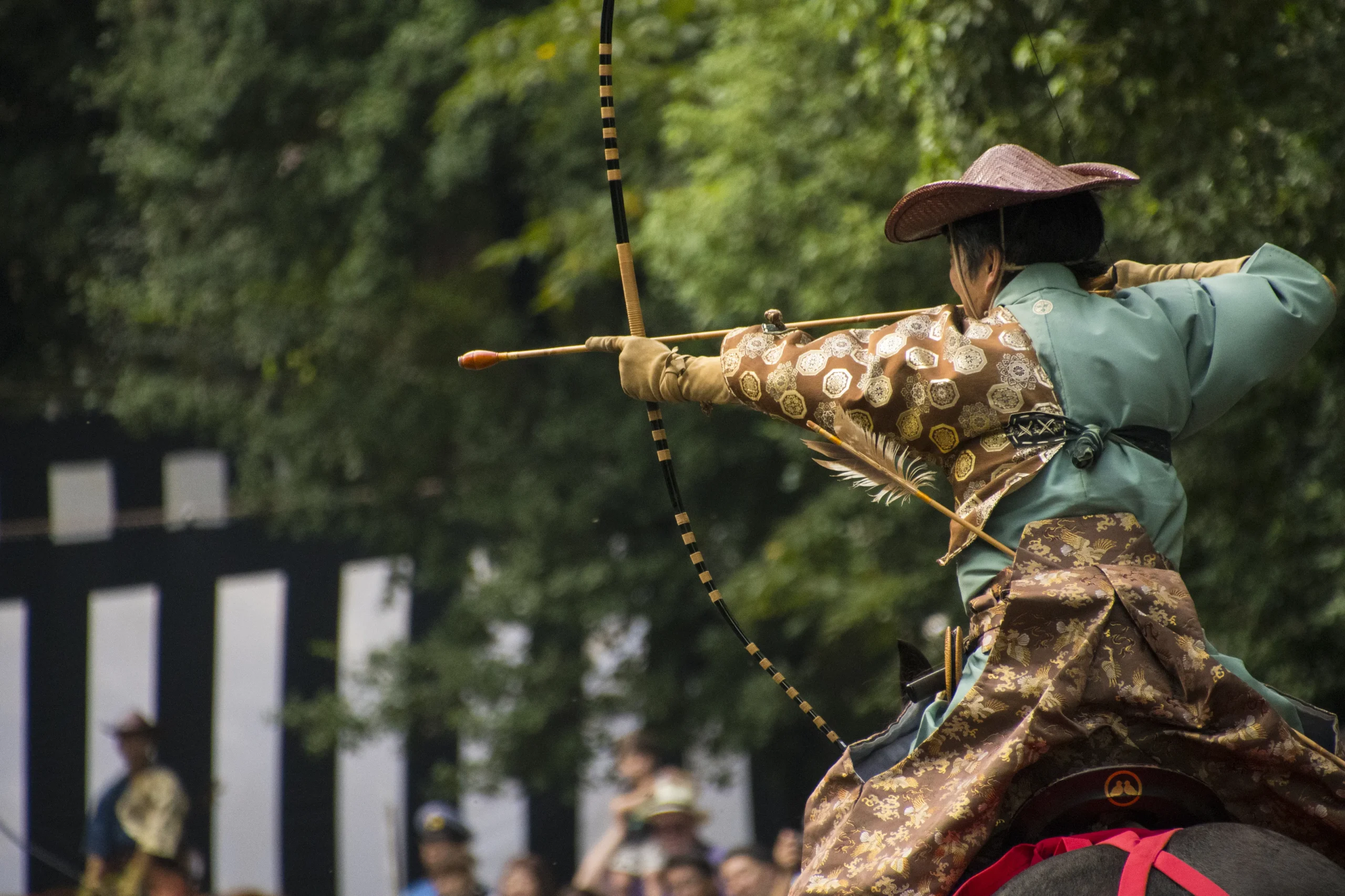
Yabusame is Japanese mounted archery: a trained rider shoots at three targets while a horse gallops along a course. At shrine ceremonies, this skill becomes an offering, performed to pray for peace, good harvests and people’s health. Its appeal lies not only in a successful shot, but also in the posture, equipment and coordinated work that make it possible.
For travellers staying in Tokyo or Kyoto, Kamakura, Shimogamo Shrine and Meiji Jingu provide useful starting points. Match your dates with an event, then choose viewing arrangements that suit your interests and comfort. One well-planned visit leaves room to appreciate the tradition, rather than simply catch its most dramatic moment.
Event information reviewed on 11 October 2026. Established dates are planning guides; times, tickets and admission arrangements depend on the announcement for your travel year.
What Is Yabusame, and Why Is It Offered to the Gods?
Yabusame combines riding and archery with religious observance. Understanding that relationship explains why the preparations and ceremonies matter as much as the shooting.
Three Targets and a Prayer
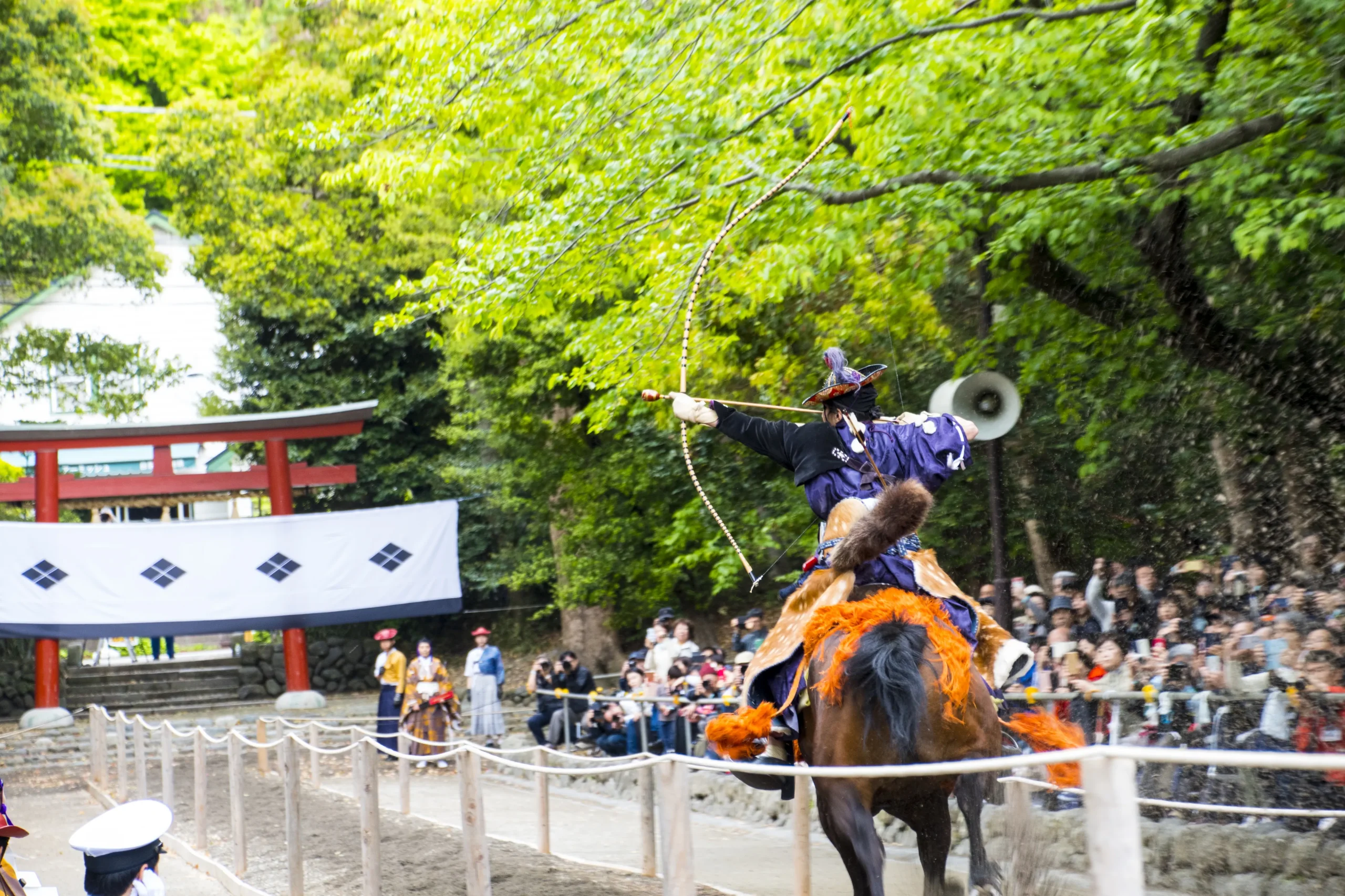
In the sequence described by the Japan Equestrian Archery Association, the rider shoots at three targets positioned to the left. Between them, the archer must prepare another arrow while the horse continues forward. Balance, timing and accuracy must work together.
At a shrine, that skill also serves a religious purpose. Shinto is Japan’s shrine tradition, and kami are the deities honoured there. The association describes yabusame as an offering for peace, harvests and health. The physical challenge therefore carries an intention beyond demonstrating ability.
The course’s arrangement can reflect that intention. At Tsurugaoka Hachimangu in Kamakura, the targets stand on the southern side, avoiding shots towards the shrine. Even the direction of an arrow expresses respect for the deity.
A Ritual, a Competition or a Visitor Experience?
Religious observance and competition are not necessarily opposites. The association’s account includes votive shooting, performed as an offering, followed by a competitive stage for successful archers. Both belong within the ceremony it describes.
Related activities have different formats. Kasagake is another form of mounted archery, involving different target positions and shooting angles. It can also be offered as a shrine ritual. Visitor lessons, meanwhile, teach selected skills under their own participation conditions.
Before choosing an occasion, establish whether it is a public ceremony, a demonstration or a supervised activity. Each offers a different kind of understanding; the format matters more than the general label “horseback archery”.
How Yabusame Developed—and How It Survives Today
The history of yabusame includes early traditions, medieval development and periods of decline and transmission. Its survival depends on people preserving knowledge through changing circumstances.
Early Traditions and the Kamakura Shogunate
The association recounts an origin tradition linking mounted shooting to Emperor Kinmei in the sixth century. It associates this account with Usa, in present-day Oita Prefecture. This is an origin tradition, rather than a securely documented founding date.
A clearer landmark is 1187, when Minamoto no Yoritomo held a yabusame ritual at Tsurugaoka Hachimangu. Yoritomo founded the Kamakura shogunate, the warrior-led government that reshaped Japanese political life. The shrine’s interpretation connects his ceremony with prayers for peace and the training of warriors.
The association also credits Yoritomo with gathering specialists to discuss manners and establish procedures. This helps explain the combination visitors see today: martial skill accompanied by formal conduct. The practice developed through attention to behaviour as well as shooting.
Schools, Training and Preservation
The Ogasawara and Takeda schools are major lineages associated with yabusame. A school here means a tradition of teaching, with inherited methods and ceremonial procedures. The Japan Equestrian Archery Association maintains the Takeda tradition.
Its historical account describes yabusame fading from prominence during turbulent periods of warfare, while teachings continued through generations. The tradition’s long history does not mean that every detail remained unchanged or equally prominent throughout that time.
Present-day performance involves different conditions too. The association notes that Western breeds used today can be larger and faster than earlier Japanese horses. Riders apply inherited skills to the demands of the horse beneath them. Continuity rests on active training, rather than historical appearance alone.
What Makes Yabusame Worth Watching?
On a first visit, it is natural to follow the arrow and wait for the hit. The rider’s preparation, equipment and supporting team offer another way to understand the run.
A Steady Archer on a Moving Horse
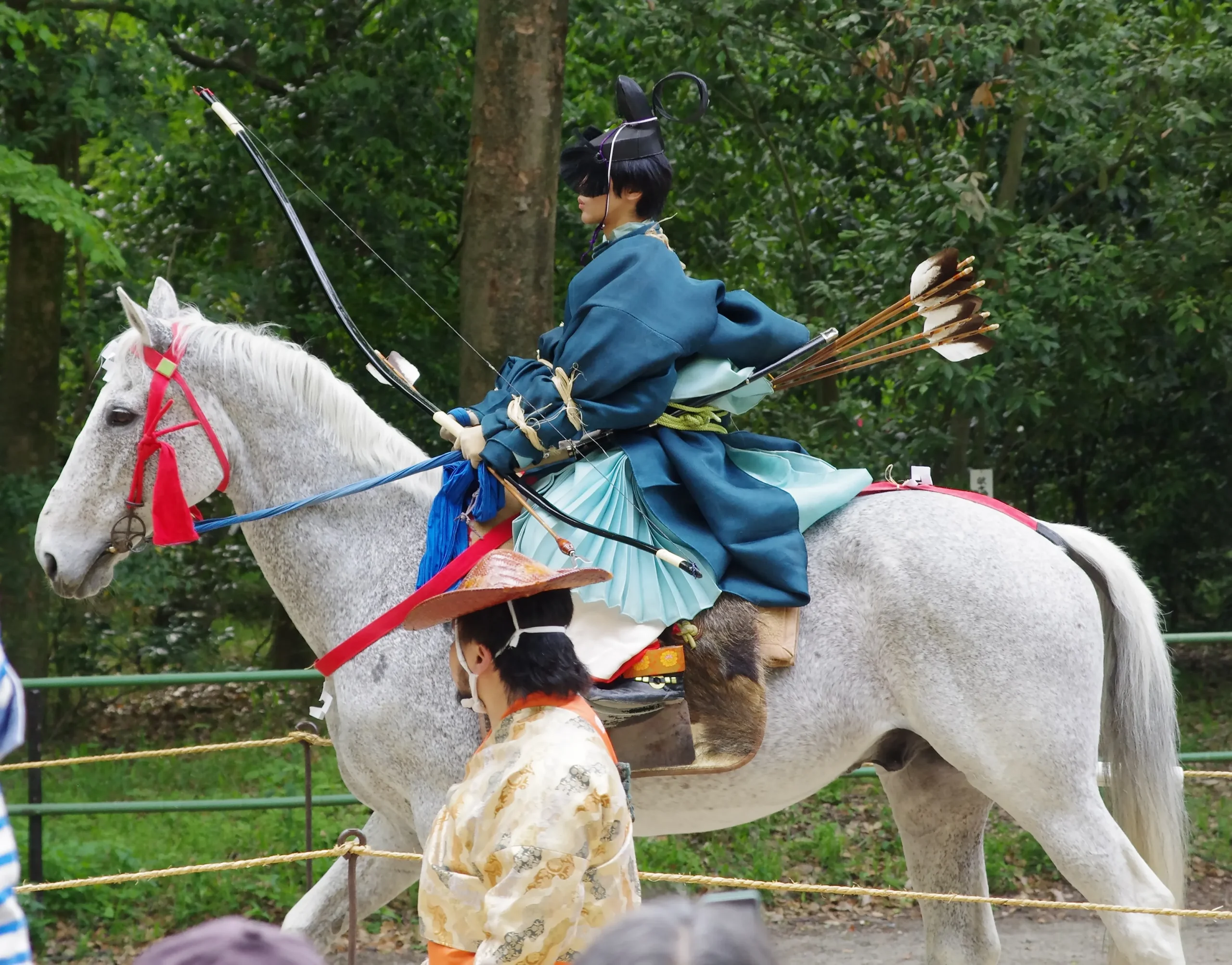
The rider’s upper body is a useful starting point. In the Takeda tradition described by the association and Japan Cultural Expo, tachisukashi is a riding posture that keeps the hips slightly above the saddle. Weight passes through the stirrups, helping the archer maintain stability while shooting.
The association describes the ideal as jinba ittai, “rider and horse as one”: their movements work in close harmony. This draws attention to the relationship between them, not simply the rider’s ability to aim.
Watch one complete run first. During another, follow what happens between targets: the rider prepares the next arrow and returns to a shooting position while continuing forward. You need not memorise technical terms to recognise the coordination involved.
The preparation becomes part of the achievement. Instead of waiting only for impact, you can follow how each shot takes shape.
Clothing and Equipment with a Purpose
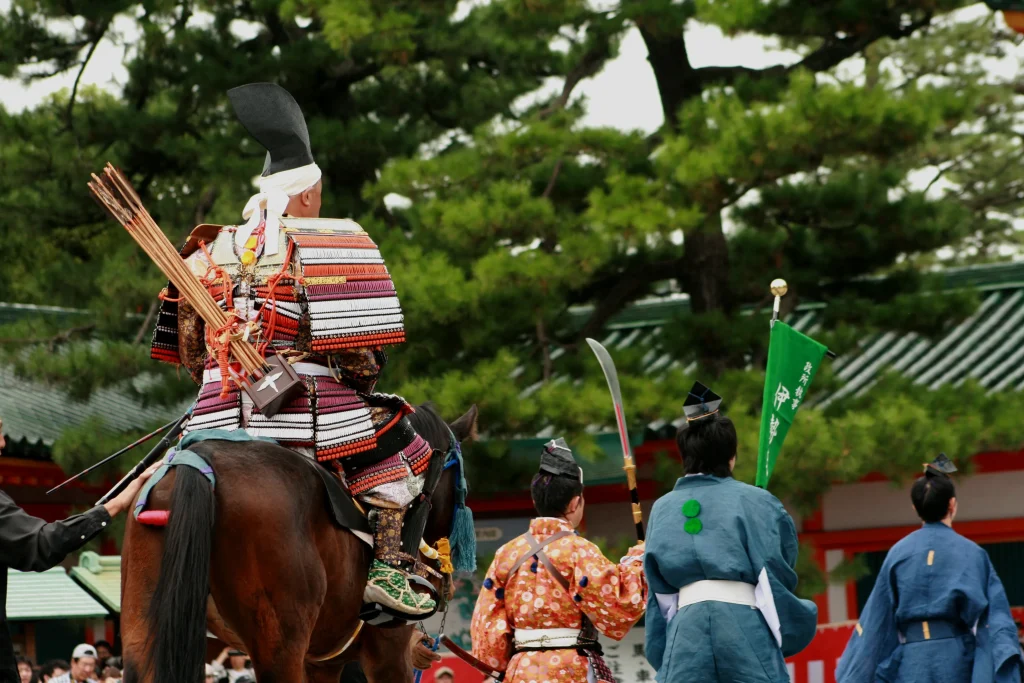
The association’s description gives concrete details to look for. An archer’s left-shoulder covering bears a family crest embroidered in gold thread. Wooden Japanese saddles and broad iron stirrups connect the performance with older forms of riding.
The saddle is called a wagura; the stirrups are waabumi. Their materials and shape support the rider’s posture. These objects are working equipment, not simply historical decoration.
The association also describes repairing antique saddles and stirrups and using them carefully. This offers a quieter perspective on preservation: maintaining an object helps maintain the practice that depends on it. Notice the equipment as well as the costume.
The People Beyond the Archer
The ceremony relies on a team. In the association’s account, flag-bearers lead the procession, drums signal key stages, and assistants wave fans to begin a horse’s run. Other participants judge hits, indicate successful shots and return discharged arrows.
Follow the activity before and after each run. A raised fan or recovered arrow becomes part of a coordinated procedure, rather than background movement. The rider attracts attention, but the supporting work keeps the event functioning.
Keep photography secondary to watching at least one complete sequence. A clear view of the process can be more revealing than a photograph of the impact alone.
Where and When to Watch Yabusame in Japan
Start with the city already on your itinerary, then compare dates and viewing conditions. An event that fits your route is often a better choice than an additional long journey.
| Venue | Planning window | Main consideration |
| Tsurugaoka Hachimangu, Kamakura | The established autumn ceremony is on 16 September | Use the shrine’s announcement for the year’s viewing arrangements.mlit.go |
| Shimogamo Shrine, Kyoto | The early-May ceremony is on 3 May | General viewing and paid seating are separate options. |
| Meiji Jingu, Tokyo | The organiser lists 3 November for 2026 | Confirm shooting time, entrance and capacity arrangements separately.yabusame.or |
These entries identify an established date or a stated year. They do not confirm every future year’s timetable, tickets or access conditions.
Kamakura: Tsurugaoka Hachimangu
Tsurugaoka Hachimangu offers a direct connection with Yoritomo’s history. Its September yabusame ceremony is associated with the Ogasawara school, and the riding ground crosses the shrine’s main approach.
The official access guide gives a ten-minute walk from JR Kamakura Station’s east exit. Allow additional time to reach the designated reception or viewing area. Arriving at the shrine and reaching your place beside the course are different stages.
Spring programmes may also include yabusame during the Kamakura Festival. For the wider occasion, see ENJYU JAPAN’s Kamakura Festival guide. Spring and autumn should be considered as separate events, with their own announcements and arrangements.
Keep the rest of the day flexible. A tightly timed onward journey leaves little room for the ceremony and the movement of spectators afterwards.
Kyoto: Shimogamo Shrine in Early May
Shimogamo Shrine holds its yabusame ceremony in Tadasu no Mori, the wooded shrine precinct. It is a purification rite praying for the safety of the Aoi Matsuri procession. Yabusame takes place on 3 May; the procession follows on 15 May.
The shrine offers free viewing and paid seating. Use the announcement for your travel year to compare prices, sales arrangements and availability. Choosing a paid seat and being admitted to general viewing are separate decisions.
The official access guide gives approximately twelve minutes on foot from Demachiyanagi Station. From Kyoto Station, one rail route uses the JR Nara Line to Tofukuji, followed by the Keihan railway to Demachiyanagi. Add time for event controls and finding the reception within the grounds.
Tokyo: Meiji Jingu in Early November
Meiji Jingu provides an option within Tokyo. The association’s calendar lists its 2026 yabusame ritual for Tuesday, 3 November.
The organiser’s 2025 guide placed the riding ground along the western approach and recommended the Sangubashi entrance. Viewing was free and standing-only, with no reservations and possible restrictions once capacity was reached.
Those details show why the event notice matters; they are not confirmation of another year’s operation. The same applies to English interpretation offered in 2025. Select your entrance using the current event map, rather than assuming the nearest familiar station is the best approach.
Plan Your Arrival, Viewing and a Comfortable Visit
Preparation matters most between the station and the viewing area. Once those steps are clear, you can give your attention to the occasion.
Confirm the Event, Not Just the Shrine
Use the shrine or organiser’s current notice to establish:
- The year, date and location.
- The ceremony and shooting times.
- General admission, paid seating, reservations and capacity limits.
- The entrance, reception point and viewing area.
- Weather changes and equipment restrictions.
Shrine admission does not establish permission to enter every event area. Likewise, a ceremony’s start time may precede mounted shooting. The association’s 2025 Meiji Jingu programme listed these stages separately.
An English website does not establish English commentary or staff support at the event. Confirm those services separately if they are important to your visit.
If Japanese is difficult for you, translate the notice before departure and save the original map and names. Useful names include 鶴岡八幡宮, 下鴨神社 and 明治神宮. A booking screenshot and clearly marked destination can make asking for help easier.
Prepare for Walking and Waiting
Allow for walking, waiting, watching and leaving—not only the published programme length. Comfortable shoes, manageable luggage, drinking water and a waterproof layer make an outdoor visit easier.
If prolonged standing would be difficult, investigate seating before choosing the event. For children, consider whether they will see comfortably from the designated area. For wheelchair users, ask about the event’s viewing surface and route, not only the shrine’s general accessibility.
Follow staff instructions and remain outside the horse’s course. Rules for umbrellas, tripods, flash and portable chairs are venue-specific; confirm them rather than carrying permission over from another event. Good preparation protects both your comfort and other visitors’ space.
If Rain, Crowds or Cancellations Change Your Day
A changed plan can still serve your cultural interests. Choose an alternative before travelling, while keeping severe-weather decisions separate from ordinary rain.
Rain does not necessarily mean cancellation. A published Shimogamo Shrine notice states that its 3 May ceremony proceeds in rain and that paid seats are uncovered. Check the notice for your travel year before relying on those arrangements.
Whether the event takes place and whether you wish to remain outdoors are separate decisions. If rain, restricted admission or waiting makes viewing unsuitable, use a nearby alternative only when the journey remains safe.
| Route | Plan A: viewing suits you | Plan B: local travel is safe | Plan C: travel is disrupted |
| Tokyo | Attend Meiji Jingu under the current arrangements | Visit Meiji Jingu Museum if open | Stay near your accommodation and reconsider the visit |
| Kamakura | Attend Tsurugaoka Hachimangu | Visit the history and culture museum if its opening date fits | Change the day trip before departure |
| Kyoto | Attend Shimogamo with suitable rain protection | Visit Kyoto Museum of Crafts and Design if open | Avoid an unnecessary cross-city journey |
Tokyo: Explore the Shrine’s Background
Meiji Jingu Museum displays objects associated with Emperor Meiji and Empress Shoken. It offers historical context rather than a replacement archery display.
Published hours are 10:00–16:30, with last admission at 16:00 and adult admission at ¥1,000. Thursday and exhibition-change closures require attention; the Japanese guide includes a public-holiday exception.
Do not assume you can enter after the shooting finishes. Choose the museum when its hours fit the revised day.
Kamakura: Turn to Local History
Kamakura’s history and culture museum is approximately seven minutes’ walk from Kamakura Station. It opens 10:00–16:00, with last admission at 15:30 and general admission at ¥400.
It closes on Sundays, public holidays and during exhibition changes, so it cannot serve as a universal fallback. Establish whether it is open before leaving Tokyo. If it does not fit, changing the excursion is better than travelling simply to rescue the original plan.
The municipal guide also confirms wheelchair and pushchair access within the museum. That is useful facility information, but it does not establish suitable access at the separate yabusame viewing area.
Kyoto: Follow Materials and Craftsmanship
The Kyoto Museum of Crafts and Design offers another way to explore the skills behind Japanese culture. Choose it for its materials and craft techniques, rather than expecting a yabusame exhibition.
The official guide lists hours of 10:00–18:00, admission before 17:30 and standard adult admission at ¥500. The museum is in Miyakomesse’s basement, approximately ten minutes north of Higashiyama Station’s exit 1.
This requires a separate journey from Shimogamo. Plan the transfer in advance; if using a taxi, save “Miyakomesse / みやこめっせ” as the destination. During severe weather, reducing movement takes priority over reaching any second attraction.
Can Visitors Try Yabusame?
Watching a ceremony and joining a lesson are different choices. Wooden-horse archery, introductory riding and advanced mounted-archery instruction should not be treated as the same activity.
The association has advertised special programmes combining kasagake viewing with wooden-horse archery and Japanese–English support. These occasional activities are different from shooting while riding a galloping horse, and do not establish year-round availability.
Before booking a live-horse activity, establish the required riding experience, age or size limits, equipment, instruction language and weather policy. Watching the full ceremony is a complete cultural experience; a suitable lesson can be a separate next step.
Experience the Power and Precision of Yabusame
Choose an event that fits your dates, then leave time to notice the rider, the equipment and the people supporting each run. Historical understanding and practical preparation work best together: one explains why you came, while the other lets you watch without rushing.
If you would prefer help fitting the occasion into a wider journey, ENJYU JAPAN’s Tailor-Made Tour offers a starting point for discussing your interests and pace.
Leave a little freedom in your day to appreciate the remarkable skill of horse and rider moving as one.
References
- Japan Equestrian Archery Association – On Yabusame: History, Rituals, Riding Technique and Traditional Equipment
- Japan Tourism Agency / Tsurugaoka Hachimangu – Yabusame Archery Track: Yoritomo’s Ceremony and the Kamakura Tradition
- Japan Equestrian Archery Association – Yabusame Schedule: 2026 Event Dates and Locations
- Japan Equestrian Archery Association – Meiji Jingu Yabusame Ritual: 2025 Programme, Viewing Conditions and Entrance Directions
- Tsurugaoka Hachimangu – Access: Walking Directions from Kamakura Station
- Shimogamo Shrine – Aoi Matsuri and Related Rituals: Yabusame and Viewing Options
- Shimogamo Shrine – Access and Precinct Map: Routes from Kyoto Station and Demachiyanagi
- Shimogamo Shrine – Rain Notice for Yabusame: Uncovered Paid Viewing Seats
- Meiji Jingu – Meiji Jingu Museum: Collections, Opening Hours and Admission
- Meiji Jingu – Museum Visitor Information: Holiday Exceptions and Exhibition Closures
- Kamakura City – History and Culture Museum: Opening Hours, Admission, Closures and Access
- Kyoto Museum of Crafts and Design – Plan Your Visit: Opening Hours, Admission and Transport