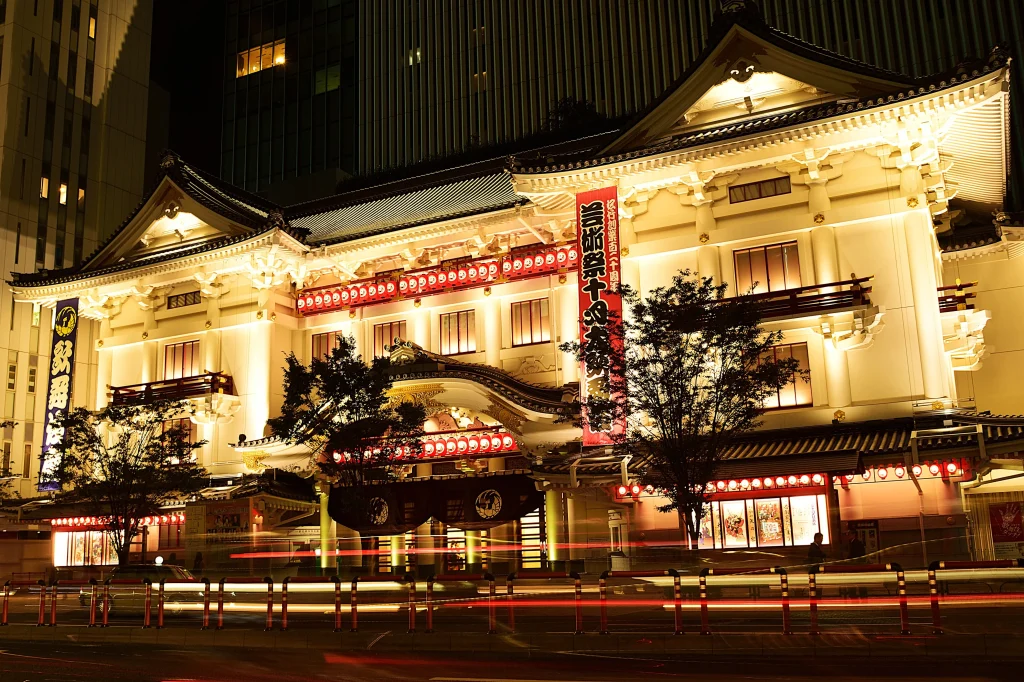
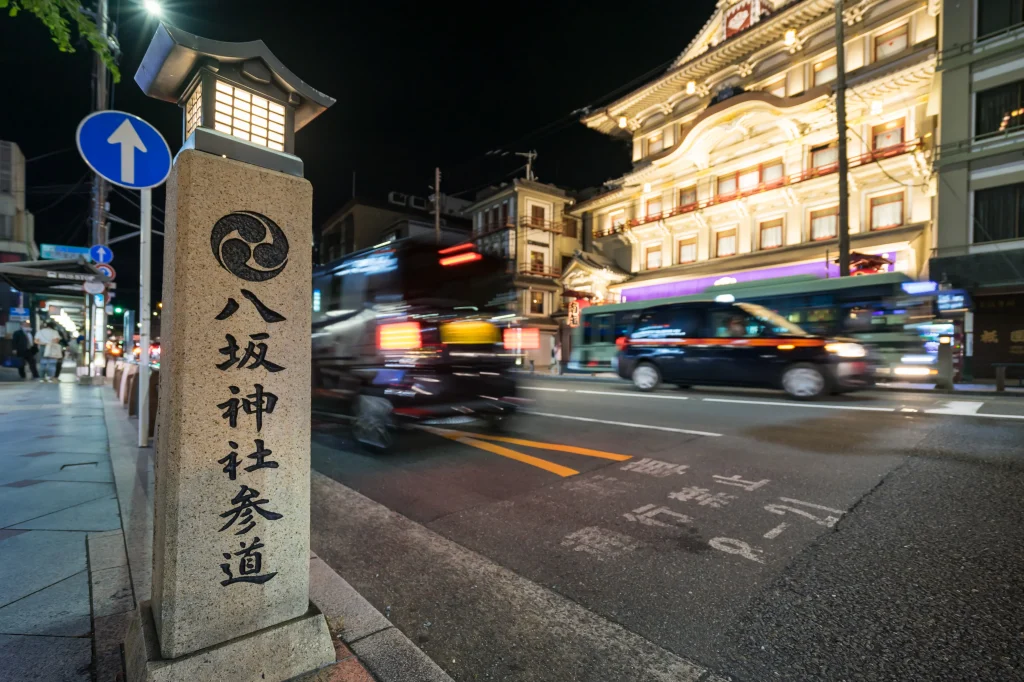
If Kyoto’s dance traditions leave you wondering whether an introduction is required, let us settle that point first: Gion Odori is a public performance.
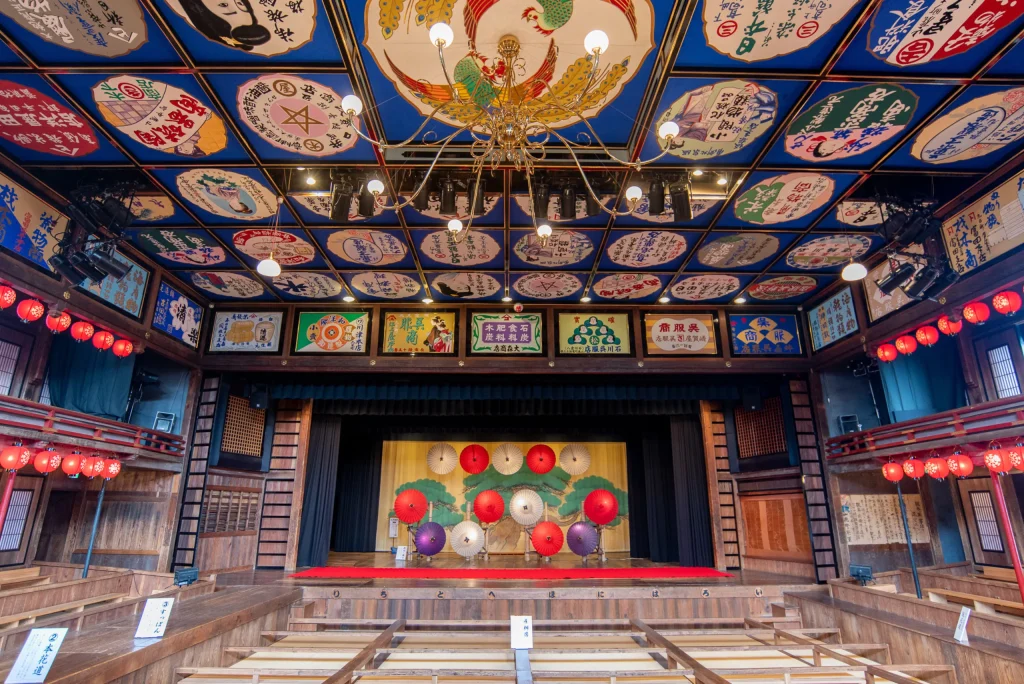
The geiko and maiko of Gion Higashi present this annual production at Gion Kaikan. Geiko are professional artists known elsewhere as geisha; maiko are apprentices training in their arts. In 2026, performances run from 1 to 10 November, twice daily, each lasting approximately one hour. You purchase a theatre ticket, rather than arrange a private meeting with the performers.
A little preparation makes room for the experience itself. Choose your performance and tea option, save the correct collection number, and bring three simple viewing ideas. Once those arrangements are settled, you can give the stage your attention.
Gion Odori 2026 at a Glance
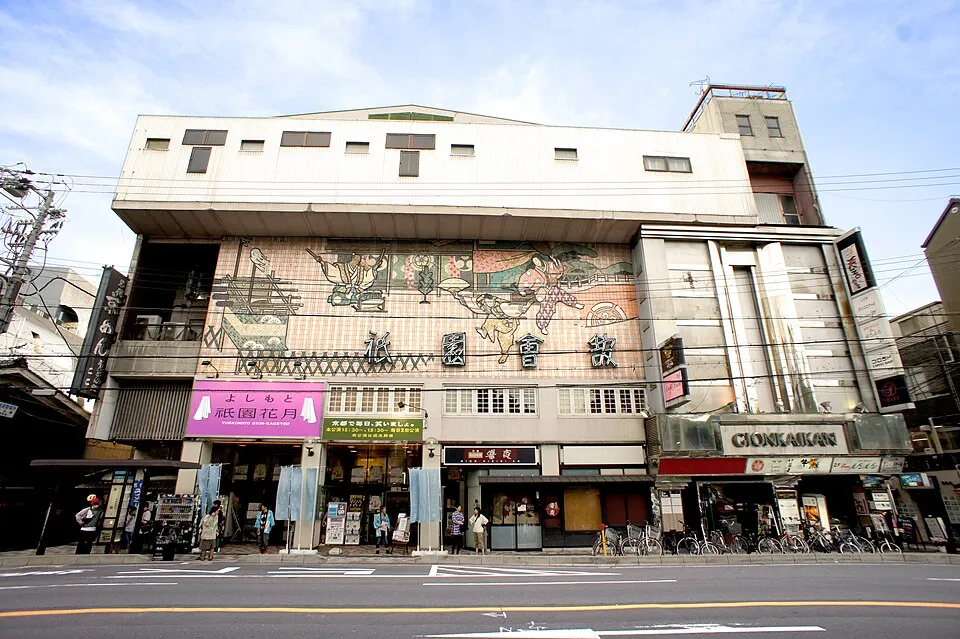
Gion Odori fits a Kyoto stay during the first ten days of November. Start by matching the performance dates and times to your itinerary, then consider whether to include tea before the show.
| Item | Confirmed 2026 information |
|---|---|
| Dates | 1–10 November 2026 |
| Performances | 13:30 and 16:00 daily, Japan Standard Time |
| Running time | Approximately 60 minutes |
| Venue | Gion Kaikan |
| Performance-only ticket | ¥6,000 |
| Ticket including tea | ¥7,000 |
| Programme booklet | ¥1,000 |
| Annual programme | The 67th Gion Odori: Kyoraku Tamamizu no Megumi |
| Information checked | 27 October 2026 |
Prices include tax. These are the organiser’s arrangements for 2026, not advance information for a future year.
The earlier performance leaves the later afternoon available, while the second allows more time before your theatre visit. If you arrive in Kyoto that morning, consider your journey and hotel arrangements before choosing. The most comfortable option is the one that does not depend on every connection running perfectly.
The stage performance lasts about an hour, but ticket collection and optional tea require additional time. Avoid placing another timed reservation immediately after the expected finish. A little space on either side keeps the afternoon manageable.
Booking Gion Odori: Tickets and the Number You Need
Decide on your date, performance and tea preference before paying. Afterwards, the essential preparation is to save the organiser’s collection number—not simply your shop order confirmation.
Performance Only or a Ticket with Tea?
The performance-only ticket suits visitors who want to focus on the dance or have less time before curtain-up. The tea-inclusive ticket adds a pre-performance tea service. The additional ¥1,000 is for tea, not a guaranteed seat upgrade.
| Option | What to consider |
|---|---|
| Performance only | A simpler theatre visit, without the pre-show tea service |
| Performance with tea | Additional time before the show to include tea |
Both options provide assigned theatre seating, but you cannot select a seat number when purchasing. Choose according to your interests and available time, rather than assuming the higher price secures a particular view.
If the choreography is your main interest, performance only is a reasonable choice. If you would enjoy tea as part of the visit, allow time before the show. Neither option should be understood as a private lesson or a promise of individual conversation.
Buy Through the Official Route and Save Your Voucher Number
The announced online sales period through the official Gion Odori ticket shop ran from 1 August to 28 October 2026 and has now ended. Theatre-counter sales are scheduled from 30 October to 10 November, daily from 11:00 to 16:00, subject to remaining seats.
If you bought online during the sales period, use the following checklist to prepare for collection:
- Confirm the date, performance and ticket type in your order.
- Make sure you can access the email address used for your purchase while travelling.
- Save the voucher number sent by Gion Higashi Ochaya Kumiai, the organiser’s teahouse association.
- Present that number at reception to collect your ticket.
The organiser’s voucher number differs from the BASE order ID. Physical tickets are not posted, and an automatic “shipped” message does not mean a paper ticket is coming. Keep the organiser’s message available offline, rather than relying on mobile data at reception.
Allow messages from [email protected] and [email protected], and check your spam folder if the expected email is missing. Resolve a missing collection number before travelling to the theatre; that is the document you will need on arrival.
Check Restrictions Before Paying
The shop does not accept changes or cancellations after purchase. All seats are assigned, but seat numbers cannot be chosen. Children under three cannot enter, and everyone aged three or above requires a ticket. These conditions belong in your booking decision, not in a last-minute check.
Wheelchair users must telephone before purchasing. If adjacent seats or particular assistance are essential, explain the requirement before committing—for example, remaining in a wheelchair or sitting beside a companion. The published contact is +81 75 561 0224, Monday–Friday, 10:00–16:00, excluding public holidays; English telephone assistance is not specified.
Three Ways to Follow the 2026 Performance
You can begin watching without understanding every lyric. The following suggestions are points of attention, not translations: the changing water theme, group dances with their music, and the district’s closing song.
Follow Water as the Scenes Change
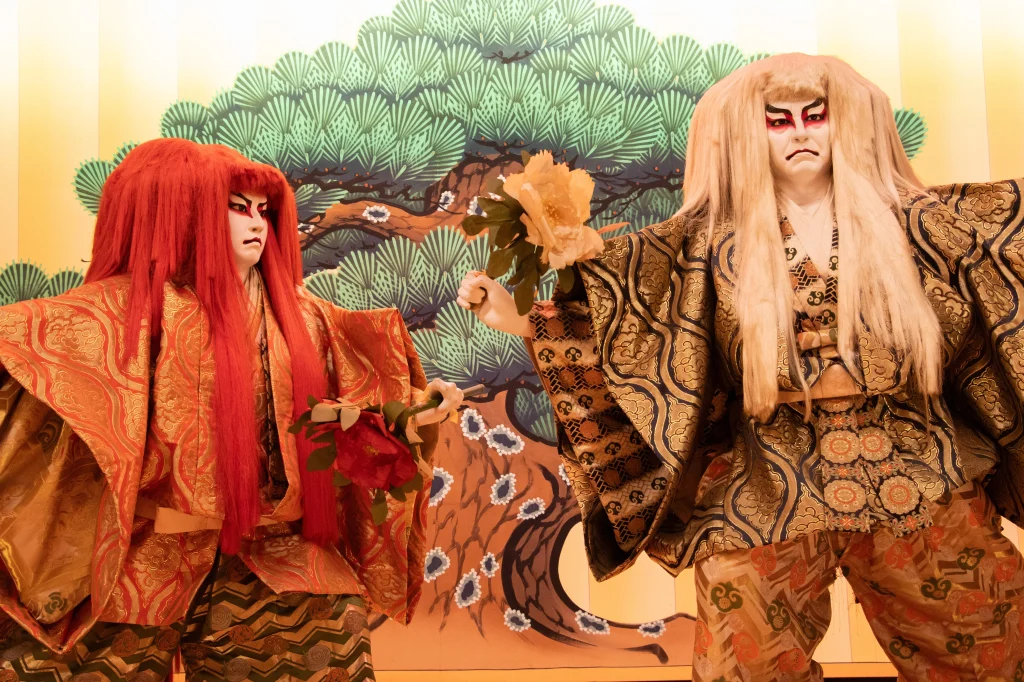
The 2026 programme, Kyoraku Tamamizu no Megumi—京洛玉水恵—takes water as its theme. The official leaflet introduces scenes involving tea preparation, white herons, Kibune, rain umbrellas and spring water. Water connects the production, but the programme is not simply one continuous river story.
Tea preparation, a passing shower and visits to springs provide three recognisable settings. One places water within a gathering, another brings it into the street, and another connects it with the landscape. Keep those differences in mind as scenes change; they give you a concrete thread without requiring the whole synopsis.
The Kibune scene adds a staged supernatural story: competing dragons disturb the river, and a goddess’s dance restores calm. Treat this as part of the production’s narrative, rather than a complete account of local religious beliefs. Knowing the outline helps you recognise the scene while leaving the dance itself to hold your interest.
Notice the Group Dances and Listen to Their Rhythm
The leaflet identifies Amagasa, the rain-umbrella scene, as a geiko group dance. Wakimizu Meguri, the springs scene, features a maiko group dance. These offer useful moments to move your attention between one performer and the group.
Watch for shared beginnings, held positions and changes across the stage. You might follow a single gesture, then look at how the surrounding dancers shape the scene. This is an invitation to observe, not a claim that every movement has a meaning you must discover.
The organiser describes Gion Odori as a dance medley using nagauta and kiyomoto. These are traditional forms of vocal music associated with shamisen accompaniment; the shamisen is a three-stringed instrument. Listen for how a sung phrase and a movement relate, rather than trying to identify each musical form.
Recognise Gion Higashi Kouta at the End
The finale, Gion Higashi Kouta, celebrates the seasons around the district and brings its geiko and maiko together. It provides a continuing local conclusion to the changing annual programme. The water theme belongs to 2026; the closing song returns attention to the neighbourhood behind the performance.
Remembering that title gives you a specific connection between stage and place. Instead of leaving with only an impression of “a Kyoto dance”, you can recognise the moment when this production names its own community.
English subtitles, audio guidance and English explanations in the programme booklet are not confirmed in the materials checked for this article. If translated commentary is essential, ask before booking. The viewing suggestions here are a starting point, not a substitute for a translation.
Why Gion Higashi Has Its Own Dance Tradition
Gion Higashi is a distinct artistic community, not another name for Gion Kobu. Understanding the difference explains whose production you are booking and why the full theatre name matters.
Gion Higashi and Gion Kobu Are Different Districts
Gion Higashi’s official history records the division into two associations on 12 May 1881. Today, Gion Higashi and Gion Kobu are separate members of Kyoto’s five kagai—districts associated with geiko and maiko arts. Their public productions belong to different communities and venues.
Gion Odori takes place in November at Gion Kaikan. Miyako Odori is Gion Kobu’s April production at Gion Kobu Kaburenjo. Searching simply for “Gion dance” can therefore lead towards a different performance; save the exact name before planning your route.
For a broader introduction to the performers, ENJYU JAPAN’s guide to geiko, maiko and geisha experiences explains the cultural background. Here, the useful distinction is between the two districts and their stages.
New Scripts, Continuing Local Arts
Gion Odori uses an original script for each production. Behind that annual stage, the district’s official introduction lists teaching in dance, nagauta, kiyomoto, flute, percussion and tea practice. The public performance draws on these continuing disciplines, rather than existing as an isolated visitor attraction.
This gives you another way to appreciate the work: consider how separate skills contribute to one production. The year’s subject changes, while the community continues the practices that support it. The recurring district song makes that connection particularly clear.
Getting to Gion Kaikan and Preparing for the Day
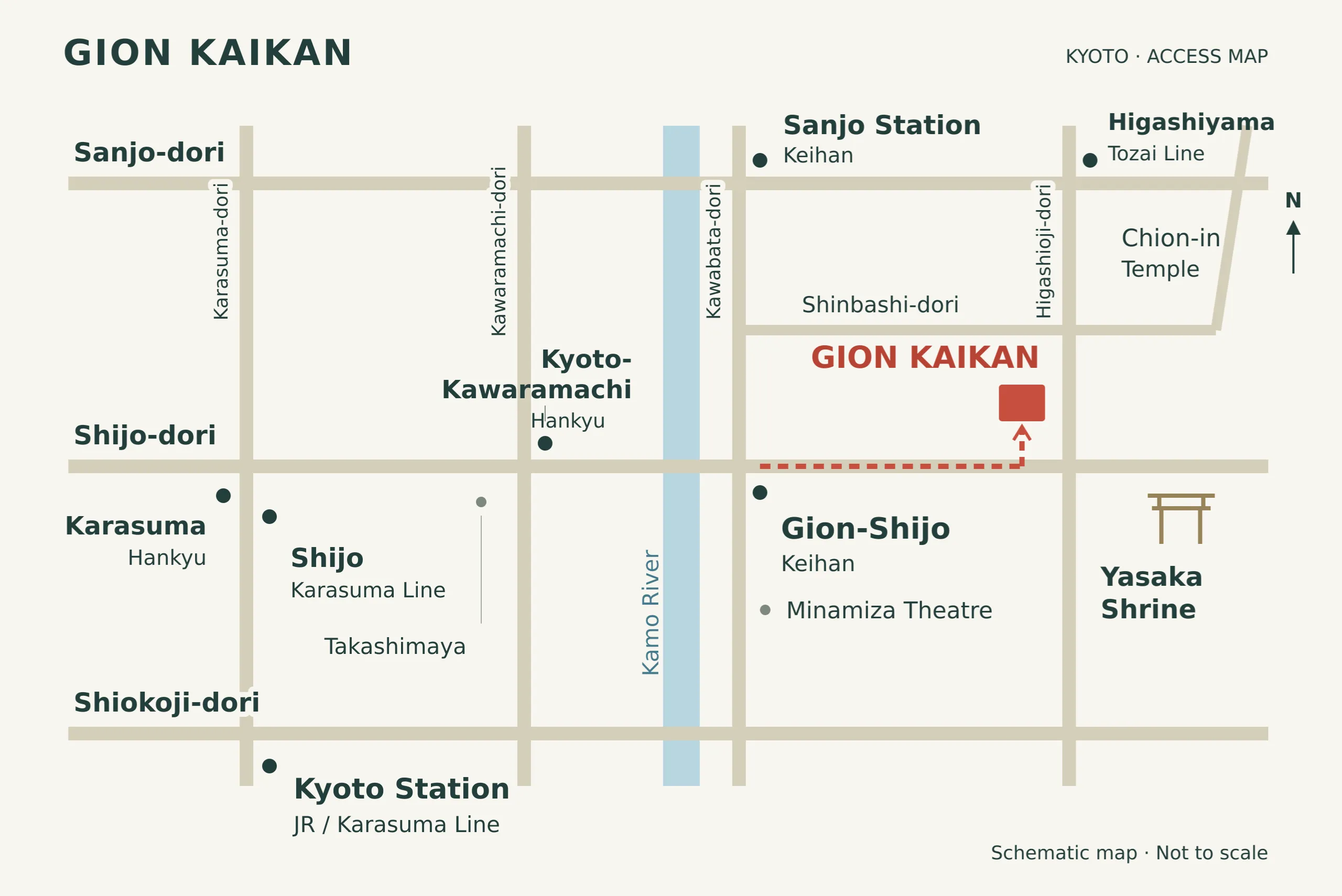
Prepare the theatre address and your collection details together. Having both ready reduces uncertainty, especially when you cannot easily read Japanese signs.
Find the Correct Theatre
Save the following destination:
| Gion Kaikan — 323 Gionmachi Kitagawa, Higashiyama-ku, Kyoto |
| 祇園会館 — 京都市東山区祇園町北側323 |
This is the performance venue, not the organiser’s office or Gion Kobu’s theatre. The official page gives the following approximate walking times; use them as estimates and add time for crossings and finding the entrance.
| Station | Approximate walk |
|---|---|
| Keihan Gion-Shijo, Exit 7 | 10 minutes |
| Hankyu Kyoto-Kawaramachi, Exit 1 | 15 minutes |
| Subway Higashiyama, Exit 2 | 10 minutes |
The Gion bus stop is nearby, and the theatre has no dedicated car park. If steps or walking distances are difficult, check your station route separately. A walking estimate does not establish a step-free journey.
Ticket Collection, Tea and Your Seat
Tea is scheduled from one hour before the performance until five minutes before it starts: 12:30–13:25 for the first show, and 15:00–15:55 for the second. This is the service window, not a statement that tea itself takes an hour.
For tea-inclusive tickets, follow the arrival and ticket-collection instructions supplied with your booking. Leave time for reception and the tea service before the performance begins.
| Stage | What to do |
|---|---|
| Arrival | Have the organiser’s email and theatre address ready |
| Reception | Present the voucher number and collect your ticket |
| Tea, if included | Follow staff directions within the pre-show service period |
| Seating | Find your assigned place |
| Performance | Allow approximately one hour |
| Departure | Leave space before another fixed appointment |
The organiser’s website and leaflet give different door-opening times: around forty minutes and one hour before the performance respectively. Follow any arrival instructions sent with your booking. For tea-inclusive tickets, also check the separate tea-service times above.
Language, Photography and Mobility
Keep your address, performance time and voucher message together on your phone, with offline copies. If you need help, showing the relevant booking information is clearer than explaining it from memory.
Current photography rules, luggage arrangements, late entry and English assistance are not established in the materials reviewed. Check venue notices before using a camera, and clarify any condition that affects your visit before purchase. Wheelchair users should make the required advance telephone contact rather than leaving arrangements until reception.
Plan for Rain, Sold-Out Shows or Different Dates
Use the performance as your day’s fixed point, then adjust the surrounding activities. A shorter route can preserve the afternoon more effectively than adding another attraction.
Keep the Show and Adjust the Walk
For the earlier performance, choose an early lunch if you have included tea. For the later show, keep your return journey in mind before planning a distant morning excursion. In either case, a short local walk is optional, not something you must complete.
| Situation | Practical response |
|---|---|
| Dry weather and comfortable walking | Short nearby walk, meal, theatre, then a break |
| Ordinary rain or tired legs | Reduce walking, travel directly to the theatre, and rest afterwards |
| Preferred performance sold out | Check another time or date before purchasing |
| Online sales have ended | Check theatre-counter sales and remaining availability |
| Travel outside 1–10 November | Choose a different experience operating during your stay |
| Severe weather or transport disruption | Check organiser and transport announcements before leaving |
The organiser announces theatre-counter and same-day sales, but availability can change. Confirm seats rather than assuming that arriving at the counter will secure admission.
An indoor venue lets you shorten outdoor sightseeing in ordinary rain. It does not guarantee operation during severe weather or transport disruption. Keep any cancellation announcement separate from the shop’s normal no-change condition, and avoid beginning a difficult new journey simply to fill the day.
Choose a Different Performance, Not the Same Experience
Gion Corner offers a different introduction if its timetable and seats fit your stay. Its approximately fifty-minute programme presents several traditional arts, including Kyoto dance. Choose it for that range of short presentations, rather than expecting another version of Gion Higashi’s annual production.
Other districts’ autumn performances are possibilities only when their published dates match your visit. Spring productions belong in a future-trip plan, not a same-day replacement. If no performance suits your stay, leaving an afternoon open is preferable to forcing an unsuitable substitute.
Make Time for Gion Higashi’s Autumn Stage
Choose your performance and tea option, then save the collection details before setting out. With those arrangements settled, the water-themed scenes, group dances and local finale can become the centre of the visit rather than another appointment to manage.
You need not master the whole tradition in advance. Begin with a few concrete details, follow what interests you, and leave enough time around the theatre for a comfortable journey.
Keep a little of your day unclaimed; Kyoto may yet charm you into spending it differently.
References
- Gion Odori 2026 at a Glance: Gion Higashi Kabukai – The 67th Gion Odori (2026)
- Booking Gion Odori: Tickets and the Number You Need: Gion Higashi Kabukai Official Shop – Gion Odori Tickets
- Three Ways to Follow the 2026 Performance: Gion Higashi Kabukai – The 67th Gion Odori Official Leaflet (2026)
- Why Gion Higashi Has Its Own Dance Tradition: Gion Higashi Kabukai – About Gion Higashi
- Plan for Rain, Sold-Out Shows or Different Dates: Gion Corner – Official English Guide