Every August, the city of Kochi on Shikoku island becomes the stage for one of Japan’s most energetic summer traditions: the Yosakoi Festival. While variations of Yosakoi are now performed across the country, from Sapporo to Tokyo, Kochi is where the dance began, and the festival held here each year remains the largest and most historically significant expression of it. In 2026, the festival marks its 73rd year, taking place from August 9 to 12.
History: How the Festival Began in 1954
The Yosakoi Festival began in 1954, at a time when Kochi was still recovering from the aftermath of World War II. The local Chamber of Commerce organized the first event over two days, August 10 and 11, with the goal of lifting the spirits of local residents and reviving the city’s struggling downtown economy. What started as a modest civic initiative has grown, over nearly seven decades, into Kochi’s defining summer event, drawing dancers and visitors from across Japan and, increasingly, from overseas.
This history matters for understanding what visitors encounter today. Yosakoi was never designed as a tourist spectacle; it is a community tradition that happens to welcome outside visitors. Teams are organized by local companies, neighborhood associations, and shopkeepers rather than professional performers, and this civic character continues to shape the festival’s atmosphere.
The 2026 Yosakoi Festival Schedule: What Happens Each Day
The festival unfolds over four days, each with a distinct role.
August 9 – Eve Festival (Zenyasai)
The festival opens with the Tosa Student Yosakoi Contest at Kochi Castle, followed by a pre-festival ceremony. The evening concludes with the Kochi City Summer Fireworks Festival, featuring approximately 4,000 fireworks over the Kagami River.
August 10–11 – Main Festival
These are the core festival days, when dance performances run continuously from late morning until after 9:00 p.m. across the city’s many venues.
August 12 – National Tournament and Closing Festival
The strongest teams from the preceding days compete in the Yosakoi National Tournament, and the festival concludes with an awards ceremony and finale performances at Central Park (Chuo Koen).
Across the four days, approximately 200 teams and 18,000 to 20,000 dancers perform at 16 to 17 venues throughout Kochi City, nine ticketed competition stages and seven to eight free performance venues.
The Rules: What Makes a Dance “Yosakoi”
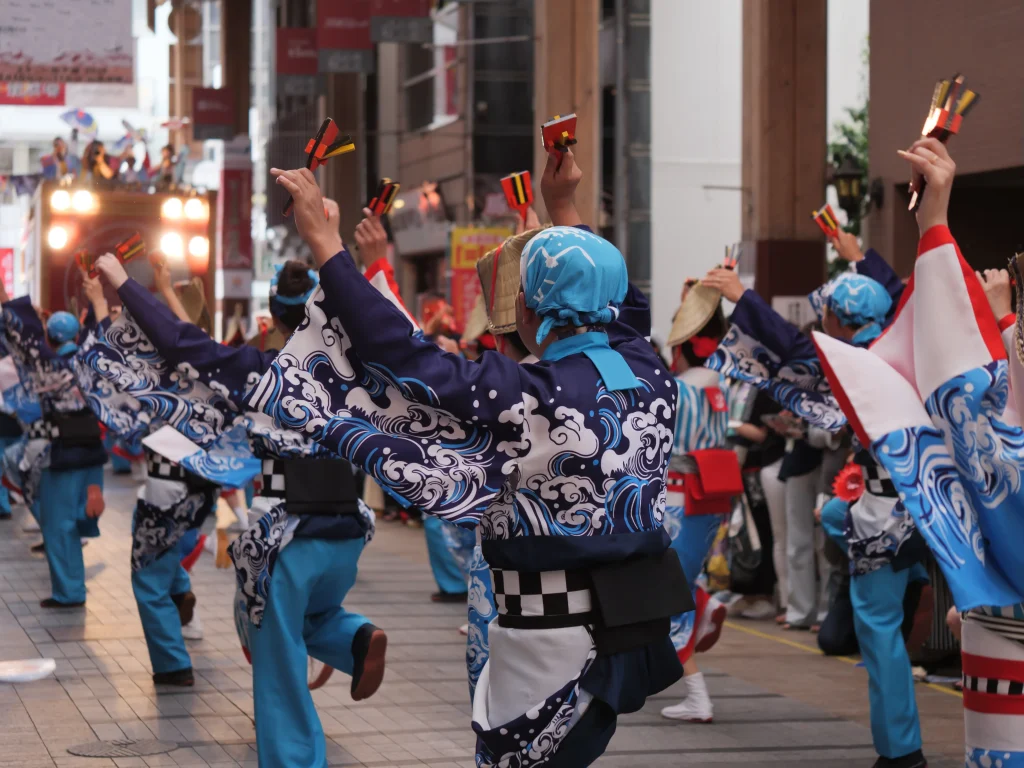
Despite its scale, Yosakoi is governed by only two formal rules. Every dancer must move forward through the street while holding Naruko, small wooden clappers traditionally colored scarlet, yellow, and black, which produce a rhythmic clicking sound with each movement. And every team’s music must incorporate a portion of the “Yosakoi Naruko Odori,” the song composed for the festival’s founding. Beyond these two requirements, teams are free to choose their own choreography, costumes, and musical style, which ranges from traditional Japanese melodies to rock, samba, and electronic music.
Each team performs alongside a jikatasha, a large decorated truck carrying speakers and, often, live musicians, which moves through the street together with the dancers rather than remaining fixed at one stage. This combination of a single shared ritual element, the Naruko, with near-total creative freedom in everything else is what allows Yosakoi to stay vibrant, with each team, and each year, producing something distinct.
It is worth noting that the Yosakoi Soran Festival held in Sapporo each June, while popular in its own right, is a later variation. It began in 1992, when students at Hokkaido University combined Kochi’s original Naruko dance with a Hokkaido fishing work-song. Visitors who wish to experience the tradition in its original form, in the city where it has been held each August since 1954 (with a brief pause during the COVID-19 pandemic), should look to Kochi rather than Sapporo.
Who Takes Part: Teams, Dancers, and How They Prepare
A Yosakoi team, called a ren, ranges from several dozen to as many as 150 dancers, the maximum team size permitted under the festival’s rules. Teams are formed around companies, neighborhood associations, universities, or groups of friends, and membership often spans several generations within a single team, it is not unusual to see participants ranging from young children to dancers in their seventies performing the same routine. In recent years, teams from more than 30 countries outside Japan have also taken part alongside local Kochi teams.
Preparing a team’s performance for the following August typically begins months in advance. Team leaders select or compose music that still incorporates a phrase of the “Yosakoi Naruko Odori,” design costumes suited to Kochi’s August heat, and choreograph routines intended to work both on stationary stages and as the team moves through the streets. As a result, each team’s performance changes from year to year, even for teams with decades of history.
Winning teams are recognized with medals awarded by a judging panel. The most prestigious of these, the scarlet Hana (“flower”) Medal, is given to the team judged to have best captured the spirit of the festival that year, rather than simply the most technically accomplished routine.
Why No Two Performances Look Alike
One of the more distinctive aspects of Yosakoi is the range it allows within a single shared tradition. At the same venue, an audience might watch a team performing choreography rooted in classical Japanese dance, immediately followed by a team set to electronic music with modern staging. This is by design: because the festival’s only fixed requirements concern the Naruko and a fragment of the founding song, each team is free to interpret the tradition through its own generation, region of Japan, or even country of origin. Long-established Kochi teams with decades of continuous participation perform alongside newly formed teams and, increasingly, groups traveling from abroad specifically to take part rather than simply observe.
This range is part of what distinguishes Kochi’s festival from later, more standardized versions of Yosakoi held elsewhere in Japan. Visitors watching for even a single afternoon typically see far more stylistic variation than the word “traditional festival” might suggest.
Visiting the Festival: Tickets, Free Venues, and Access
Most festival venues are within walking distance of JR Kochi Station, with the city’s streetcars and buses connecting the rest. Dance performances are free to watch at every venue. Reserved seating is available only at the two premium stages, Otesuji Main Competition Avenue and Central Park, with tickets released in late June through platforms such as Ticket Pia, Lawson Ticket, Klook, and KKday. As demand is high and same-day tickets are rarely available, visitors planning a trip around the festival are advised to arrange seating well in advance.
The seven free venues offer an equally rewarding, and more spontaneous, way to experience the festival. The Obiyamachi covered shopping arcade is a particularly popular free venue, where dancers pass within close view of spectators along a sheltered pedestrian street. For visitors who wish to follow specific teams, Kochi Prefecture provides a free real-time locator service, available in English, showing each team’s current and upcoming venue.
Because so much of the festival unfolds simultaneously across the city, visitors are generally better served by choosing two or three venues to follow closely over an evening than by attempting to see every stage. A single competition venue in the late afternoon, followed by one of the free arcade venues after dark, is enough to experience both the formal and the informal sides of the festival within a few hours.
The Cultural Meaning Behind the Dance
Kochi’s hospitality tradition, known as Okyaku, centers on gathering to eat, drink, sing, and welcome guests as part of the community rather than as observers. Yosakoi reflects this custom on a citywide scale: teams are often formed by neighborhood businesses and izakaya, the informal pub-restaurants found throughout central Kochi, which means the dancers performing tonight may also be the shopkeepers or restaurant staff visitors meet the following day.
The atmosphere shifts noticeably after dark. String lights and neon fixtures mounted on each jikatasha illuminate the street as teams pass, and some incorporate stage lighting effects such as dry-ice mist. Viewed from a free venue like Obiyamachi in the evening, with the sound of an approaching team’s music building before the dancers themselves come into view, the festival takes on a more intimate character than the ticketed daytime stages.
This context is worth keeping in mind before attending, as it changes how the festival is best understood. Yosakoi is not a performance staged for an audience of tourists; it is a competitive, community-organized tradition in which local businesses, families, and long-established teams all take part on equal footing. Approached with this in mind, the festival offers a more direct view of regional Japanese culture than is typically available along the well-established Tokyo–Hakone–Fuji–Nagoya–Kyoto–Osaka route.
Local Cuisine: What to Eat While You Watch
Kochi’s signature dish, katsuo no tataki, is bonito lightly seared over an open flame and served sliced with garlic, ginger, and citrus. It is widely available from food stalls near festival venues throughout the four days, and many restaurants near the Obiyamachi Arcade offer festival-season menus. Visitors are advised to allow extra time between performances to enjoy it.
Read More: Places to Visit in Kochi: The Ultimate Guide for Your Shikoku Trip
Planning a Visit: Getting to Kochi
Kochi is not connected to Japan’s main Shinkansen network; most travelers arrive via a connection through Okayama or by flying directly into Kochi Ryoma Airport. As the Yosakoi Festival takes place on fixed dates each August, and hotel availability in central Kochi tightens considerably once dates are confirmed, early planning is recommended for those wishing to combine the festival with other Shikoku destinations such as Kochi Castle, Katsurahama Beach, or sites connected to the historical figure Sakamoto Ryoma.
For travelers seeking an authentic, community-rooted cultural experience beyond Japan’s most familiar routes, the Yosakoi Festival in Kochi offers a rare combination: a tradition now in its 73rd year, held in the city where it began, and still shaped today by the same civic spirit that created it in 1954.