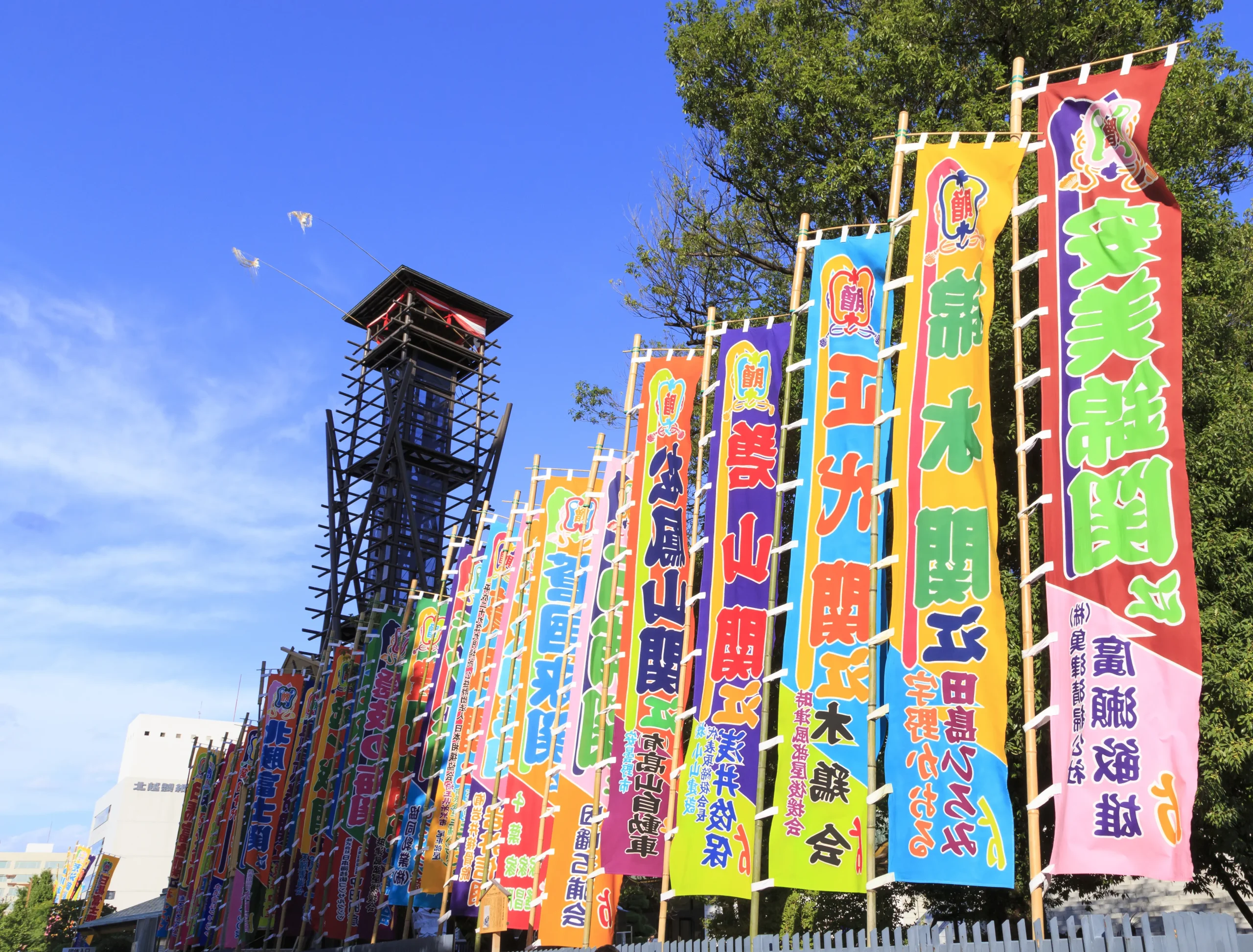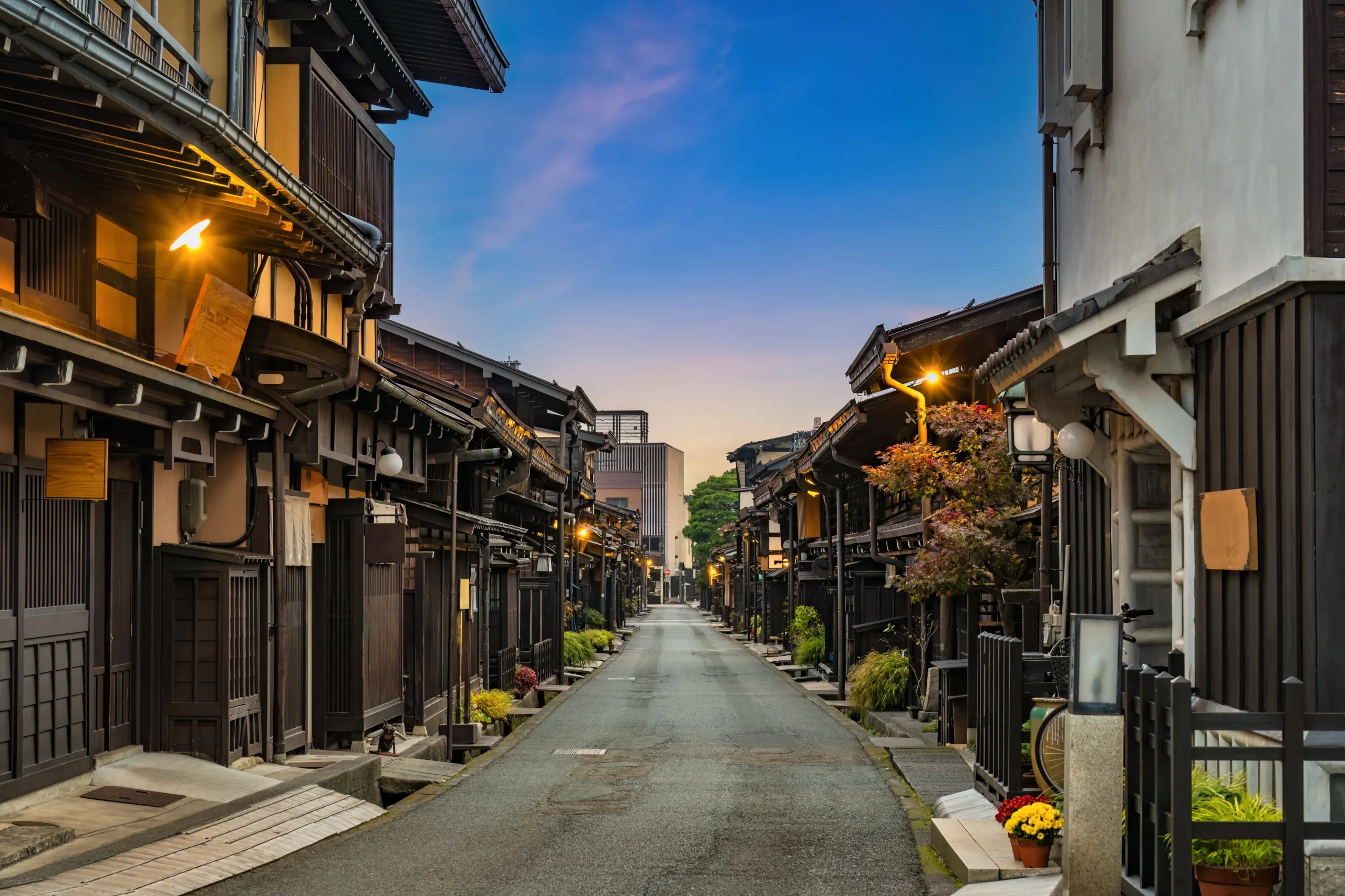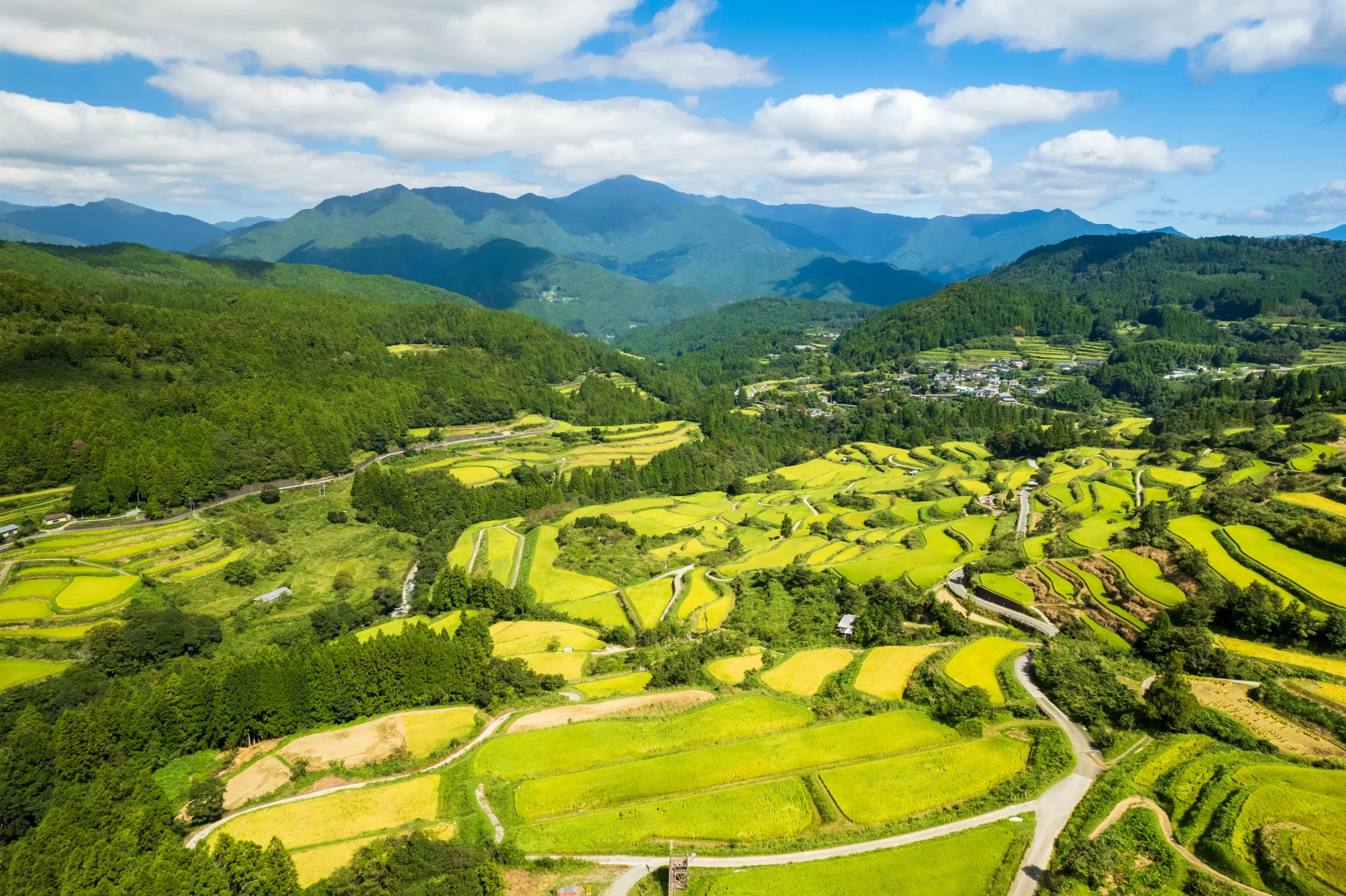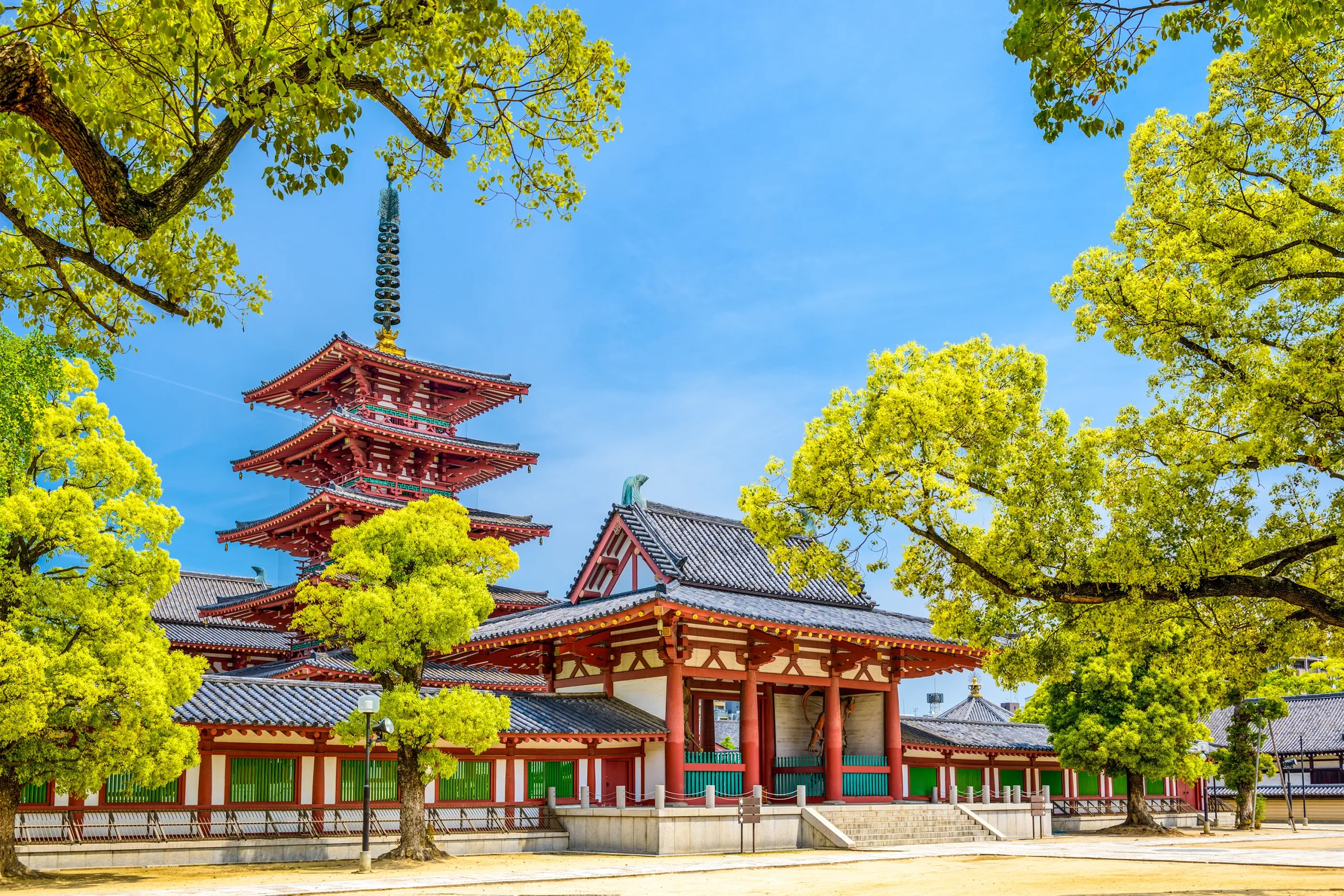
If you want to see sumo in Japan but the tournament dates never quite line up with your trip, there’s a second option most first-time visitors overlook: the jungyo. Between the six official tournaments, top wrestlers, yokozuna included, travel to regional cities for single-day exhibition events that are closer, calmer, and easier to fold into a longer itinerary than a 15-day tournament in Tokyo or Osaka.
It isn’t competitive sumo, and that’s rather the point: with no rankings on the line, the day loosens up and the wrestlers come within reach. Here’s what the 2026 jungyo looks like, what a day there actually feels like, and how to decide whether it’s worth building a day around.
What Jungyo Actually Is, and Isn’t
Sumo’s real business happens at the six honbasho, the official grand tournaments where every win and loss reshapes the banzuke, the ranking sheet that sets each wrestler’s standing and pay. Jungyo runs on the opposite logic. These are exhibition tours the Japan Sumo Association takes out between tournaments, carrying sumo to towns and cities that never host a honbasho.
Results don’t count toward anything, so no one is fighting for promotion, and you feel it. The mood is lighter, the wrestlers are more at ease, and the day is built as much around meeting local fans and encouraging young amateurs as around the bouts themselves. It’s a working part of the sumo world rather than a sideshow: the tours keep the sport visible in places far from the tournament cities, and they give promising local wrestlers a rare chance to share a ring with the professionals.
That relaxed framing is also the trade-off. If you came for the raw tension of a title race, a honbasho gives you that in a way jungyo simply doesn’t.
Not everyone travels, either: the tour leans on the sekitori, the salaried upper-division men, along with the tsukebito attendants who look after them, and a big name nursing an injury may skip a tour entirely. So think of jungyo as sumo at its most approachable rather than its most fierce. For a lot of people, especially on a first sumo outing, that turns out to be exactly the right way in.
Reference: A day at Jungyo (Provincial Tour) – Japan Sumo Association
The 2026 Jungyo Schedule
The tour runs in seasonal blocks across the year rather than on fixed annual dates, and the association publishes each block as it’s confirmed, so the calendar fills in gradually and can shift. The spring leg, which ran from late March to late April, has already finished.
Two blocks are still ahead in 2026: the summer tour in August and the autumn tour in October. A winter tour usually follows, but those dates tend to be announced later in the year.
Each city on the tour gets a single day at one arena, so a stop either falls on your travel dates or it doesn’t; there’s no second chance later in the week the way there is across a 15-day tournament. Dates and venues can still change, so confirm on the official schedule before planning around a particular city.
2026 Summer Jungyo Schedule (August)

The summer tour opens in Gifu on August 2 and works its way north through the Tohoku region before turning back toward the Kanto area near Tokyo, finishing in Tachikawa on August 30. Sendai hosts two days, and there’s a single rest day on August 17.
2026 Autumn Jungyo Schedule (October)
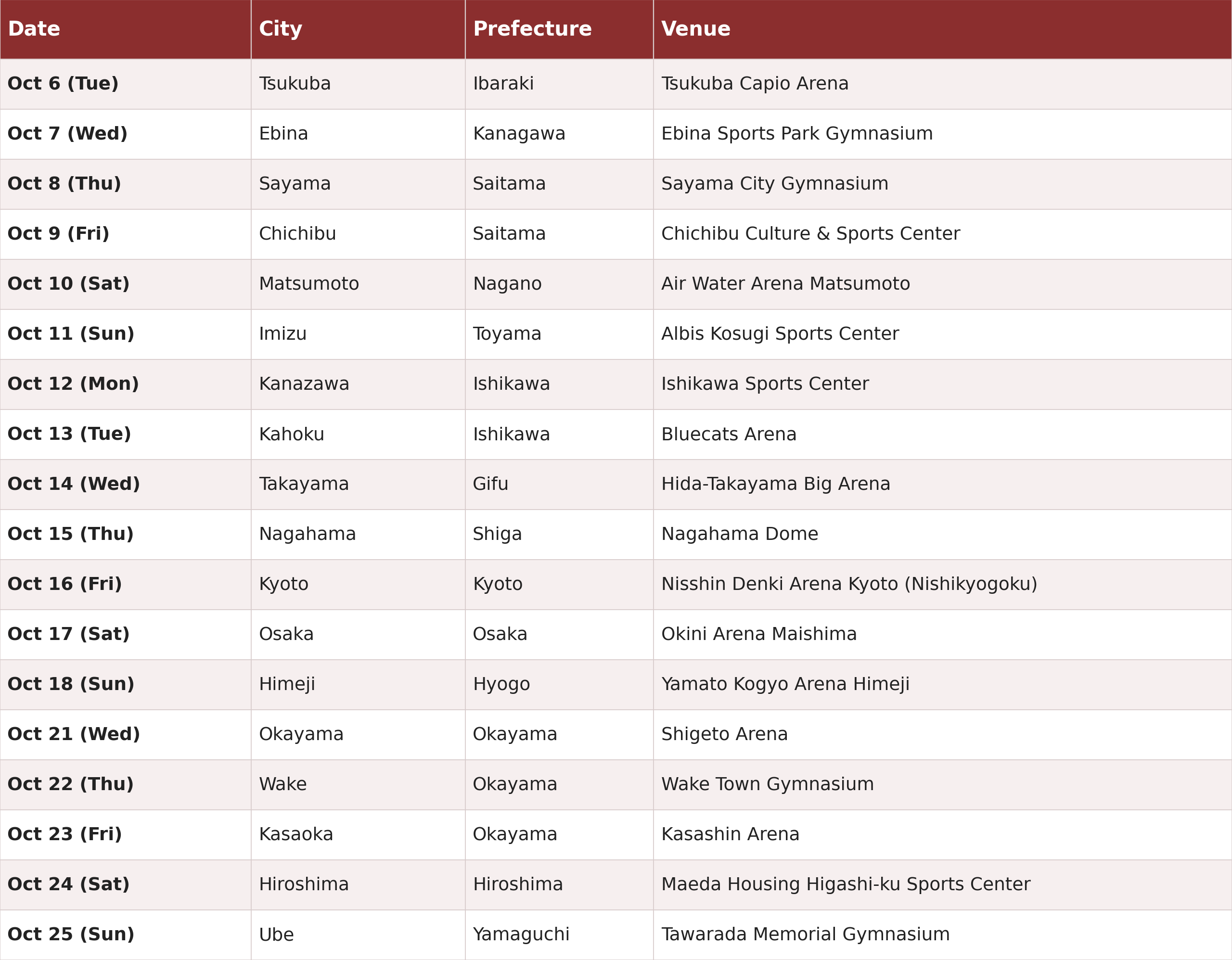
The autumn tour starts in the Kanto area and works its way down through central and western Japan. As of June 24, the official schedule lists only the stops that have been confirmed, currently running from October 6 to October 25. More may still be added, so check the official page before planning around it.
Reference: 2026 Jungyo Schedule – Japan Sumo Association (Official Website, Japanese)
A Day at the Jungyo: What to Expect
A jungyo day starts early and runs on its own rhythm. Doors usually open around 9:00, announced by the yobidashi beating the taiko drum, and the first thing you see is training rather than a show: wrestlers warming up on the clay, the lower ranks first, then the top division, with the yokozuna and ozeki going last.
Watching this practice up close, before the seats fill in, is one of the quiet pleasures of the day. Nothing is walled off the way a tournament stages things, so you can follow the footwork, the conditioning, and the plain physical scale of these athletes from surprisingly near.
By late morning the bouts begin with the junior divisions, and the tour folds in things you’ll never catch at a tournament. There’s shokkiri, a comic routine where two wrestlers act out every illegal move in the book for laughs; sumo jinku, the folk songs wrestlers sing while standing in the ring; and demonstrations of how a topknot is dressed and how a yokozuna’s heavy white belt is tied. Taiko drumming runs through the gaps.
The afternoon turns ceremonial and then serious. Around 1:00 the top-division wrestlers perform their dohyo-iri, the ring-entering ceremony in embroidered aprons, and if a yokozuna is on the tour, his own entrance follows.
The top-division matches come next, ending with the musubi-no-ichiban, the final bout of the day. Then a single wrestler performs the yumitori-shiki, twirling a bow to close proceedings, usually by mid-afternoon.
Practice, spectacle, ceremony, and real matches, all inside one afternoon, and that compact arc is a good part of why a jungyo slots so neatly into a trip as a single day.
Jungyo or a Grand Tournament: Which Fits Your Trip?
The honest answer comes down to where you’ll be and what you’re after. The grand tournaments run six times a year, fifteen days each, and only in four cities, so a comparison makes the choice clearer:
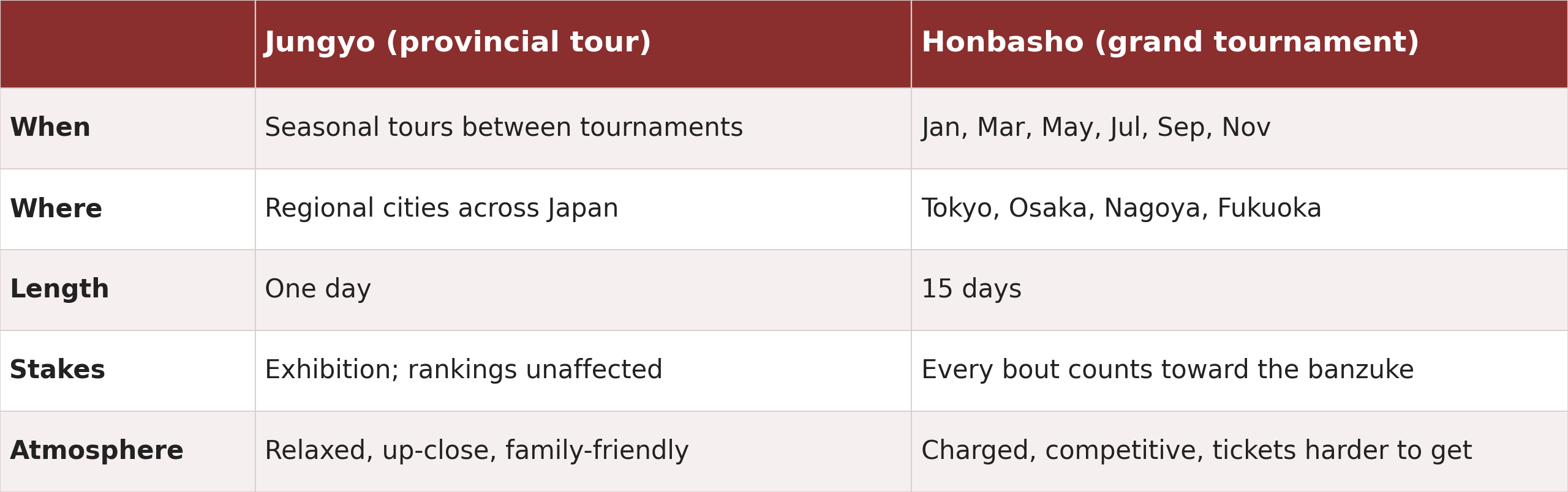
If your trip overlaps a tournament week in one of those four cities, the honbasho is worth planning around. If it doesn’t, which is common on a longer itinerary that ranges beyond the usual route, a jungyo lets you see the same top wrestlers without bending your whole trip back toward Tokyo or Osaka.
It also asks less of your schedule: one afternoon in a city you’re passing through, rather than carving a full day and a harder-won ticket out of a fixed tournament week.
Read more: Sumo season in Japan: when and how to watch – ENJYU JAPAN
Join a 2026 Grand Sumo Tour by ENJYU JAPAN
Grand Sumo tickets sell out quickly—especially on weekends and the final day—and arranging seats, timing, and logistics on your own can be a hassle. With ENJYU JAPAN, your tournament seat and full-day plan are arranged for you, so you can simply turn up and enjoy. We offer three small-group, English-guided options for the September 2026 Tokyo Tournament, from a single-day taste of sumo to a week-long journey across Tokyo, Hakone, and Mt. Fuji.
| Tour | Dates | Best for | Highlights | Price (per person) | Details |
|---|---|---|---|---|---|
| 1-Day Grand Sumo Tournament & Ryogoku Walking Tour | Sep 15 only | Short stays / a first taste of sumo in one day | Morning practice at a sumo stable, sumo history sites, and a live tournament — all in a single day in Ryogoku | JPY 69,000 | View details |
| 4 Days September Grand Sumo & Cultural Tour | Sep 13–16 | A compact trip combining sumo with Tokyo culture | Live tournament & morning practice, plus Asakusa, a tea ceremony, and Shibuya. Tokyo-based, 3 nights | JPY 170,000 | View details |
| 7 Days September Grand Sumo Tour | Sep 13–19 | A full journey of sumo plus Japan’s iconic scenery | Live tournament & morning practice, plus Asakusa, a tea ceremony, Hakone, and the Mt. Fuji area, with onsen ryokan stays. 6 nights | JPY 420,000 | View details |
All tours include a reserved tournament ticket (Chair C seats), an exclusive sumo-stable morning practice visit, and an English-speaking guide. The 4- and 7-day tours are small-group departures (max 10, minimum 4 to operate).
Interested in any of these sumo tours?
Contact ENJYU JAPAN to check availability and start your booking. Places are limited and confirmed on a first-come, first-served basis, so early inquiry is recommended.
Planning a Day Around the 2026 Jungyo
A jungyo is a one-day event in a city you might not otherwise stop in, so a little logistics goes a long way. Each venue is organized locally, which means tickets are handled stop by stop rather than through one central box office, and popular dates can sell out, so it’s worth sorting early. If you want the morning practice and not just the afternoon bouts, plan to arrive close to opening.
Because the venues are scattered across the regions, the tour fits most naturally into a trip that’s already heading beyond Tokyo and Kyoto. A summer stop somewhere in Tohoku, or an autumn one in western Japan, can anchor a day when you’d be in that area anyway, rather than forcing a detour.
The regional arenas also tend to feel calmer and less packed than a big-city tournament hall, which suits anyone who’d rather watch sumo without the crush. Seating differs from stop to stop, too: some arenas use ordinary chairs, others keep cushioned floor sections nearer the ring, so it helps to know what you’re actually booking.
Plan on a morning-to-mid-afternoon commitment and you’ll still have the evening free. Photography is generally more relaxed here than at a honbasho, though it’s still best to follow each venue’s own guidance on the day.
A Few Common Questions
Is a jungyo easier to enjoy than a tournament?
For a first taste, often yes: it’s one day, more relaxed, and you can get close to the wrestlers. Just keep in mind the bouts are exhibition rather than a title race.
Will a yokozuna definitely appear?
Not always. The lineup shifts from tour to tour, and injuries or absences happen, so check the details for the specific stop you’re considering.
How do tickets work?
They’re sold for each stop separately, often through the local organizer, and prices depend on the venue and seat type. Weekend dates tend to go first, so book ahead where you can.
Can I take photos?
Usually more freely than at a tournament, but follow the venue’s instructions on the day.
Planning Help, If You Want It
Seeing a jungyo mostly comes down to matching a tour date to where you’ll already be, then handling the tickets and regional travel that make the day work.
If you’d rather not piece all that together on your own, ENJYU JAPAN designs a Tailor-Made Tour around exactly this kind of interest, building a sumo day into a wider route through the areas the tour passes. Tell us roughly when you’re traveling, and we can flag where a tour date lines up with your route, then take the tickets and regional connections off your plate.