Kawagoe sits just 30 minutes from central Tokyo, yet its main street looks closer to a 19th-century woodblock print than anything in the capital: clay-walled merchant warehouses, a wooden bell tower still keeping time, and a temple holding the last surviving rooms of the original Edo Castle. This guide covers how to get there, what to actually see once you arrive, and how to fit it all into a single day.
How to Get to Kawagoe from Tokyo
Kawagoe is reachable directly from three different Tokyo stations, and which one makes sense depends on where in the city a traveler is starting from. From Ikebukuro, the Tobu Tojo Line reaches Kawagoe Station in about 30 minutes for 490 yen, the fastest and cheapest of the three main routes. From Shinjuku, the Seibu Shinjuku Line’s Koedo Limited Express reaches Hon-Kawagoe Station in around 45 minutes for roughly 1,013 yen including the express surcharge, while the JR Saikyo/Kawagoe Line offers a direct, no-transfer alternative in a similar 45 to 55 minutes, fully covered by the Japan Rail Pass.
Because Kawagoe has three separate stations (Kawagoe, Kawagoe-shi, and Hon-Kawagoe) served by different rail lines, all within a 15 to 25 minute walk of the historic district, the practical answer to “how do I get to Kawagoe” depends less on which station is objectively best and more on which line already connects to wherever a traveler is staying in Tokyo. For visitors without a JR Pass, the Tobu Tojo Line from Ikebukuro remains the most direct and least expensive option, making the 30-minute journey genuinely comparable to crossing central Tokyo itself.
Why Kawagoe Is Called “Little Edo”
Kawagoe earned its nickname, Koedo, or “Little Edo,” from its role as a supply depot and trading hub for Edo, the city that would later become Tokyo, during the Tokugawa shogunate (1603–1868). Its position on the Musashino Plain, combined with river access to the capital, made it wealthy enough that local merchants could afford Kurazukuri, thick clay-walled warehouse buildings originally built to protect valuable goods from the fires that regularly swept through Japan’s wooden cities.
That fire-resistant construction is precisely why so much of Kawagoe survived intact into the present: unlike much of Tokyo, which was rebuilt repeatedly after fires, earthquakes, and wartime bombing, Kawagoe’s old town escaped both the 1923 Great Kanto Earthquake and World War II largely undamaged. The result is a merchant district that isn’t a reconstruction built to look historic, but a genuinely surviving piece of Edo-period commercial architecture, a distinction that separates Kawagoe from many of Japan’s other “historic streets.”
Kurazukuri Street: Walking Through Warehouses That Survived Fire
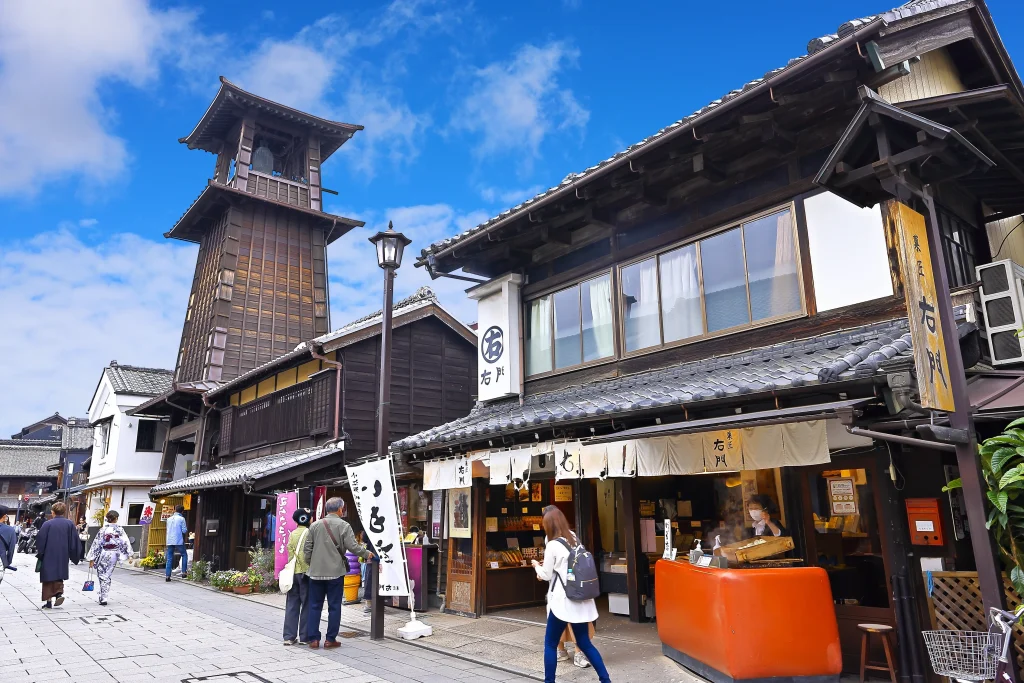
Kurazukuri-no-Machinami, the warehouse district’s main street, is lined with roughly 30 surviving Kurazukuri buildings, most now converted into shops, cafés, and small museums rather than the original merchant storehouses. The oldest of these, the Osawa Residence, was built in 1792 and is registered as an Important Cultural Property, giving visitors a specific, dateable reference point for just how long this style of construction has stood on the same street.
Because the buildings now house working businesses rather than static displays, walking Kurazukuri Street means moving between genuine shops selling sweet-potato snacks, sake, and crafts inside 18th- and 19th-century architecture, rather than viewing preserved buildings from behind a rope. Even a chain coffee shop on the street, a Starbucks built directly into the traditional warehouse style, has been designed to fit the streetscape rather than interrupt it.
Toki no Kane: The Bell Tower That Gives Kawagoe Its Rhythm
Toki no Kane, the wooden bell tower that has become Kawagoe’s defining symbol, has marked time in the town for roughly 350 years, though the current 16-meter structure is its fourth iteration, rebuilt in 1894 after a major fire the previous year destroyed much of the surrounding district. The bell still rings automatically four times daily, at 6 a.m., noon, 3 p.m., and 6 p.m., and timing a visit to Kurazukuri Street around one of these moments turns an already atmospheric street into something closer to stepping directly into the period the architecture represents.
Because the tower sits just off the main warehouse street, most visitors reach it as a natural stop within a longer walk rather than a separate destination requiring its own trip, making it one of the easiest “must-see” sights in Kawagoe to work into any itinerary without extra planning.
Kita-in Temple: The Only Surviving Rooms of the Original Edo Castle
Kita-in, founded in 830 by the monk Ennin, holds a historical significance easy to miss at first glance: after the 1923 earthquake destroyed the last structures at Edo Castle’s original site in Tokyo, the rooms relocated to Kita-in in the 17th century became the only surviving parts of that castle anywhere in the world. Visitors can walk through the actual reception rooms, study, and birth room of Tokugawa Iemitsu, the third shogun, moved here after a fire destroyed Kita-in’s own buildings in 1638 and the shogunate donated sections of Edo Castle to help rebuild it.
Alongside the castle rooms, Kita-in’s garden holds 540 stone rakan statues, carved between 1782 and 1825 to depict Buddha’s disciples, each with a distinct facial expression and pose so that, according to local tradition, visitors can find one bearing at least some resemblance to themselves or someone they know. Admission to this inner precinct costs roughly 400 yen for adults, a modest fee for direct physical access to the only remaining fragment of Edo Castle left standing anywhere.
Kawagoe Castle’s Honmaru Goten and Hikawa Shrine
Kawagoe Castle, originally built in 1457 by the father-and-son architects Ota Dokan and Ota Dōshin (the same Dokan credited with building Edo Castle itself), has almost entirely disappeared, but its Honmaru Goten, the lord’s residence built in 1848, survives as one of the few remaining examples of a honmaru palace great hall anywhere in Japan. Entry costs a modest 100 yen for adults, and walking its corridors offers a specific, tangible sense of how a feudal lord’s administrative residence actually functioned, rather than the reconstructed exteriors common at many Japanese castle sites.
A short distance away, Hikawa Shrine, with roughly 1,500 years of continuous history, has become one of Kawagoe’s more distinctive sights for a different reason: visitors seeking marriage or relationship blessings can use a small fishing rod to catch a tai (sea bream)-shaped omikuji, or fortune slip, from a pool at the shrine, a specific ritual not found at most other shrines in Japan.
The Kawagoe Festival and Taisho Roman Street
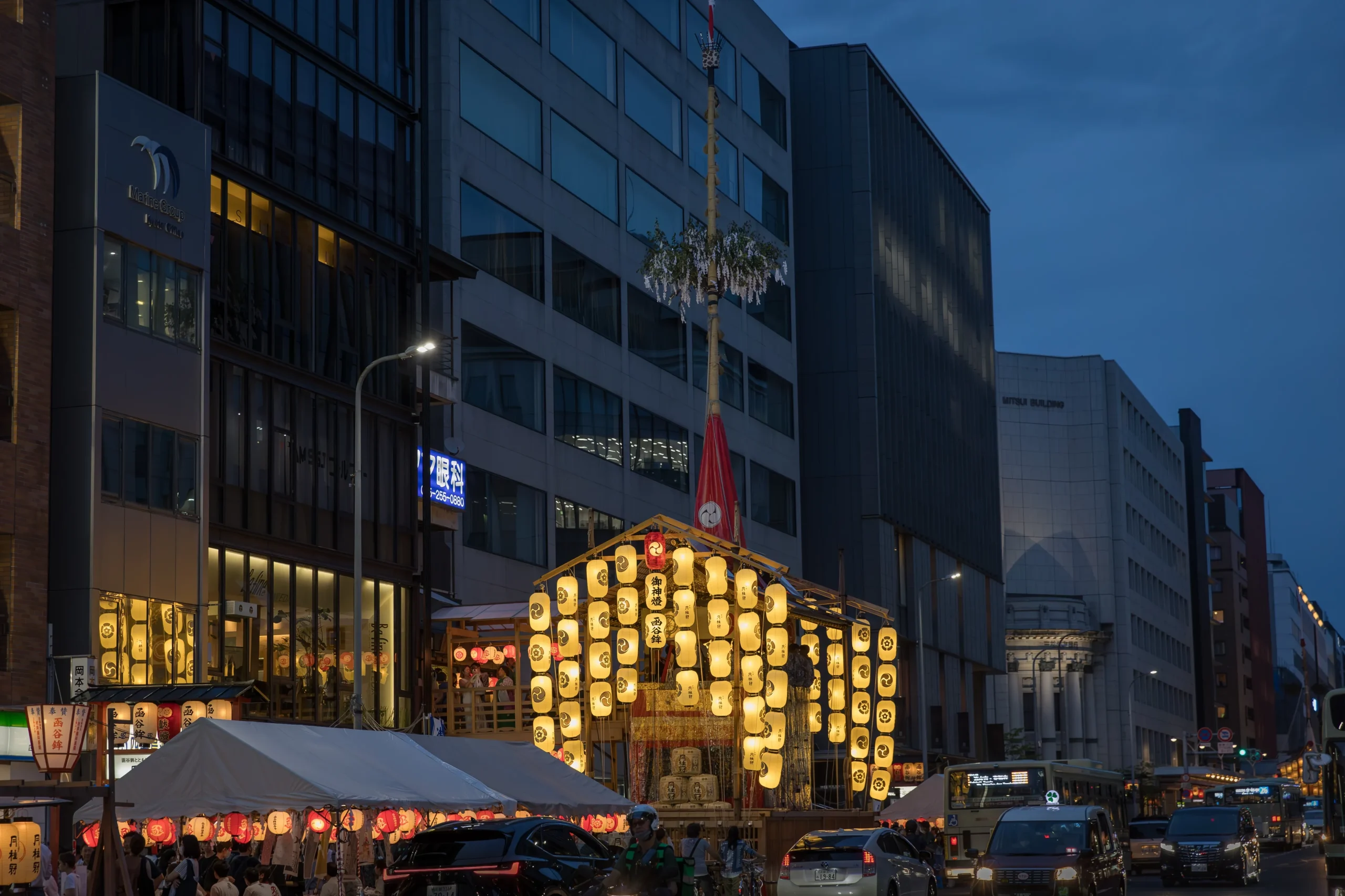
Every October, on the third weekend of the month, Kawagoe hosts the Kawagoe Festival, in which ornately decorated floats up to several meters tall are pulled through the old town in a tradition connected to nearby Hikawa Shrine, recognized by UNESCO as Intangible Cultural Heritage alongside dozens of other Japanese float festivals. Visitors who cannot time a trip to October can still see the floats up close year-round at the Kawagoe Festival Museum, which displays actual festival floats and recreates the atmosphere of the event through video and sound.
Between Hon-Kawagoe Station and the warehouse district, Taisho Roman Street offers a noticeably different architectural period from Kurazukuri Street’s Edo-era buildings: storefronts styled after the Taisho era (1912–1926), a period when Japan absorbed Western architectural influences into a distinctly hybrid style. Walking from Taisho Roman Street into Kurazukuri Street means passing through two adjacent but visually distinct eras of Japanese commercial architecture within the same short walk, a detail most visitors don’t notice until it’s pointed out.
Kashiya Yokocho and What to Eat in Kawagoe
Kashiya Yokocho, or Candy Alley, is a short street of roughly 30 shops selling traditional Japanese sweets, some still made by hand using techniques visible to visitors standing at the shop counter. The alley’s fragrance earned it a place on Japan’s official list of 100 Sites of Fragrant Landscapes, a detail that signals just how central the smell of roasting and simmering sugar is to the street’s identity, rather than being incidental to it.
Kawagoe’s signature food, however, is satsumaimo, the sweet potato that has been a regional specialty since the Edo period, when the surrounding sandy soil proved especially suited to growing it. Sweet-potato soft-serve ice cream, roasted whole sweet potatoes sold from carts, and sweet-potato-based sweets appear throughout both Kurazukuri Street and Kashiya Yokocho, making “try Kawagoe’s sweet potato in at least one form” a genuinely specific, local answer to the question of what to eat there, rather than a generic recommendation that could apply to any Japanese town.
Planning a Day in Kawagoe: A Suggested Route
A full day in Kawagoe comfortably covers the warehouse district, Toki no Kane, Kashiya Yokocho, and either Kita-in or the Honmaru Goten, starting from whichever station a traveler arrives at and working toward the old town on foot or via the Koedo Loop Bus, which connects the main sights directly. Visitors arriving by early-to-mid morning can reach Kita-in first, since its 4 p.m. closing time makes it worth prioritizing earlier in the day, before working back through the warehouse district and Kashiya Yokocho in the afternoon and finishing at Toki no Kane in time for one of its scheduled chimes.
Because Kawagoe’s core sights sit within a roughly 25-minute walking radius of each other, a single day is genuinely enough to see the highlights without the rushed feeling that comes from spreading similar sights across a wider area, unlike some of Tokyo’s other popular day-trip destinations.
Pick a morning train from Ikebukuro or Shinjuku, time your walk down Kurazukuri Street to catch Toki no Kane’s chime, and you’ll have covered a genuine slice of Edo-period Japan and been back in central Tokyo before dinner.