Okutama sits inside the official boundaries of Tokyo, yet it looks nothing like the city most travelers picture: 94% of its 225 square kilometers is forest, and the area falls entirely within Chichibu-Tama-Kai National Park. Reaching it from Shinjuku takes roughly the same time as a trip to Kamakura or Nikko, but the destination is a reservoir ringed by mountains, a 1,270-meter cave system, and a 2,000-year-old shrine reached by cable car, all without technically leaving the city limits. This guide covers what to do in Okutama, how to get there, and how much time each stop actually requires.
Is Okutama Really Part of Tokyo? Getting There from Shinjuku
Yes, and this is worth stating clearly, since it is the detail most visitors find hardest to believe. Okutama Town sits at Tokyo’s westernmost edge, still administratively part of the Tokyo Metropolis despite feeling closer in character to the Japanese Alps than to Shinjuku. Getting there requires no special ticket or long-distance train: from Shinjuku Station, the JR Chuo Line runs to Ome Station, where a transfer to the JR Ome Line, branded by JR East as the “Tokyo Adventure Line,” continues to Okutama Station, the line’s final stop. The full journey takes about 90 minutes to two hours and costs roughly 1,000 yen one way, with a direct weekend Holiday Rapid service cutting out the transfer at Ome.
Because the Ome Line runs only one or two trains per hour beyond Ome Station, checking the timetable before departure matters more here than on more heavily trafficked commuter lines. Missing a connection can mean a 30- to 60-minute wait rather than the few minutes typical elsewhere in Tokyo.
Lake Okutama: A Reservoir Ringed by Mountains
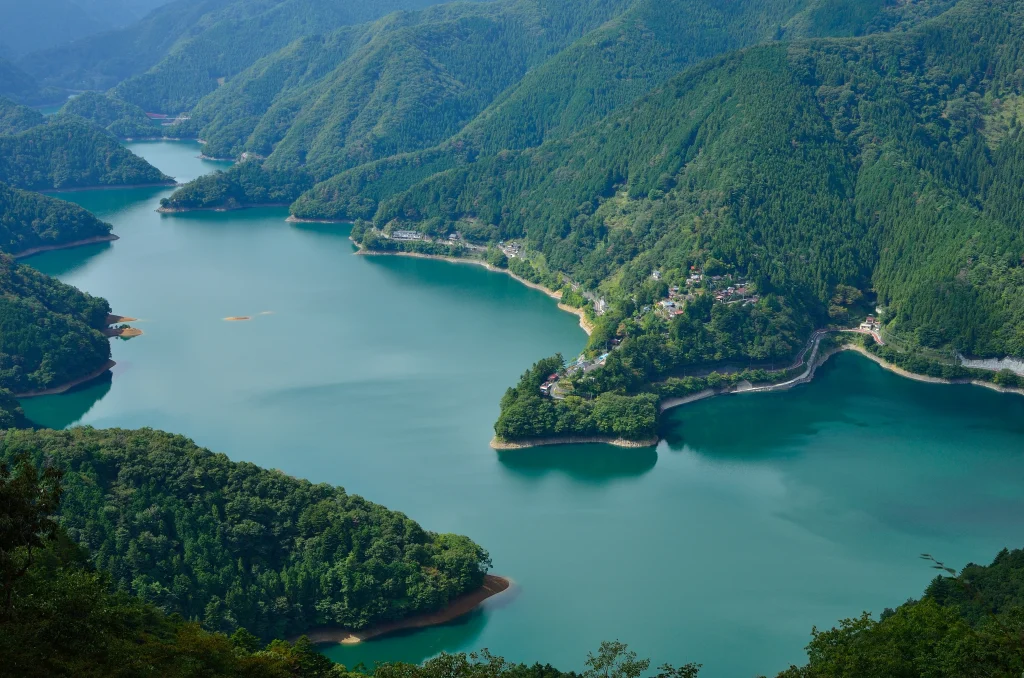
Lake Okutama is an artificial reservoir created in 1957 by the Ogouchi Dam, built to supply drinking water to central Tokyo and now ringed by forested peaks that turn deep red and orange each November. From Okutama Station, a roughly 20-minute local bus reaches the lake, where a lakeside walking path and a free-admission visitor center called the Water and Greenery Exchange Center make an easy, low-effort stop for travelers not planning to hike.
Two suspension bridges cross sections of the reservoir, though both close periodically when the water level drops too low or during high winds, so confirming their status with the Okutama Tourism Association before building a day around them is worth the extra step. The lake’s color itself shifts with the seasons, from a deep turquoise in summer to a flatter, silver-grey surface in winter, when the surrounding peaks are more likely to carry a dusting of snow. For travelers whose main interest is the reflective, mountain-ringed water rather than a full hiking itinerary, the lake alone justifies the bus ride from the station.
Nippara Limestone Cave: Kanto’s Largest Cave System
Nippara Limestone Cave, discovered in 1962 and designated a natural monument by the Tokyo Metropolitan Government, is the largest cave system in the greater Kanto region, running 1,270 meters in total length with a height variance of 134 meters. Inside, the temperature holds at a constant 11°C (52°F) year-round regardless of the season outside, making it one of the few Okutama attractions equally suited to a July heatwave and a January cold snap.
The main walking route covers roughly 800 meters through illuminated chambers of stalactites and stalagmites formed over an estimated 250 million years, reached from Okutama Station by a 25- to 35-minute local bus. Because the approach road narrows considerably near the cave entrance, the bus is the recommended way in regardless of whether the rest of the day’s itinerary involves a rental car.
Hatonosu Gorge and the Okutama Mukashi-Michi Trail
Hatonosu Gorge, a short walk from Hatonosu Station on the Ome Line, drops travelers directly beside one of the clearest rivers in the Tokyo area, visible from a suspension bridge roughly 40 meters above the water. From the gorge, the Okutama Mukashi-Michi, or “old road,” follows the river toward Okutama Station along a historic route once used by traders moving goods through the mountains, passing moss-covered stone markers and small shrines largely unchanged since the trail’s original use.
The full Mukashi-Michi walk from Hatonosu to Okutama Station takes roughly two to three hours at a relaxed pace, making it accessible to travelers without dedicated hiking gear, while the short walk to the gorge itself from the station requires only about ten minutes for those short on time.
Mount Mitake: A 2,000-Year-Old Mountain Shrine You Reach by Cable Car
Mount Mitake, reached via Mitake Station on the Ome Line, is home to Musashi-Mitake Shrine, a site of mountain worship believed to date back nearly 2,000 years, with the shrine’s buildings deliberately oriented to face east toward old Edo, the historical name for Tokyo, for spiritual protection. A cable car from Takimoto Station carries visitors most of the way up the 929-meter mountain in about six minutes, leaving a 20- to 30-minute walk past a small village of shukubo, traditional pilgrim lodgings that have hosted travelers to the shrine for centuries, before reaching the summit.
Beyond the shrine, hiking trails continue to the Rock Garden, a moss-covered forest valley with two waterfalls, and to neighboring peaks including Mount Odake and Mount Hinode. Visitors who prefer not to hike can still reach the shrine entirely by cable car and a short paved walk, while those seeking a fuller day can continue on foot for two to three additional hours through the surrounding trail network.
River Activities: Rafting, Kayaking, and Fishing in Mitake Valley
Mitake Valley, on the Tama River near Mitake and Kawai Stations, holds the closest whitewater rafting center to central Tokyo, alongside canoeing, kayaking, and bouldering along the same stretch of river, generally running from April through November. The river’s water volume stays stable regardless of season, which local operators cite as the reason Mitake works well even for first-time rafters unfamiliar with reading river conditions elsewhere.
Further upstream, the Nippara and Otamba Rivers, both tributaries of the Tama River, offer designated mountain stream fishing spots where visitors can catch and then barbecue their own fish on-site, a specific, hands-on activity difficult to find within Tokyo’s official boundaries anywhere else.
Moegi no Yu: Ending the Day in an Okutama Hot Spring
Moegi no Yu, a roughly 10-minute walk from Okutama Station, draws its water from deep underground in Okutama itself and offers both indoor and outdoor bathing areas. A three-hour visit costs 950 yen for adults, 550 yen for elementary-school-age children, and is free for younger children, making it an accessible final stop after a day of hiking or river activities rather than a destination requiring separate planning.
Because Moegi no Yu sits close to the station, it works equally well as the final stop before the return train to Shinjuku or as a standalone visit for travelers who came primarily for the lake or cave and want to end the day with a soak rather than another hike.
How Much Time You Actually Need
A single day is enough to comfortably combine two of Okutama’s main attractions, for example Lake Okutama and the Nippara Cave, or Hatonosu Gorge and Moegi no Yu, without rushing either stop, since most sites sit within a 10- to 35-minute bus or walk from the nearest station. Fitness requirements vary sharply by destination: the lake, the cave, and the hot spring involve minimal walking, while the full Mukashi-Michi trail or a Mount Mitake hike beyond the shrine calls for reasonable stamina and two to three hours of continuous walking.
Travelers drawn to the area’s overnight lodging options, including the shukubo pilgrim accommodations on Mount Mitake, can extend a single day into two, splitting the lake-and-cave itinerary from the Mitake hiking and shrine visit rather than compressing both into one long day.
A Few Extras Worth Knowing
Beyond its outdoor attractions, Okutama is home to working sake breweries that offer tours and tastings using water drawn from the same mountain sources feeding the region’s rivers, a detail that connects the area’s drinking water reputation to what visitors can taste directly. During the second and third weekends of August, JR East also runs the Ozashiki Train, a limited seasonal service on the Ome Line fitted with traditional tatami-mat seating in place of standard train seats; tickets cost more than a normal fare and require advance reservation, but the ride itself becomes part of the day’s experience rather than simply transportation to it.
Camping is another option largely absent from Tokyo’s more famous day-trip destinations: several campgrounds near Lake Okutama and along the Tama River operate from spring through autumn, giving travelers who want more than a single day in the area a straightforward way to stay overnight without booking a shukubo or hotel room.
Why Okutama Feels Farther From Tokyo Than It Is
Okutama’s real appeal is not simply that it is scenic, but that it is scenic while remaining inside Tokyo’s own administrative boundary, letting travelers step directly from a train they boarded in Shinjuku into forest silence, cold cave air, and a mountain shrine nearly two millennia old, all without the logistics of a longer regional trip. For a traveler who wants distance from the city without the commitment of leaving it, that combination is rare enough to be worth telling people about afterward.
Pick one or two stops from this list, check the Ome Line’s next departure time before you leave, and Tokyo’s wildest corner is less than two hours from Shinjuku Station.