Wisteria, or fuji in Japanese, blooms just as cherry blossom season fades, turning trellises, tunnels, and shrine grounds across the country into cascades of purple, pink, and white for roughly three weeks each spring. The flower has been part of Japanese aristocratic culture for over a thousand years, referenced in the eighth-century poetry collection Man’yoshu and woven into one of the country’s most powerful historical clans. This guide covers when to see wisteria in Japan, where the best gardens and tunnels are, and what the flower actually means.
When Is Wisteria Season in Japan?
Wisteria typically reaches peak bloom between mid-April and mid-May, with the exact window shifting by roughly two to three weeks depending on latitude: gardens in Fukuoka and other parts of Kyushu tend to peak first in mid to late April, while Tokyo-area sites often peak slightly later, and some northern gardens extend into mid-May. Because peak bloom depends on that year’s specific weather rather than a fixed calendar date, most major gardens publish real-time bloom-status updates on their official websites or social media in the weeks leading up to the season, and checking those updates before booking travel is worth the extra step.
Unlike cherry blossoms, which typically last just five to ten days at their fullest, wisteria’s bloom period generally holds for two to three weeks at good gardens, giving travelers a noticeably wider planning window and reducing the risk of arriving just after peak has passed. The flower’s scent adds a dimension photographs cannot capture: wisteria carries a light, slightly sweet fragrance that becomes noticeable within a few meters of a full trellis, especially in the still, humid air common on late-April afternoons.
Ashikaga Flower Park: Japan’s Most Famous Wisteria Trees
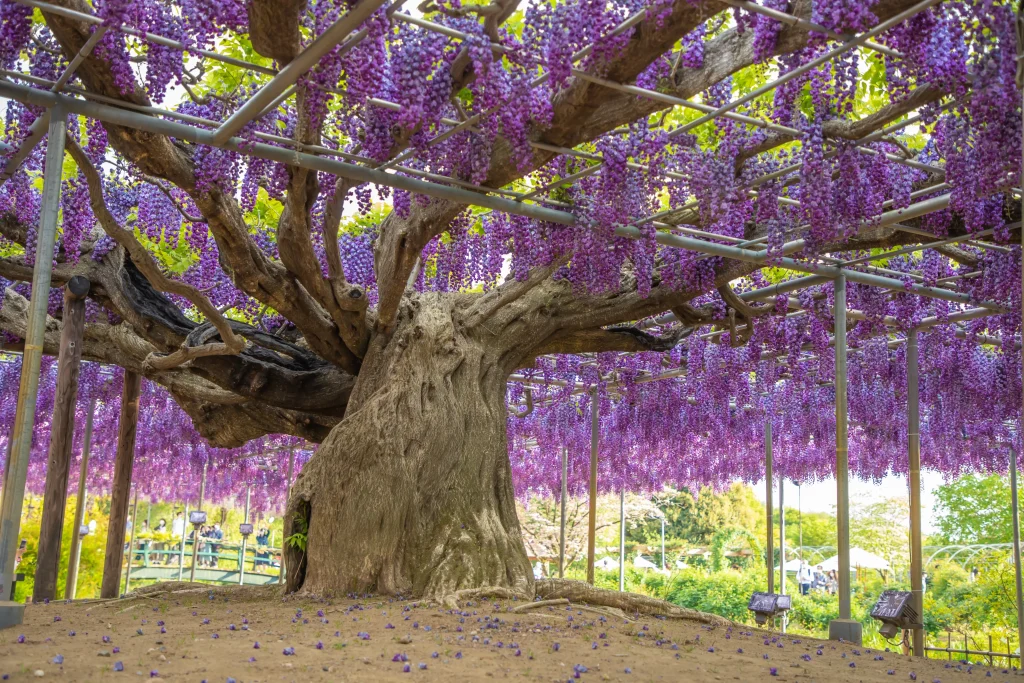
Ashikaga Flower Park, in Tochigi Prefecture about 90 minutes north of Tokyo, holds more than 350 wisteria trees, including a single tree over 160 years old whose canopy alone spans roughly 1,000 square meters, an area equivalent to 600 tatami mats. The park’s signature sights include an 80-meter white wisteria tunnel and a rare yellow-flowered kibana wisteria tunnel, a color combination difficult to find at other gardens in the country. After dark, the park’s evening illuminations light the wisteria canopies from within, their reflections doubling across the surface of an adjacent pond.
Since being named a “Dream Destination” by CNN Travel in 2014, Ashikaga has become one of the most internationally recognized wisteria sites in Japan, and its annual Great Wisteria Festival, running from mid-April through mid-May, draws large enough crowds that advance e-tickets, priced between roughly 1,200 and 2,300 yen depending on the day, are strongly recommended over walk-up admission during peak weekends and Golden Week.
Kawachi Fuji Garden: The Wisteria Tunnels Behind the Viral Photos
Kawachi Fuji Garden, a private garden in the hills south of Kitakyushu in Fukuoka Prefecture, is likely the single wisteria site most visitors already recognize before arriving in Japan, having circulated widely on social media as two roughly 100-meter tunnels formed from 22 varieties of wisteria in colors ranging from white to deep violet. At the garden’s center, a separate canopy of large wisteria trees forms what visitors often describe as a floating purple roof suspended overhead.
The garden’s popularity has made it one of the strictest wisteria sites to visit: during the 2026 peak season, running April 18 to May 6, entry requires a reservation for a specific date and time slot booked in advance, and visitors without one are turned away regardless of ticket availability elsewhere. Reservations, available from late March through the garden’s official bilingual website, cost 600 yen with an additional balance payable on arrival depending on the day’s bloom conditions, meaning the exact viral tunnel shot circulating online requires planning weeks ahead rather than a same-day decision.
Kameido Tenjin Shrine: Tokyo’s Own Wisteria, No Day Trip Required
For travelers without time to leave central Tokyo, Kameido Tenjin Shrine in Koto Ward holds more than 100 wisteria plants trained over trellises surrounding the shrine’s vermilion drum bridge, a scene famous enough to have been recorded in ukiyo-e woodblock prints, most notably by the 19th-century artist Hiroshige in his “100 Famous Views of Edo” series. The shrine has been associated with wisteria since its founding in the mid-17th century, when its first head priest recognized that the grounds’ damp soil suited the flowering vine particularly well.
During the annual Kameido Tenjin Wisteria Festival, typically running through most of April, the flowers are illuminated after dusk during peak bloom, alongside food stalls and cultural events including tea ceremonies and taiko drumming. For travelers weighing whether a dedicated day trip to Tochigi or Fukuoka is worth the time, Kameido Tenjin offers a genuinely comparable experience reachable by ordinary Tokyo subway.
Kasuga Taisha and the Symbolism of Wisteria in Japanese Culture
Wisteria’s cultural weight in Japan traces back specifically to the Fujiwara clan, whose name literally translates to “wisteria field” and who dominated the imperial court from 710 to 1160, making them arguably the most powerful family in early Japanese history. The clan adopted wisteria as its family crest, and because purple, wisteria’s dominant color, was historically restricted to the aristocracy under Japan’s strict clothing laws, the flower became permanently associated with nobility, wealth, and refinement rather than a simple garden bloom.
Kasuga Taisha, the Fujiwara clan’s shrine in Nara established in 768, remains the clearest place to see this connection made physical: its Sunazuri-no-Fuji, an aged, drooping wisteria tree whose flower clusters grow long enough to nearly brush the ground, blooms each year in late April and early May across the shrine grounds the clan itself once built. In hanakotoba, the Japanese language of flowers, wisteria’s meaning extends beyond nobility to represent welcome, kindness, and longevity, the last tied directly to the plant’s famously long-lived, slow-climbing vines. Some individual wisteria specimens in Japan are documented at well over a century old, still blooming on the same trellis their original planters never saw reach full size.
More Wisteria Spots Worth Knowing
Beyond the three most internationally known sites, several other gardens offer distinct takes on the same flower. Byakugoji Temple in Hyogo Prefecture centers its display around a single large wisteria trellis forming a dense flowering canopy over temple grounds otherwise known for quiet, uncrowded viewing. Omishima Fuji Park in Ehime Prefecture holds a 300-meter trellis supporting around 160 wisteria vines along the Miyaurahon River, one of the largest single wisteria structures in the country, accompanied by an annual festival with outdoor tea ceremonies. Tennogawa Park in Aichi Prefecture and Kurosawa Wisteria Park in Gunma round out a list of well-regarded but comparatively low-traffic sites for travelers who have already seen Ashikaga or Kawachi and want a quieter second stop.[C6]
Because each of these gardens differs in scale, trellis structure, and peak timing, choosing a second or third wisteria destination is less about finding “the best” garden and more about matching a specific visual, a tunnel, a wall, a freestanding tree, or a full canopy, to what a traveler is specifically hoping to photograph.
Tickets, Timing, and Avoiding the Crowds
Reservation requirements vary sharply by garden and are worth confirming before travel rather than assuming walk-up entry will be available. Kawachi Fuji Garden requires timed reservations throughout its entire peak window; Ashikaga Flower Park strongly recommends advance e-tickets during weekends and Golden Week without requiring them outright; and Kameido Tenjin, as a public shrine rather than a ticketed garden, has no reservation system at all. Arriving early on a weekday morning consistently produces a quieter, less crowded experience than a weekend afternoon at every site on this list, and is particularly worth prioritizing at gardens without a capped reservation system.
Getting the Photo You’ve Already Seen Online
Much of wisteria’s international visibility comes down to a handful of specific shots, the Kawachi tunnel disappearing into the distance, Ashikaga’s illuminated canopy doubled in reflection, and recreating them requires less luck than most visitors assume. At tunnel-style gardens, standing at the tunnel’s center and shooting straight down its length, rather than across it, produces the deep, layered effect seen in most widely shared photos; arriving within the first hour after opening avoids both crowds in the frame and the flattest, most overhead light of midday. For illuminated evening displays, a tripod or a steady surface matters more than an expensive camera, since the low light levels that make the illumination striking to the eye also make handheld night photography prone to blur.
Overcast days, somewhat counterintuitively, often produce better wisteria photographs than bright sun: the even, diffused light avoids the harsh shadows that direct sunlight casts through dense trellises, letting the flower’s natural purple and white tones read more accurately in camera than they do under a clear midday sky.
Missing Cherry Blossoms? Wisteria Fills the Gap
For travelers whose Japan trip falls just after cherry blossom season rather than during it, wisteria offers a genuine second flowering season rather than a lesser consolation. The two flowers share a springtime cultural role, both draw crowds for hanami, or flower-viewing gatherings, but wisteria’s longer bloom window and its deeper historical association with Japan’s aristocratic past give it a distinct character rather than a simple substitute for what was missed in late March or early April.
Check the current-year bloom forecast for whichever garden matches the tunnel, tree, or trellis you want to see, and build a few days of flexibility into the booking. Wisteria rewards travelers willing to plan around the flower’s own schedule rather than the other way around.