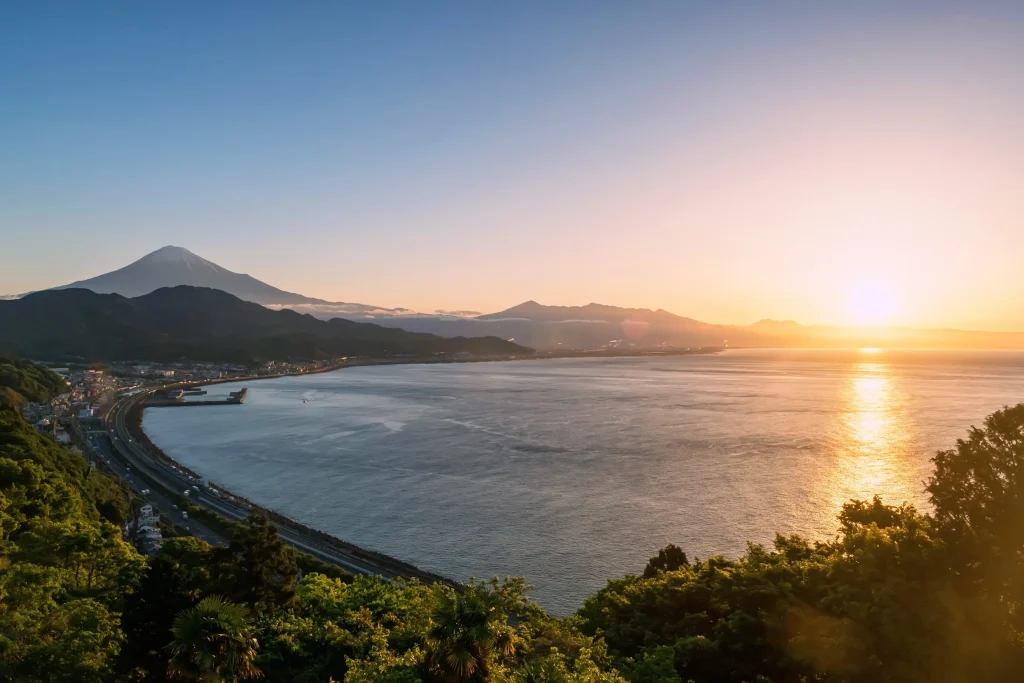
Japan’s name in Japanese, Nihon, literally translates to “origin of the sun,” and that connection is not just etymology; watching the sunrise here carries a cultural weight that goes well beyond a nice photo opportunity. This guide covers where to see the best sunrises in Japan, from a 3,776-meter volcano summit to a city rooftop, along with the actual times you need to know before setting an alarm.
Why the Sunrise Matters So Much in Japan
In Shinto belief, the sun goddess Amaterasu sits at the top of the pantheon as the mythological ancestor of Japan’s imperial family, which gives the daily sunrise a symbolic weight rarely attached to it elsewhere. That weight becomes most visible on January 1st, when the tradition of Hatsuhinode, or “first sunrise,” draws crowds to beaches, mountains, and rooftops across the country. According to Shinto belief, Toshigami, the deity of the new year and harvest, arrives with that first light, and watching it while making a wish is thought to carry the wish through the coming year.
Understanding this background changes what a sunrise in Japan actually is: not simply good light for a photograph, but a moment with roughly 1,200 years of continuous cultural meaning behind it, dating back to court nobility greeting the new year at dawn during the Heian period (794–1185). That history turns an early alarm into part of a living tradition, not just a chance to catch a view.
Mount Fuji: Japan’s Earliest Sunrise, If You Can Reach It
The summit of Mount Fuji, at 3,776 meters, is the single earliest point to see the sun rise anywhere across Japan’s four main islands, and the sunrise viewed from there has its own name, goraiko, distinct from an ordinary sunrise. Because Fuji’s climbing season runs only from early July to early September, and sunrise times shift by more than 30 minutes across that window (from around 4:30 a.m. in early July to roughly 5:15 a.m. by late August), checking the specific date’s sunrise time before planning an overnight climb is essential rather than optional.
Standing on the crater rim above a sea of clouds as the sun clears the horizon, with the mountain’s own shadow stretching for kilometers across the landscape below, is an experience genuinely different from viewing Fuji from a distance. The Yoshida Trail is generally recommended for first-time climbers specifically because it has the most mountain huts and the clearest markings, giving climbers the flexibility to rest partway up and still reach Kengamine, the true summit point, in time for sunrise.
Read more: Beyond the View: What to Do Around Mt. Fuji in 2026
Cape Inubosaki: The Earliest Sunrise on Mainland Flat Ground
For travelers who want an early sunrise without climbing a volcano overnight, Cape Inubosaki in Choshi City, Chiba Prefecture, is recognized as the location where the sun rises earliest of anywhere on Japan’s mainland flatlands, thanks to its position at the easternmost point of the Kanto region. A 19th-century lighthouse, built in 1874, still stands directly on the cape, and watching its white tower catch the first light as the sun clears the Pacific Ocean, with no landmass blocking the horizon, is a specifically different visual from a mountain or lake sunrise.
Access is straightforward: the Choshi Electric Railway runs to Inubo Station, from which the cape is roughly a 10-minute walk, and extra trains run on the morning of January 1st specifically to accommodate Hatsuhinode crowds. On New Year’s Day, the sun typically rises at Inubosaki around 6:45 to 6:46 a.m., a detail worth confirming against that year’s exact tables before setting out in the dark.
Diamond Fuji: Sunrise and Mountain in a Single Frame
Among the Fuji Five Lakes, Lake Motosu and Lake Shoji offer two distinct versions of a Fuji sunrise. At Lake Shoji, the lake’s stillness produces a mirrored reflection of the mountain as the sun rises behind it, doubling the scene on the water’s surface. At Lake Motosu, visitors gather each January 1st specifically because the sun rises from a position that lines up almost exactly with Fuji’s peak, an alignment locally called “Diamond Fuji” for the brief, brilliant point of light it creates at the mountain’s summit.
Because this precise alignment depends on both the calendar date and the exact viewing position along the lakeshore, arriving with enough time to find the correct spot, and confirming the expected date range for that year’s alignment, makes the difference between witnessing the diamond effect and simply seeing an ordinary lake sunrise with Fuji in the background.
Where to Watch Sunrise in Tokyo
Tokyo offers a wider range of sunrise settings than its skyline might suggest, spanning coastline, mountains, and rooftops within the same metropolitan area. Kasai Rinkai Park, on Tokyo Bay’s eastern edge, is a comparatively quiet option where the sun rises directly over the water, in view of Tokyo Disneyland’s Cinderella Castle from certain angles, and is reachable directly from Tokyo Station via the Keiyo Line. Odaiba, the artificial island in Tokyo Bay, pairs a similar coastal sunrise with the Rainbow Bridge as a foreground element, best viewed from Odaiba Seaside Park’s promenade.
For a rooftop alternative, Tokyo Skytree and Tokyo Tower both host sunrise viewing, and Roppongi Hills’ Tokyo City View observation deck, on the 52nd floor, adds an additional outdoor Sky Deck for an unobstructed view when weather cooperates. Travelers who prefer a natural setting without leaving Tokyo’s administrative boundary can head instead to Mount Takao or Mount Mitake in the city’s western mountains, where sunrise is viewed from forest trails rather than skyscrapers, a genuinely different register of the same event.
Where to Watch Sunrise in Osaka
Osaka’s sunrise viewing centers on its two tallest observation decks rather than a coastal or mountain setting. The Kuchu Teien Observatory, atop the Umeda Sky Building, sits 173 meters above ground and offers both an open-air rooftop and a more sheltered indoor viewing floor, with the sun rising over the distant Ikoma mountain range to the east. Harukas 300, atop Osaka’s tallest building, offers a comparable high-altitude view from the opposite side of the city.
Both locations run limited-capacity, ticketed sunrise events on January 1st specifically, with tickets released online roughly two to three weeks ahead and known to sell out quickly; for a sunrise visit at any other time of year, both towers keep their standard observation-deck hours, which do not include pre-dawn access, so a January 1st ticket or a private arrangement is generally required to see the sun actually rise from either building.
Beyond the Golden Route: Quieter Sunrise Spots
For travelers who have already covered Tokyo, Fuji, and Osaka on a previous trip, a handful of less-visited spots offer the same emotional payoff with a fraction of the crowds. Yoshiminedera Temple, perched on Mount Nishiyama southwest of Kyoto and established in 1029, looks east over the Higashiyama mountain range, giving the sunrise a temple silhouette in the foreground rather than a city skyline or open water. On the opposite side of the country, Jodogahama in Iwate Prefecture sits at the easternmost point of Honshu, where white rock formations frame a sunrise over the open Pacific with almost none of the crowds found at Chiba’s more famous capes.
Bandokorobana Nature Park, at the southern tip of Kyushu in Kagoshima Prefecture, adds a third regional option entirely: a sunrise silhouetting Mount Kaimon, a symmetrical volcanic cone locally known as “Satsuma Fuji” for its resemblance to Japan’s most famous peak. Together, these three spots make the point that a memorable sunrise in Japan is not limited to the handful of locations that dominate search results and New Year’s news coverage.
What Time Does the Sun Actually Rise in Japan?
Sunrise times in Japan swing dramatically across the year and shift measurably even within the same country on the same date, which surprises many first-time visitors. In Tokyo, the sun rises as early as around 4:30 a.m. at the height of summer and as late as roughly 7:00 a.m. in the depths of winter, a difference of two and a half hours across the calendar. Because Japan spans a meaningful range of longitude despite using a single time zone, eastern locations such as Chiba’s Inubosaki see sunrise measurably earlier than western cities like Osaka on the exact same date, typically by 15 to 25 minutes depending on the specific locations compared.
For any sunrise trip, checking the exact date’s sunrise time for the specific location, rather than relying on a general seasonal estimate, is the difference between arriving with time to find a good spot and arriving to find the sun already above the horizon. Japan’s National Astronomical Observatory publishes detailed sunrise tables, including a dedicated New Year’s timetable, though the tool is Japanese-language only.
Getting the Photo: Practical Tips for Shooting Sunrise
Arriving 30 to 45 minutes before the listed sunrise time captures the pre-dawn color shift, the deep blues and violets that build before the sun itself appears, which often produces more distinctive images than the moment of sunrise alone. At coastal and lake locations specifically, the stillest air and calmest water typically occur in the final hour before sunrise, making that window the most reliable time for the kind of mirror-flat reflections seen in Lake Shoji’s classic Fuji photographs.
A tripod matters more for sunrise than for most daytime photography, since the light levels in the 20 minutes before the sun clears the horizon are low enough that handheld shots often come out softer than intended. For crowded, ticketed locations such as the Umeda Sky Building’s New Year’s event, arriving at the building well before the listed opening time secures a clearer, less obstructed spot along the railing than arriving closer to the stated start.
Pick one sunrise from this list that matches your itinerary and the season you’re traveling in, check that specific date’s exact sunrise time before you go, and set your alarm early enough to catch the color building before the sun itself appears.