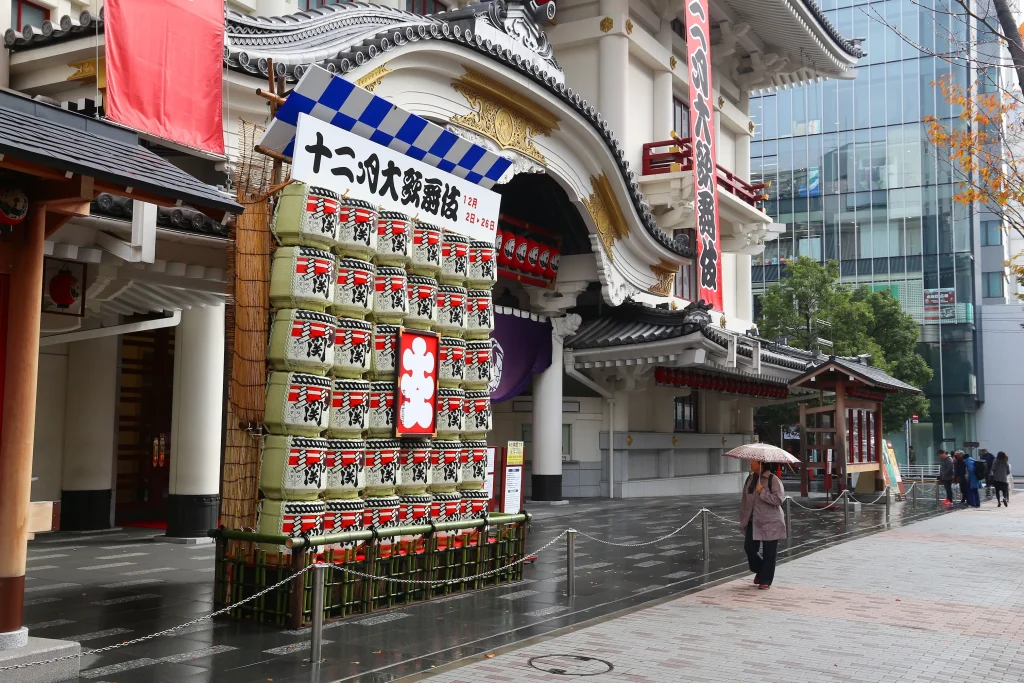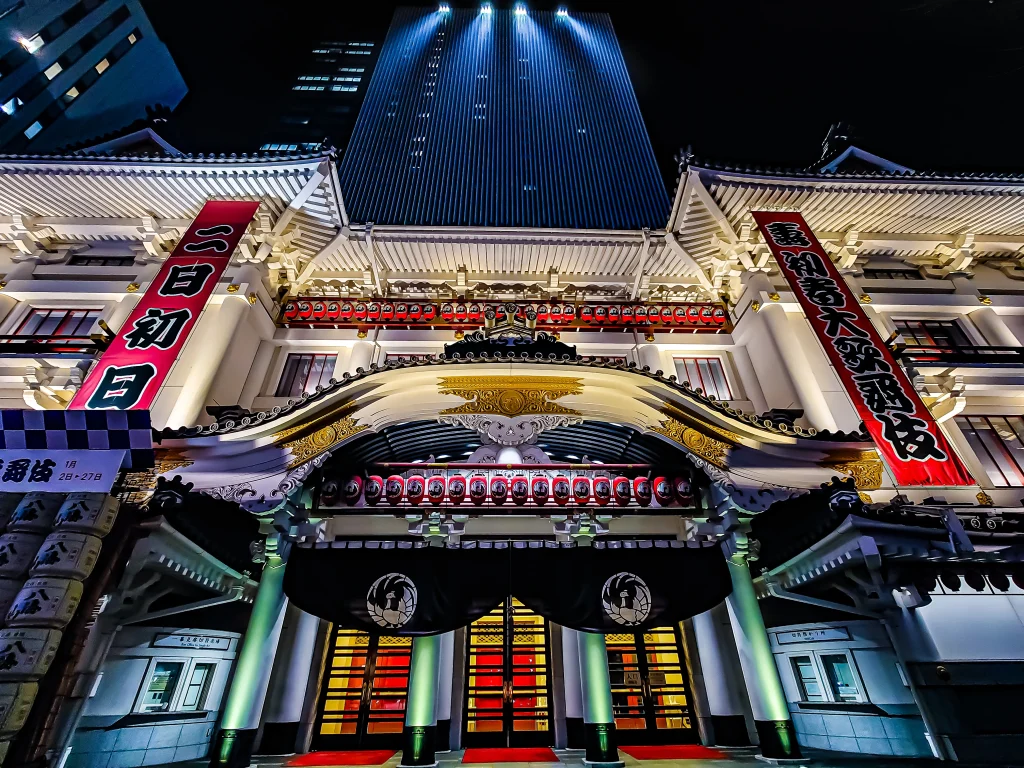
When an evening opens in Tokyo and kabuki comes to mind, begin not with a famous title but with the date already written in your itinerary. At Kabukiza Theatre in Ginza, the programme changes each month, so the practical question is whether a performance fits the days and hours of your stay.
Kabukiza presents kabuki every month, usually for around 25 days. The plays, cast, start times and dark days—scheduled days without a performance—change with each programme. This guide shows how to match your travel dates with the official schedule, choose between a full performance and a Single Act, use English support, and prepare a second option if your first choice does not work.
A kabuki visit can take the centre of an afternoon or evening, but it does not need to occupy every hour of your day. With the right timetable, it may be a full programme with intervals, one selected act before dinner, or a special production that changes the pace of a day in Ginza.
Kabuki in Tokyo: Check Your Travel Date First
Before choosing a play, actor or seat, confirm whether kabuki is performed on the dates you will actually be in Tokyo. The monthly schedule is the starting point for every other decision.
Kabukiza Has Performances Every Month
Kabukiza Theatre presents kabuki throughout the year. A monthly programme usually runs for around 25 days, although it does not include a performance on every calendar day. Dark days may fall during the run, and the next programme then begins with a new selection of plays, dances and performers.
This is a repertory theatre rather than a long-running production that repeats the same show every night. Actors work across a large body of inherited plays and dances, while the theatre prepares a new programme each month.
For travellers, this has one clear consequence: do not rely on a general opening-hours listing or an old travel guide. Check the official page for the specific month of your visit.
Performance Days and Times Change Each Month
The structure of the day is not fixed. Some programmes use a matinee, meaning a daytime performance, and an evening show. Others divide the day into three separately ticketed parts.
For example, Kabukiza’s October 2026 programme runs in three parts, beginning at 11:00, 14:30 and 18:00. The November 2026 programme uses a matinee at 11:00 and an evening show at 16:30. The contrast shows why a monthly check matters: even the format of a theatre day can change.
When reading the official schedule, check these four details:
- Performance dates
- Dark days
- Start and expected finish times
- Ticket availability and ticket type
The finish time matters almost as much as the start time if you have a restaurant reservation, an intercity train or another evening plan.
Current and Upcoming Kabukiza Schedule
The table below reflects official information checked on 30 September 2026. It is a planning aid, not a replacement for the live KABUKI WEB schedule.
|
Month |
Performance dates | Format / start times | Dark days |
Ticket sale date |
|
October 2026 |
2–20 October | Part 1: 11:00; Part 2: 14:30; Part 3: 18:00 | 9 October | From 14 September, 10:00 JST |
|
November 2026 |
1–25 November | Matinee: 11:00; Evening Show: 16:30 | 9 and 17 November | Scheduled to go on sale on 14 October, 10:00 JST |
|
December 2026 |
2–25 December | To be announced | 9 and 17 December | To be announced |
Specific dates, times, ticket conditions and availability can change. Confirm the official KABUKI WEB listing before booking.
Full Performance or Single Act? Choose by Your Travel Style
There is no single correct way to attend kabuki. A full performance and a Single Act use your time differently, and both can suit a first visit.
Full Performance — For a Longer Theatre Experience
A full programme at Kabukiza usually lasts around three to four hours, including intervals. It may combine several plays, dance pieces and dramatic scenes in one sitting. This format gives you the clearest sense of how a kabuki programme changes its pace over the course of an afternoon or evening.
Choose a full performance if you have a substantial block of time and would like to experience the intervals as well as the stage itself. Check the finish time before booking. A matinee that ends in late afternoon creates a different itinerary from an evening show that ends after dinner time.
If you want a specific date, seat category or adjacent seats for companions, advance booking is the sensible option.
Single Act — For a Shorter First Visit
A Single Act Ticket lets you watch one selected act or scene rather than the whole programme. It is not a reduced version of kabuki. It is a different scale of theatre visit.
Under current arrangements, Kabukiza offers advance reserved Single Act options and same-day non-reserved seats on the fourth level, the upper gallery level of the theatre. Eligible acts, prices and sales conditions vary by programme, so check the official monthly Single Act notice before leaving your hotel.
Single Act ticket prices vary by act and seat type. For October 2026, fourth-level seats cost 1,500–4,000 yen per act, while upgraded second-level seats have separate, higher prices. Check the monthly notice for the act you want before travelling to the theatre.
The duration can also vary widely, from a short dance to a longer dramatic act. This makes a Single Act useful when a museum entry time, dinner reservation or intercity transfer leaves only a limited theatre window. It can also be a focused way to watch one entrance on the hanamichi, a raised passage through the audience, one dance or one highly stylised scene.
|
Choice |
Best for | Typical commitment | Booking approach |
Check before going |
|
Full performance |
Travellers who want several plays, dances and intermissions | Around 3–4 hours; check the monthly timetable | Advance booking for a fixed date or preferred seat | Finish time, seating level, captions |
|
Single Act |
A first visit, limited time or one selected scene | Varies by act; check the monthly notice | Advance reserved and same-day fourth-level options may be available | Eligible act, price, sale method, captions |
Tickets, English Support and What to Expect
Once you know your dates and preferred format, the remaining questions are practical: when tickets go on sale, how English support works, and what to watch when the dialogue is difficult to follow.
When Do Tickets Go on Sale?
At Kabukiza, tickets for the following month often go on sale around the 14th of the preceding month, commonly at 10:00 JST. October 2026 tickets, for example, went on sale on 14 September, while November tickets are scheduled to go on sale on 14 October. This is a useful pattern, but it is not a universal rule for every venue or every programme.
Check the “On sale” information on the official monthly page. If you need a particular date, seat grade or adjacent seats, look soon after sales open. If your travel dates are flexible, compare more than one performance part before deciding that a programme is unavailable.
Can You Follow Kabuki Without Japanese?
Kabukiza provides support that can help you follow key dialogue, songs and context. Its captioning service offers essential English or simplified Chinese translations of selected dialogue and lyrics, together with explanatory notes about kabuki.
As of 1 October 2026, captioning-device rental at Kabukiza costs 1,500 yen for a full show or 1,000 yen for a Single Act, payable in cash. Some full-show tickets can also be booked online with captioning for an additional 1,500 yen. Check the booking page for your performance. The printed Japanese programme includes English synopses at the back.
These tools do not translate every word spoken on stage. They work best as part of a wider way of watching: read the synopsis, follow captions when needed, then look back to the actors, costumes, music and stage movement. Very short Single Acts may not offer captioning, so confirm the service for your chosen act.
How Long Should You Allow?
A full performance usually takes around three to four hours, including intervals. The number and length of intervals vary by programme. A Single Act has no interval, and its duration depends entirely on the selected scene.
Check the scheduled finish time, not only the starting time. This is particularly important if you are arranging dinner in Ginza, returning to a hotel outside central Tokyo or catching a train. If a full programme takes more time than your itinerary allows, a Single Act is a valid alternative rather than a failed attempt at the longer format.
Look Beyond the Plot: Three Things to Watch on Stage
Kabuki offers important information beyond spoken dialogue. If the story is unfamiliar, choose two or three stage elements to follow rather than watching the caption screen throughout.
|
Observation point |
What to look for |
What it can show |
| Actor’s movement and pose | The hanamichi is a raised passage through the audience to the main stage. A mie is a held pose that concentrates attention at a dramatic moment. Notice pace, stillness and gaze. | A character’s presence, emotion or change of status |
| Costume and colour | Costumes, wigs and make-up can offer visual clues to a character’s role, status or dramatic type. | Visual clues about role, status and relationships before every detail is clear in dialogue |
| Music and stage mechanics | Shamisen, percussion, flute and narration shape transitions. A revolving stage can change scenery in view of the audience, while a seri is a lift that moves performers or scenery through the floor. | How kabuki joins sound, movement and stagecraft into one performance |
These are three important parts of kabuki’s theatrical language, not decorative additions. They allow a visitor to attend actively even when a line of dialogue passes too quickly to read.
Getting to Kabukiza and Arriving Without Stress
Kabukiza is directly connected to Higashi-ginza Station, but the correct counter depends on whether you hold a full-performance ticket or plan to buy a Single Act ticket. Knowing that distinction before arrival makes the theatre easier to navigate.
A Simple Arrival Plan for First-Time Visitors
Higashi-ginza Station, served by the Hibiya and Asakusa lines, connects directly to Kabukiza via Exit 3. From Ginza Station, Exit A6 is about a five-minute walk.
The main Box Office on Basement Level 2 handles full-performance tickets and ticket collection, but it does not sell Single Act seats. Single Act sales follow separate arrangements, so check the official monthly notice for the correct booking link or sales location before you go.
The theatre usually opens around 30 minutes before the performance begins. Allow enough time to find the right counter, collect a ticket, arrange captioning if available and reach your seat without rushing.
Intermissions, Food and Theatre Etiquette
Full-performance visitors have intervals, while Single Act visitors do not. Plan food accordingly. Kabukiza has restaurants and shops, and the theatre provides opportunities for food and drink during designated breaks. If dining inside the building is important to your plan, confirm current opening hours and availability in advance.
During a performance, follow the theatre’s current guidance on photography, recording and mobile devices. Arrive on time, follow staff instructions and avoid distracting people around you. These familiar theatre rules help the audience hear the music, follow the actors’ movement and watch each scene without interruption.
If Your First Choice Does Not Work
A sold-out performance, a dark day or a timetable clash does not necessarily end the plan. There may still be useful alternatives to check, provided that you rely on current official information.
Scenario 1 — Your Preferred Full Performance Is Sold Out
- Plan A: Check another part of the day, another seat category or another date in the same programme run.
- Plan B: Check the month’s Single Act notice. In November 2026, for example, Kabukiza announced that fourth-level Single Act seats would still be available on dates when some reserved full-performance seats had sold out. This is a current example, not a permanent rule.
- Plan C: Check official listings for Shinbashi Enbujo or Japan Arts Council kabuki performances at alternative venues.
An online “sold out” notice may not always be the final answer. Kabukiza’s official page advises visitors to contact the promoter or visit the box office to check availability for preferred dates or seat areas. Do not rely on this as a guarantee, but it is worth checking before abandoning a fixed date.
Scenario 2 — Your Date Falls on a Dark Day
- Plan A: Check the previous and following performance dates at Kabukiza.
- Plan B: Check the Shochiku schedule for Shinbashi Enbujo or another theatre.
- Plan C: Check the Japan Arts Council calendar for kabuki at alternative venues.
A Kabukiza dark day does not mean that kabuki has disappeared from Tokyo. It also does not mean that another venue will definitely have a performance. The safe approach is to compare official calendars rather than making a same-day assumption.
If rain, heat or a storm changes an outdoor plan, an available theatre performance may provide an indoor alternative. Check transport conditions and theatre notices on the day, especially during severe weather.
Scenario 3 — A Full Performance Does Not Fit Your Itinerary
- Plan A: Choose a Single Act.
- Plan B: Compare another part, matinee or evening performance.
- Plan C: Move the theatre visit to another day and use the original time for another indoor cultural activity in Ginza.
A Single Act lets you focus on one scene, one actor, one dance or one piece of stagecraft. That can be useful when a museum entry time, dinner reservation or hotel transfer limits the time available for a theatre visit. It is a different arrangement of the day, not a lesser cultural experience.
The Kabuki Year: Signature Seasons and Annual Traditions
Once the practical details are in place, the annual programme names offer a deeper way to read the calendar. They do not guarantee the same plays every year, but they preserve the cultural memory of kabuki’s changing seasons.
January — New Year Kabuki
January’s Kotobuki Hatsuharu Grand Kabuki carries a New Year character. Kotobuki refers to celebration, while hatsuharu means the first spring or New Year season.
In Edo-period kabuki, Soga-mono, plays connected with the Soga brothers’ vendetta, became a customary New Year subject. The January 2026 programme included works related to this tradition. That does not mean every January will stage the same Soga play. It means that the New Year programme can still carry the memory of an older theatrical custom.
May — Danjiku Festival May Grand Kabuki
The Danjiku Festival May Grand Kabuki honours the ninth Ichikawa Danjuro and the fifth Onoe Kikugoro. “Dan” and “Kiku” come from their names.
The festival began in 1936, returned in 1958, and became a regular May programme from 1985. Its name helps a visitor see one of kabuki’s central ideas: roles, stage names and performance styles pass between generations of actors. The plays themselves vary, but the festival title gives the month a clear historical frame.
Summer — July and August Programmes
Kabukiza continues its monthly cycle through July and August. Summer programmes vary in their plays, casts and performance structure, so the official listing for the year of your visit is more useful than a fixed expectation about the season.
The practical advantage is flexibility. If the monthly timetable fits your plans, a daytime or evening performance can sit within a Tokyo itinerary without requiring you to predict the content of the programme months in advance.
September — Shuzan Festival
The Shuzan Festival takes its name from Shuzan, the artistic name of the first Nakamura Kichiemon. The festival began in 2006 to honour his art and preserve its connection with later generations.
The 2026 programme marks the festival’s twentieth edition and the 140th anniversary of Nakamura Kichiemon I’s birth. Kabuki does not preserve these plays as fixed objects: actors inherit roles and methods, then perform them for new audiences. The festival’s name draws attention to that living tradition.
October and November — Autumn Programmes and Kaomise
The title Kinshu October Grand Kabuki refers to the rich, brocade-like colours associated with autumn. It signals the season in the theatre calendar, rather than guaranteeing a particular type of play.
The November title Kaomise means “face-showing”. Historically, it referred to the period when a theatre introduced the actors appearing in its company for the coming season. Modern Kabukiza does not operate through that historical employment system, but the name remains as a link with theatre history.
Tokyo’s November programme should not be confused with Kyoto’s December Kaomise at Minamiza.
December — Year-End Kabuki
Kabukiza’s November programme may carry the name Kaomise, but the theatre continues its monthly calendar with a separate December programme. The plays, timetable and ticket sale date are announced through the usual official channels.
If you have a preferred December date or seat, check the relevant programme page as soon as it is published. Do not assume that the previous month’s format will continue into December. In 2026, the December programme runs from 2 to 25 December, with dark days on 9 and 17 December.
2026 Special Highlight — Super Kabuki “Princess Mononoke”
Super Kabuki is staged as a special production rather than a fixed monthly programme. It combines kabuki acting and visual language with contemporary stage techniques, which can include projections and wire action.
In 2026, Princess Mononoke ran at Shinbashi Enbujo from 3 July to 23 August. Travellers familiar with the Studio Ghibli story may arrive with a narrative foundation, then focus on how actors, costumes and stagecraft transform that story for live theatre. This does not make the performance automatically simpler than classical kabuki; it gives the audience a different starting point.
If Your Trip Continues to Kyoto — Minamiza Kaomise
For travellers continuing to Kyoto in December, Minamiza’s Kaomise is a separate seasonal option. In 2026, it runs from 1 to 24 December, with no performances on 9 or 17 December. The matinee begins at 10:30, the evening show at 16:00, and ticket sales are scheduled to open on 9 November. Confirm the official Minamiza page before adjusting your Kyoto plans.
Treat this as part of a Kyoto stay, not as a day trip from Tokyo or a substitute for a Kabukiza dark day.
Beyond Kabukiza: Other Places to Check
Kabukiza is the practical first place to check, but Tokyo’s kabuki calendar extends beyond one theatre. Special productions and Japan Arts Council performances may provide additional options.
Shinbashi Enbujo
Shinbashi Enbujo does not follow Kabukiza’s monthly kabuki cycle. Instead, it can host special productions and large-scale projects.
Super Kabuki Princess Mononoke was presented there in 2026. If your dates are flexible, check Shinbashi Enbujo alongside Kabukiza rather than assuming that every important kabuki production appears on the same stage. Future titles, venues and formats will differ.
National Theatre Performances During Reconstruction
The original National Theatre building closed for redevelopment at the end of October 2023. The Japan Arts Council continues to present traditional performing arts, including kabuki, at alternative venues during the redevelopment period.
The New National Theatre, Tokyo is a different institution and building. From 1 to 20 October 2026, the Japan Arts Council presents a kabuki performance there at the Playhouse. This production has an English audio guide and an English synopsis, but no subtitles. Check the Council’s official page for its dates, dark day, venue and ticket conditions rather than relying on an older guidebook.
The useful point for a traveller is simple: the original building is closed, but Japan Arts Council kabuki productions continue elsewhere.
Kabuki Schedule FAQ
How much are kabuki tickets in Tokyo?
Kabukiza ticket prices depend on the programme, seating level and ticket type. Full-performance tickets vary by seat grade. In October 2026, fourth-level Single Act seats cost 1,500–4,000 yen per act; upgraded second-level seats cost more. Confirm the monthly notice before booking.
How long is a kabuki performance?
A full Kabukiza programme usually takes around three to four hours, including intervals. A Single Act may be much shorter or substantially longer, depending on the selected scene. Check the official timetable for both the start and expected finish time.
Can you watch only one act of kabuki?
Yes. Kabukiza offers Single Act tickets for selected scenes. Under current arrangements, advance reserved options and same-day fourth-level, upper-gallery seats may be available. Eligible acts, prices and sales conditions vary by programme.
Can you follow kabuki without speaking Japanese?
Kabukiza offers English or simplified Chinese captioning, and its printed programme includes English synopses. These resources provide key dialogue and context, rather than a complete word-for-word translation.
Fitting Kabuki Into Your Tokyo Itinerary
The most dependable way to plan kabuki is to work from your travel date outward. Check the official Kabukiza programme, note the dark days and finish time, choose a full performance or Single Act, then confirm ticket conditions and English support.
A full programme can shape an afternoon or evening. A Single Act can sit between a Ginza meal, a museum booking or a hotel transfer. Neither choice asks you to prove how much you already know about kabuki; it asks only that you give the theatre the time that suits your journey.
If you would like a Kabuki performance to sit naturally beside a Ginza dinner, a hotel transfer, an indoor plan for wet weather or a later journey to Kyoto, ENJYU JAPAN can help shape those details into one considered itinerary. The aim is not to add another booking to your list, but to give the theatre the right place within the journey.
Choose the performance that fits your day, then leave a small part of the evening unclaimed; Ginza is often most interesting when it still has room to surprise you.
References
- 松竹/KABUKI WEB – October Program at the Kabukiza Theatre (2026)
- 松竹/KABUKI WEB – November Program at the Kabukiza Theatre (2026)
- 松竹/KABUKI WEB – December Program at the Kabukiza Theatre (2026)
- 松竹/KABUKI WEB – Single Act Tickets at Kabukiza, October 2026
- 松竹/KABUKI WEB – Single Act Tickets: Purchase Conditions
- 松竹/KABUKI WEB – Service for International Visitors: Captions and English Synopses
- 松竹/KABUKI WEB – Enjoy Your Theatregoing: Tickets, Duration and Theatre Etiquette
- 松竹/KABUKI WEB – Kabukiza Theatre Information: Access and Box Offices
- 松竹/KABUKI WEB – Performances Throughout the Year: Kabukiza’s Monthly Cycle
- 松竹/歌舞伎美人 – 秀山祭九月大歌舞伎(2026年)
- 松竹 – スーパー歌舞伎『もののけ姫』(2026年)
- 松竹/歌舞伎美人 – 南座「吉例顔見世興行」(2026年)
- 日本芸術文化振興会 – 国立劇場:再整備中の代替会場公演
- 日本芸術文化振興会 – Kabuki Performance in October 2026: Venue, Dates and Language Support
- 松竹/KABUKI WEB – Unique Stage Structures and Dynamic Stage Sets