When a curious mind asks how old sumo truly is, the honest answer refuses to settle on a single figure. Its origin stories reach back to gods, harvest prayers and a legendary duel, while its recorded history runs through the imperial court, Edo-period shrine grounds and the modern Kokugikan.
Legend tells one part of the story; records and institutions reveal another. Follow that path carefully, and the salt, stamping and silence before a bout begin to make sense in ways that a simple date never could.
How Old Is Sumo, Really?
Sumo’s age can be measured in more than one way: through origin traditions, surviving written records and a cultural history of more than 1,500 years.
The claim that sumo is roughly 2,000 years old draws on origin stories set in Japan’s legendary past. The Kojiki, compiled in 712, and the Nihon Shoki, compiled in 720, preserve early accounts of contests of strength. Those dates mark the compilation of the surviving chronicles, not the dates of the contests they describe.
The Japan Sumo Association describes sumo as a tradition with more than 1,500 years of history. That history can be traced through harvest rites, court ceremonies, warrior patronage, Edo-period public tournaments and modern institutions. The figures answer different questions. One reaches into origin tradition, while the other describes a cultural history shaped by practice and organisation.
This article focuses mainly on professional sumo in Japan and the traditions that shaped it. Sumo is also practised as an amateur sport in Japan and abroad, but professional sumo has its own ranks, stables, calendar and governing organisation.
Sumo History at a Glance
|
Period |
Turning point |
|
Mythic age |
Contests of strength appear in origin stories |
|
712 and 720 |
The Kojiki and Nihon Shoki preserve early sumo traditions |
|
Eighth century |
Court sumo becomes an annual imperial ceremony |
|
Medieval Japan |
Warrior rulers patronise and use sumo |
|
1684 |
Licensed kanjin-zumo is held at Tomioka Hachimangu |
|
1909 |
The first Ryogoku Kokugikan opens |
|
1925–1952 |
Modern administration, starting lines and the suspended roof take shape |
|
Today |
Professional sumo continues through scheduled grand tournaments in Japan |
Gods, a Duel, and a Harvest Prayer
The earliest sumo stories are not match reports. They show how people in early Japan used contests of strength to explain authority, ritual and the relationship between communities and the divine.
The Kojiki, a record of Japanese myth and early history compiled in 712, includes a contest between gods connected with the transfer of land and authority. The Nihon Shoki, an official chronicle completed in 720, records a different human story: a legendary duel between Nomi no Sukune and Taima no Kehaya. Kehaya boasts that no one can equal his strength. Nomi no Sukune is summoned to face him before the emperor and wins the contest.
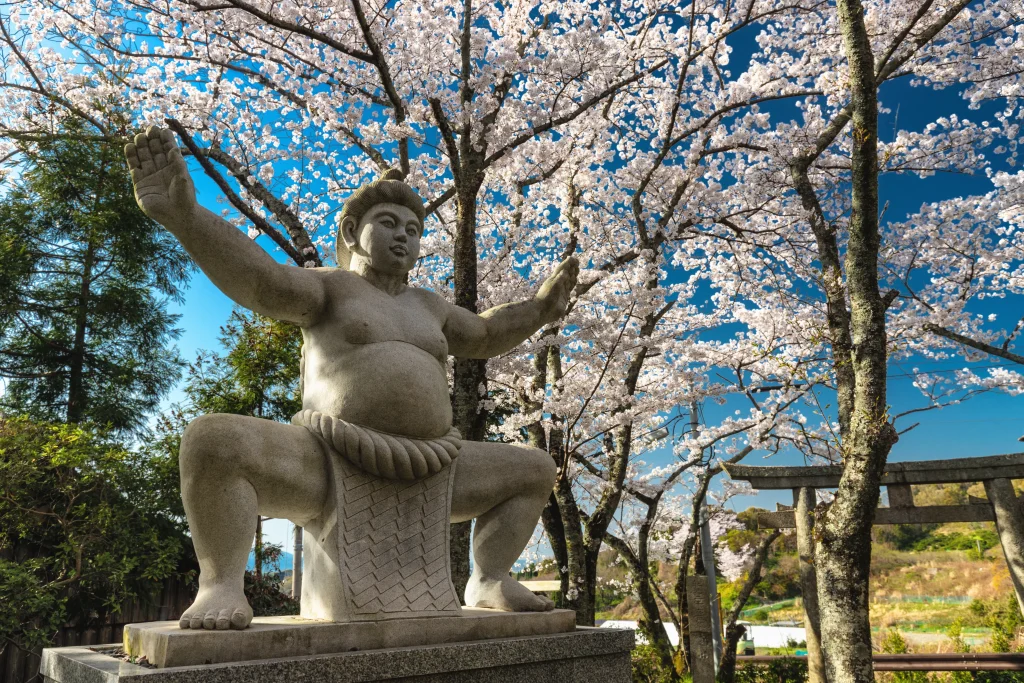
Nomi no Sukune later came to be honoured as a revered figure in sumo tradition. That does not make him the first historically documented professional wrestler. The account is an origin tradition, recorded centuries after the time in which the story is set. Katsuragi City in Nara Prefecture preserves this tradition as part of the local history associated with Taima no Kehaya.
Another strand of early sumo was tied to agriculture. Communities held bouts as part of rites intended to read the prospects for the harvest and pray for abundance. These practices linked strength with shrine observance, seasonal change and communal hopes.
Sumo should not be reduced to a “Shinto sport”. It does, however, have a long ritual background associated with shrine rites, offerings, purification and prayers for a good crop. You do not need to treat the legends as literal history to understand why ritual remains important in sumo today.
From Court Ceremony to Warrior Training
Sumo did not remain only a local rite. It moved into the imperial court, where it acquired a formal occasion, an elite audience and a more ordered place in the calendar.
From the eighth century, wrestlers were gathered from the provinces to perform before the emperor. The annual event became known as sumai no sechie, a court ceremony in which selected wrestlers appeared before the imperial household. The tradition continued for about 300 years. Court patronage gave sumo a set occasion, formal sequence and organised audience.
When political power shifted towards warrior governments, sumo found another purpose. From the Kamakura period through the age of civil war, warriors valued it as physical training. Powerful patrons staged bouts as displays of strength and skill.
Oda Nobunaga gathered wrestlers from different regions for tournaments held in his presence. The setting had changed again: from agricultural rite to court ceremony, then to an activity supported by the warrior class. Each stage gave sumo a different setting, while ritual order, physical technique and formal presentation continued to matter.
Edo and the Birth of Sumo as Public Entertainment
The Edo period, from 1603 to 1868, brought the decisive change towards recognisable professional sumo. Organisers, wrestlers and spectators turned an older practice into part of urban entertainment culture.
Kanjin-zumo and the Turning Point of 1684
One important form was kanjin-zumo: sumo events held to raise funds, often for the construction or repair of temples and shrines. These gatherings attracted crowds, but early events could also bring disputes and disorder. Authorities sometimes restricted or prohibited them.
A major turning point came in 1684, when an officially licensed kanjin-zumo event was held at Tomioka Hachimangu in Fukagawa, now part of eastern Tokyo. Approved events helped create a more stable basis for rules, organisation and repeated public tournaments.
Tomioka Hachimangu remains closely associated with this history. It is located in Fukagawa, distinct from Ryogoku, so travellers should treat the two as separate stops when exploring Tokyo’s sumo history.
Professional Wrestlers and Edo Spectator Culture
As regular tournaments developed, wrestlers could pursue sumo as a profession. The heya system organised wrestlers into stables where they lived and trained. The banzuke, a ranking sheet issued before each tournament, made the sport’s hierarchy visible to spectators.
Popular wrestlers became public figures. Tanikaze, Onogawa and Raiden were among the celebrated names of the late eighteenth and early nineteenth centuries. Woodblock prints carried their images beyond the tournament grounds, much as sporting portraits and media coverage do today.
Other familiar elements developed over time or took recognisable form within this commercial world. These included ring-entering ceremonies, ceremonial kesho-mawashi aprons, topknots and the prominent role of the gyoji, the referee in traditional robes. They form part of the visual language through which Edo spectators understood rank, ceremony and spectacle.
Becoming Modern: Kokugikan, the Association, and the Shape of Today’s Sumo
Modernisation gave sumo’s established forms new venues, clearer administration and wider audiences. Permanent arenas, national organisation and timed preparation reshaped the sport while preserving much of its ceremonial character.
From Temporary Venues to the Kokugikan
For much of its history, sumo depended on temporary venues, often in temple or shrine grounds. The first Ryogoku Kokugikan opened on 2 June 1909, giving sumo a permanent home in Tokyo.
Later moves took sumo to Kuramae in 1954 and back to a new Ryogoku Kokugikan in 1985. The building visitors see today is therefore the latest in a sequence of dedicated Tokyo venues.
Rules, Administration, and a Changing Ring
The organisation became more unified in the twentieth century. The Dai-Nippon Sumo Association was established as an incorporated foundation in 1925. The Tokyo and Osaka associations merged in 1927. In 1928, officials introduced time limits for shikiri, the repeated crouching preparation before the charge, and the two white starting lines.
In 1952, four pillars supporting the roof above the dohyo, the raised clay ring, were removed to improve sightlines. A suspended roof and four coloured tassels took their place. This apparently traditional scene is therefore also a piece of twentieth-century venue design.
Wrestlers born outside Japan have become important figures in professional sumo. Their success broadened the range of people shaping its history, while the sport remained rooted in Japanese institutions and cultural practices. Sumo has endured by shaping how change enters the ring.
The Rituals You Still See Before a Bout
The history becomes clearest in the minutes before the wrestlers collide. Purification, physical preparation, performance and modern regulation all share the same small area of clay.
Purification and Preparation
Before bouts in the two highest divisions, wrestlers may scatter salt over the ring. The gesture is commonly understood as a form of purification linked to sumo’s ritual background. Its white arc also creates a pause before the wrestlers return to the centre.
Each wrestler performs shiko, the high leg-lifting and stamping exercise. It develops balance, displays control and strengthens the legs. Sumo tradition associates the stamp with pressing harmful forces into the ground. Its practical and symbolic meanings sit beside one another.
You may also see chikara-mizu, or “power water”, and chiri-chozu, a gesture in which wrestlers open their hands to show that they carry no weapon. During shikiri, repeated crouching, eye contact and measured returns to the corners gradually build tension before the charge.
A Ring Shaped by History
Ceremony extends beyond the two competitors. During the dohyo-iri, or ring-entering ceremony, top-division wrestlers appear in richly decorated kesho-mawashi. The gyoji directs the bout and indicates the winner while wearing layered traditional robes.
Above them, the suspended roof and four tassels recall the pillars removed in 1952. The Japan Sumo Association recognises 82 kimarite, or winning techniques.
For practical guidance on tournament dates, tickets, seating and first-time etiquette, see our guide: Grand Sumo Tournament 2026: Schedule, Tickets & How to Watch
Why Sumo Feels Different When You See It in Japan
Short highlight clips preserve decisive action but compress much of the preparation. Inside an arena, the bout begins to gather weight before either wrestler charges.
You hear feet strike the clay during shiko. The yobidashi, or caller, announces each name, and the crowd grows more attentive as the wrestlers approach the starting lines. Salt falls across the sand, the wrestlers return to their corners and the gyoji keeps the sequence moving. A bout may end within seconds, but the controlled waiting gives those seconds their force.
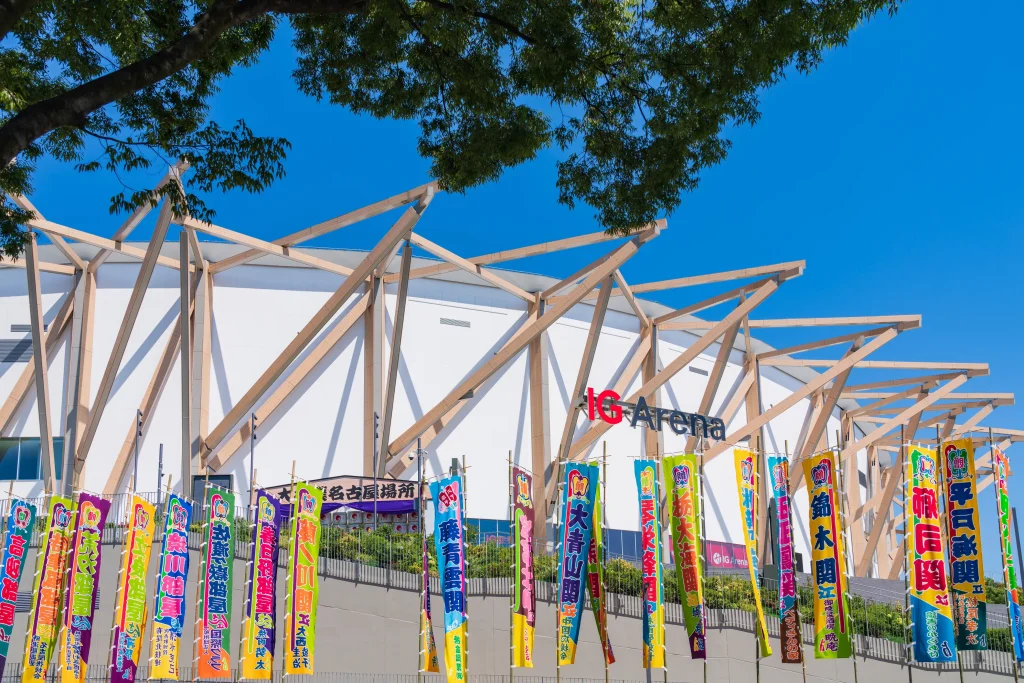
Japan holds six grand tournaments each year: three in Tokyo and one each in Osaka, Nagoya and Fukuoka. Check the Japan Sumo Association’s English schedule and ticket pages before fixing accommodation or intercity travel. If your dates do not match a grand tournament, a regional jungyo exhibition tour offers a different way to encounter professional sumo. Programmes vary by venue and year, so check the current information published for that event before making plans.
If weather or transport changes a Tokyo plan, the Sumo Museum at Ryogoku Kokugikan can offer an indoor historical alternative. Check the official page before visiting, as opening arrangements, exhibition content and entry conditions can change.
Sumo stables are working and residential spaces, not general visitor attractions. Attend training only through an officially publicised or properly arranged opportunity; an unannounced visit is neither reliable nor respectful.
A Short Bout, a Long History
Sumo’s age is not contained in one number, and its history is not confined to a museum case. It remains visible in salt on clay, a referee’s formal call and a roof redesigned for modern spectators.
If you are building a journey around a tournament, a thoughtfully paced route can place it within the host city, its season and the cultural experiences that matter to you. ENJYU JAPAN can help shape that balance.
Between the salt and the silence, the ring often reveals more to those who know where to look.
References