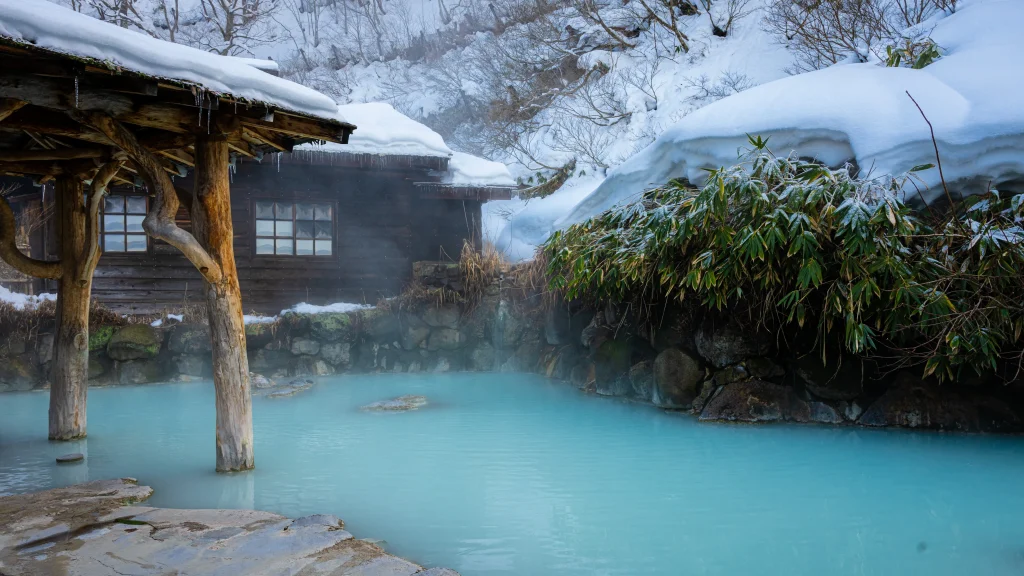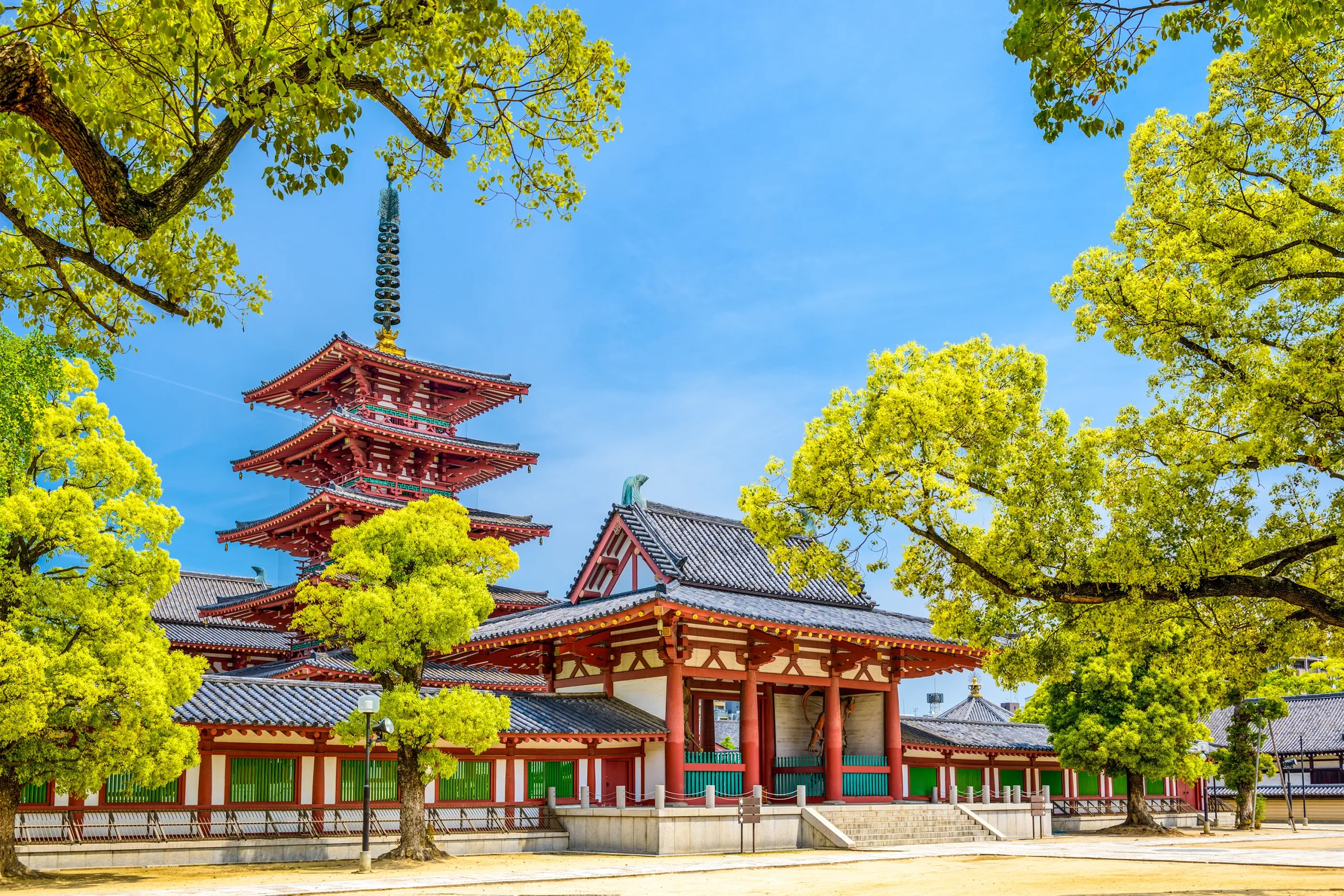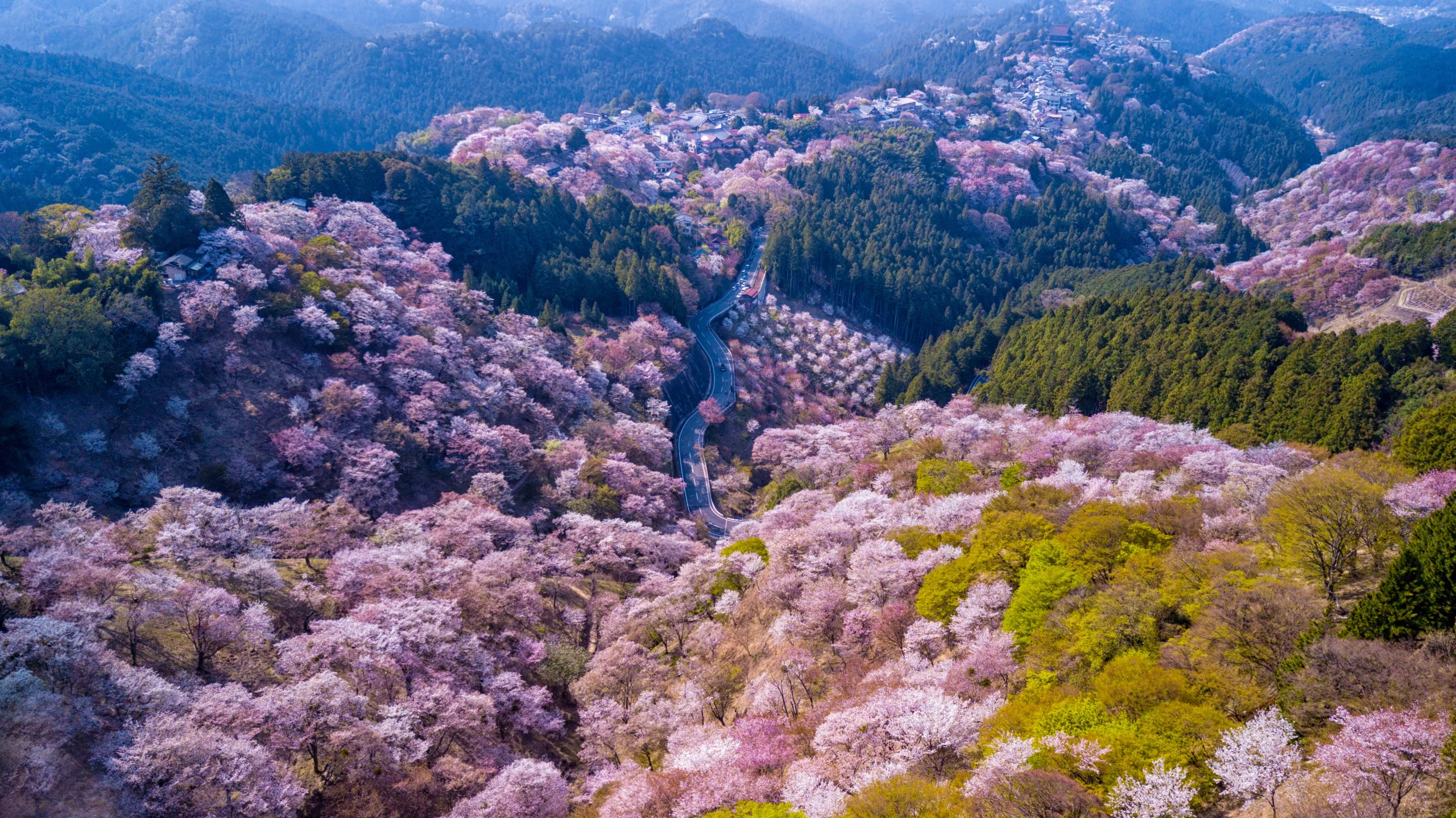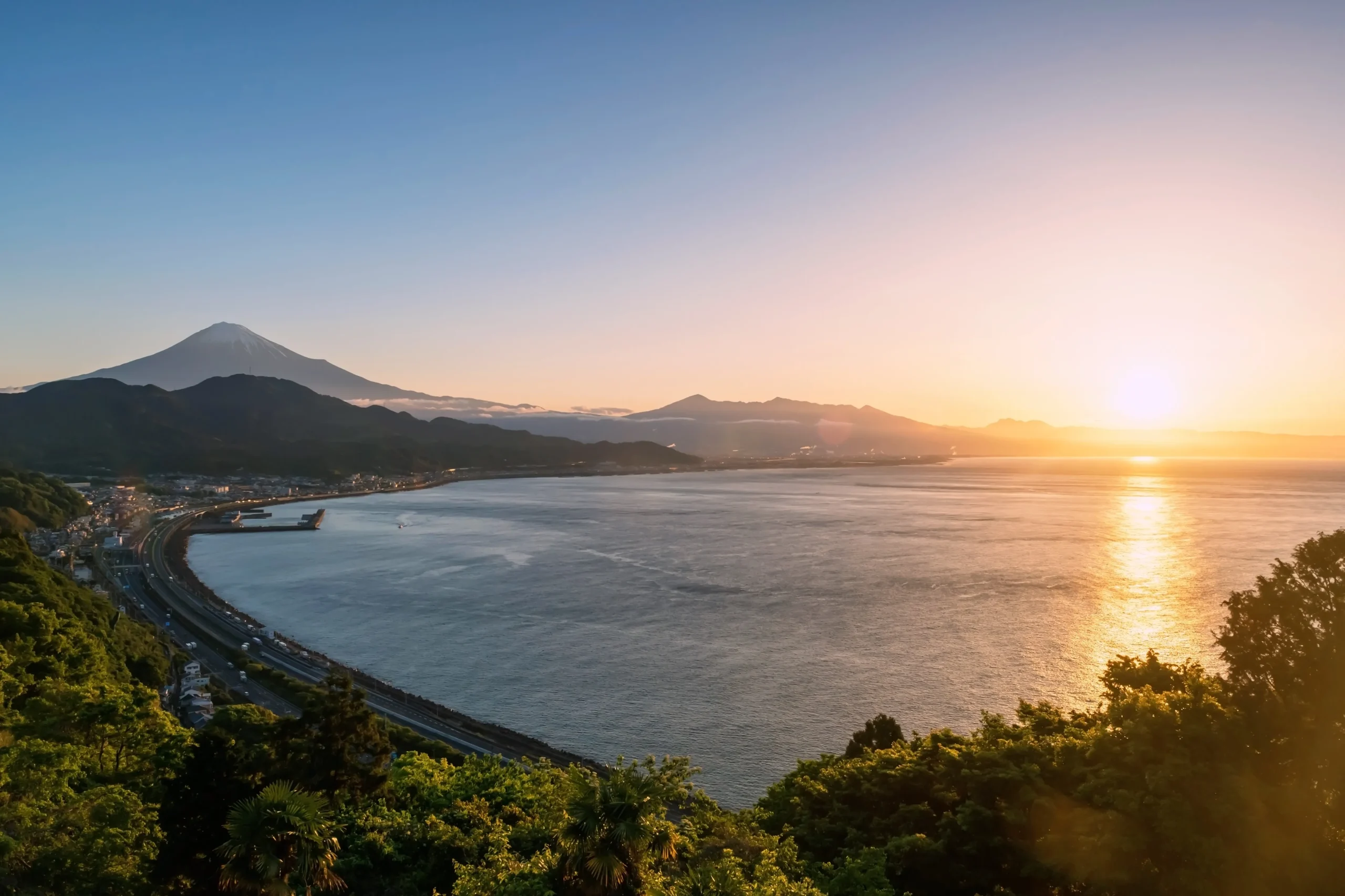
Somewhere around the third or fourth day of a Japan trip, most travelers feel it: the stations are enormous, the walking is longer than expected, and the days keep filling up. An onsen town is the built-in answer to that. These are small hot-spring towns designed around a single, unhurried rhythm — soak, eat, rest, repeat — and dropping one into your itinerary does something a city day can’t. It slows you down on purpose.
The catch is that “best” depends almost entirely on where you already are. An onsen town near Tokyo serves a very different trip than one tucked deep in Kyushu. So rather than rank these towns against each other, we’ve grouped them by how they fit a real route — near Tokyo, on the Tokyo–Kyoto line, near Kyoto and Osaka, and the few that are worth a longer detour. Whether this is your first soak or your fiftieth, there’s a town on this list you can drop into without rebuilding your itinerary. First, a quick primer and a short framework for choosing.
What is an Onsen Town?
An onsen is naturally heated groundwater that meets specific mineral and temperature standards under Japanese law — which is what separates a true onsen from an ordinary heated bath. An onsen town is a place built around that water: multiple inns, public bathhouses, and often a visible source at the town’s center, all organized around bathing rather than around sightseeing.
What makes these towns distinct isn’t a checklist of attractions. It’s how time is spent. Because hot springs are a shared resource, many towns grew up around communal bathhouses that residents and visitors use side by side, following the same rules. Bathing once is relaxing; bathing several times across a short overnight stay quietly reorganizes your whole day — meals get timed around soaks, evenings wind down early, mornings start slow. That’s the real reason an onsen town feels different from a hotel that happens to have a spa.
How to Choose the Right Onsen Town for your Trip
Four questions sort almost everyone into the right town:
-
Day trip or overnight?
- A day trip works for towns with strong public bathhouses close to a big city (Atami, Arima). But the experience is meaningfully better as an overnight ryokan stay — that’s when the slow evening rhythm actually kicks in. Some smaller villages only really open up to overnight guests, since day access to baths can be limited.
-
Do you have tattoos?
- Many onsen still restrict tattoos, though the number allowing them is growing. If this matters to you, aim for towns known for tattoo-friendly baths (Kinosaki is the classic example) or ryokan with private in-room baths, and always confirm with the specific facility in advance.
-
First time, and a little nervous?
-Onsen bathing is done nude and separated by sex, which is the single biggest hesitation for many first-time visitors. More foreigner-accustomed, walkable towns (Hakone, Kinosaki) ease you in, and booking a room with a private bath removes the public element entirely.
-
What season?
-Winter is arguably peak onsen — hot water hits differently in the cold, and towns like Kinosaki pair it with snow-crab season. In winter, the gap between the spring water’s temperature and the cold air sends steam drifting through the streets, wrapping the whole town in a soft, dreamlike haze. Autumn foliage and snow-framed baths are the other two showstoppers.
Two of those four questions end the same way: confirm with the inn before you book. That is where onsen planning usually stalls. Tattoo policy is set inn by inn rather than town by town, it is seldom written down in English, and it changes. Whether a private bath can actually be reserved for a particular evening works the same way.
This is the part ENJYU JAPAN handles as a matter of course — booking the ryokan, confirming the conditions in Japanese, and putting the town in the part of your itinerary where it belongs.
Best Onsen Towns near Tokyo
Hakone-Yumoto Onsen | Kanagawa
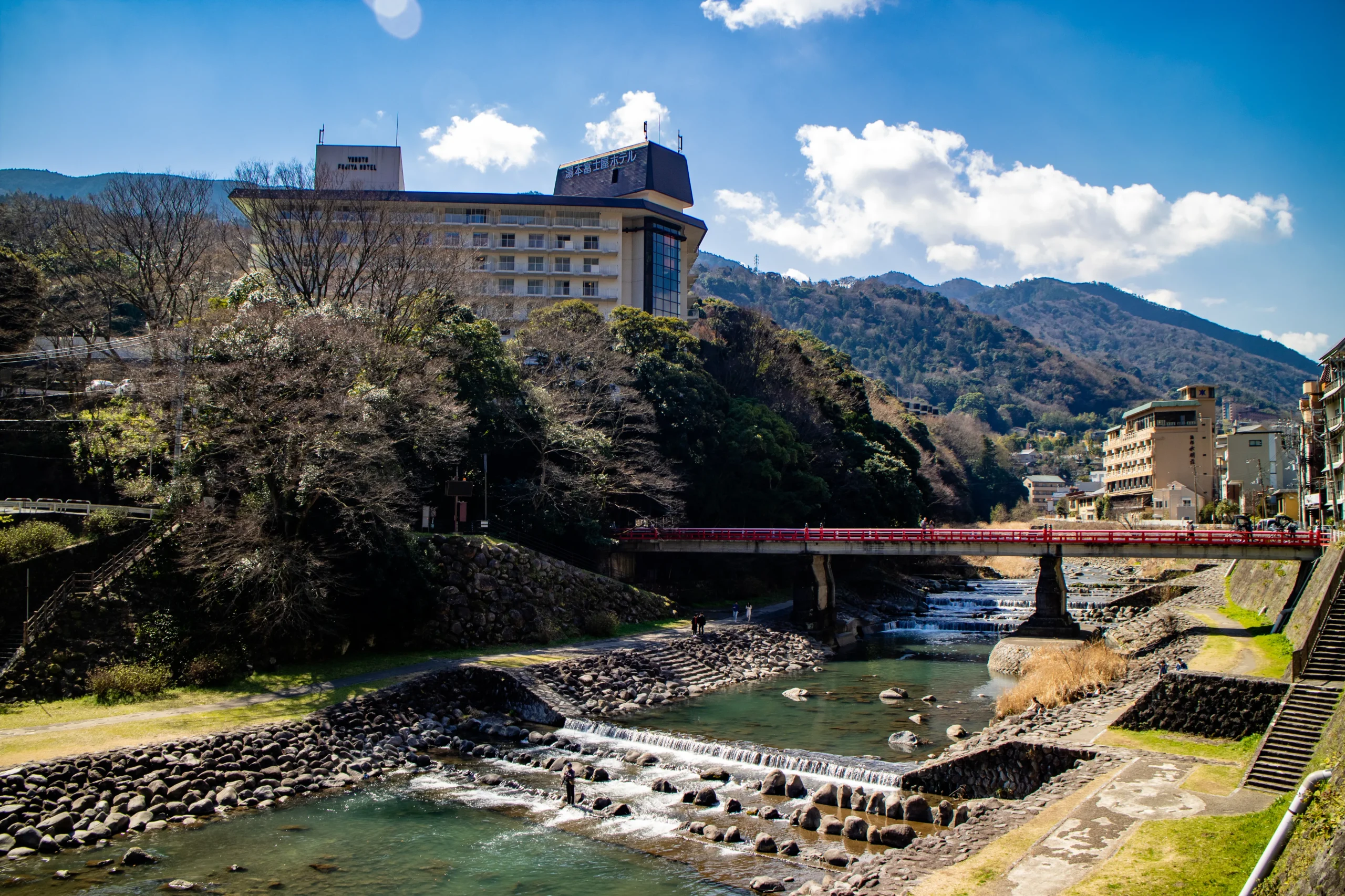
The default first onsen for a reason: Hakone-Yumoto onsen sits close to Tokyo, offers a huge range of hot springs and ryokan, and — on a clear day — views of Mount Fuji across Lake Ashi. It’s also the most international-traveler-friendly onsen area in the country, which makes it a gentle first-timer choice. Yes, it’s developed and can feel touristy, but the ryokan quality is high and it barely costs you a detour.
- Access: roughly 1.5 hours from Shinjuku by limited express to Hakone-Yumoto
- Best as: overnight, though a long day trip is possible.
- Signature experience: a Fuji-view Rotenburo (open‑air bath), plus the open-air art museum and Owakudani.
Read More: 10 Best Ryokan and Hotel with Private Onsen in Hakone
Atami Onsen | Shizuoka
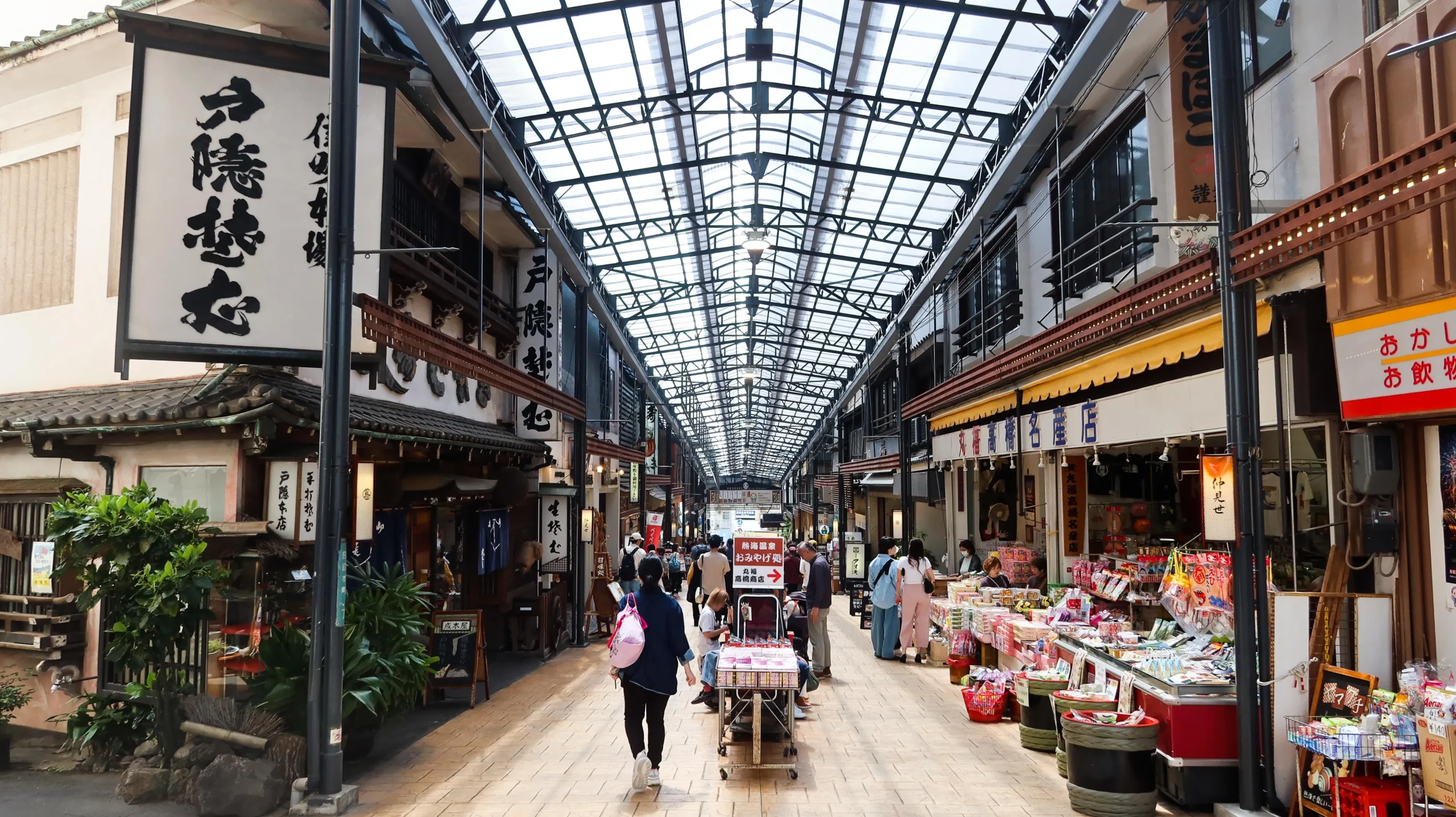
The easiest onsen escape from Tokyo — a coastal hot-spring town on Sagami Bay reachable in well under an hour by shinkansen. Atami onsen has more edge than a sleepy mountain town: a lively station area with seafood markets and a retro shopping arcade, plus quieter, scenic corners toward the coast and hillside. Good for travelers who want a soak without committing a full day to travel.
- Access: about 40 minutes from Tokyo Station by shinkansen
- Best as: day trip or easy overnight.
- Signature experience: ocean-view baths and the plum garden in late winter.
Kusatsu Onsen | Gunma
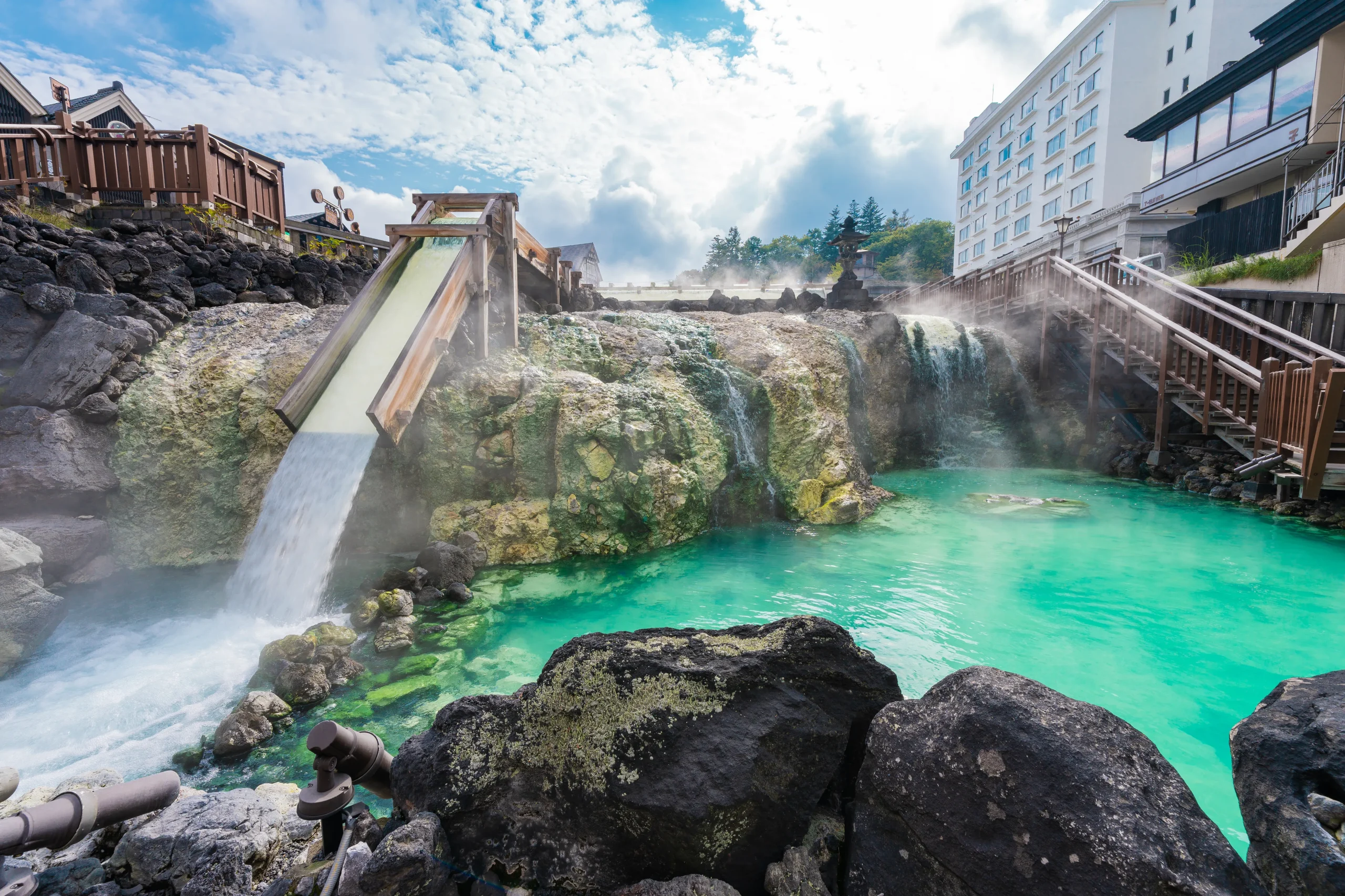
If you want the archetypal, water-first onsen town, this is it. Kusatsu Onsen is famous for the Yubatake (“hot water field”) at its center, where spring water flows openly through wooden channels to cool before distribution — not decoration, but the town’s plumbing on display. Its waters are known for exceptionally high natural output and are acidic enough to have a real reputation for potency.
- Access: roughly 3 hours from Tokyo by car
- Best as: overnight; day trips are doable but rushed.
- Signature experience: the Yubatake at night, and the traditional yumomi water-stirring performance.
Kinugawa Onsen | Tochigi
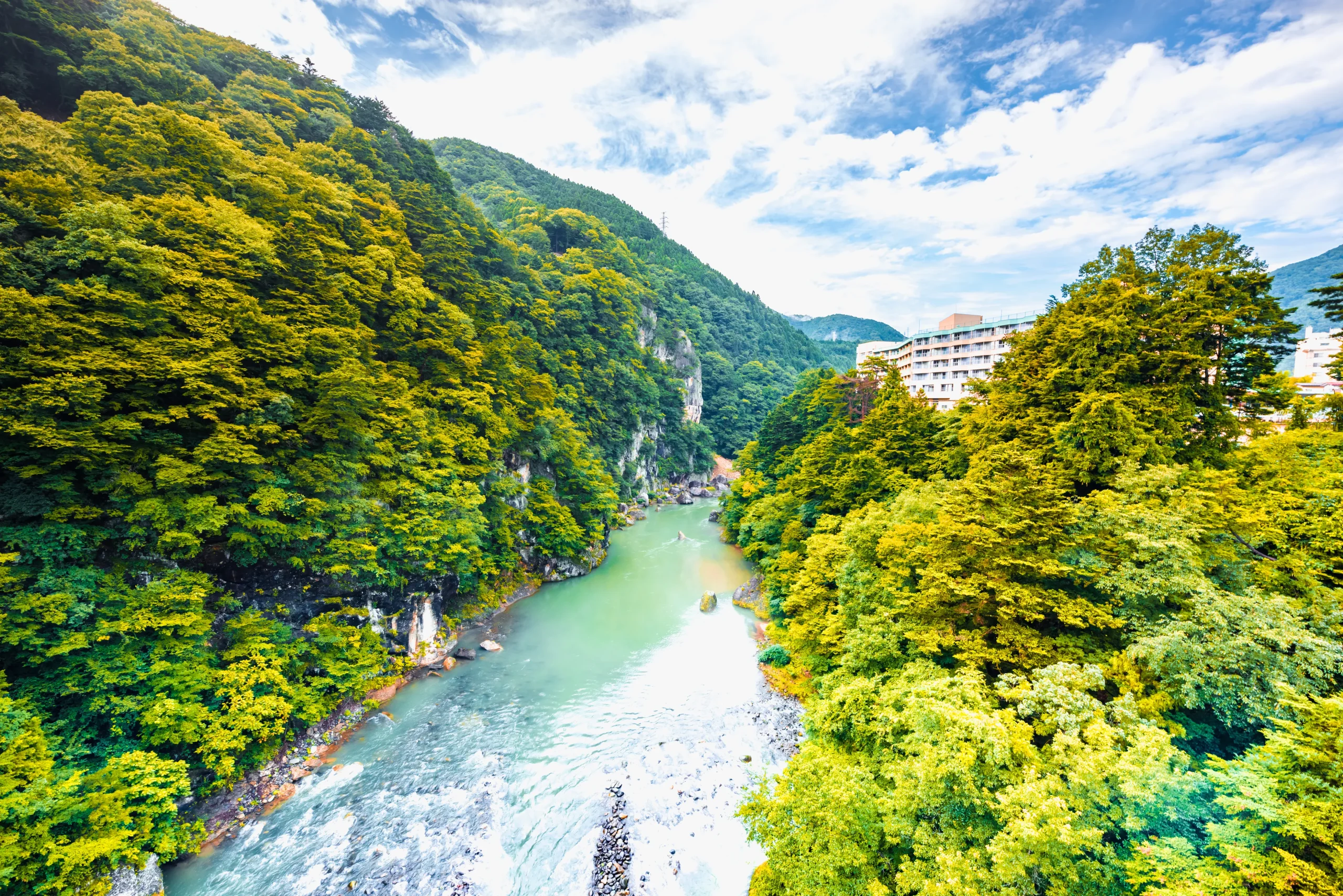
Pair the shrines and forests of Nikko with a night in nearby Kinugawa, a river-valley onsen town lined with inns built for travelers who’ve been enjoying its gentle waters for generations. It’s the natural “sightseeing plus soak” combination on Tokyo’s northern side.
- Access: roughly 2.5 hours from Tokyo by expressr train
- Best as: overnight, tacked onto a Nikko visit.
- Signature experience: a riverside ryokan dinner after a day at Toshogu.
Nozawa Onsen | Nagano
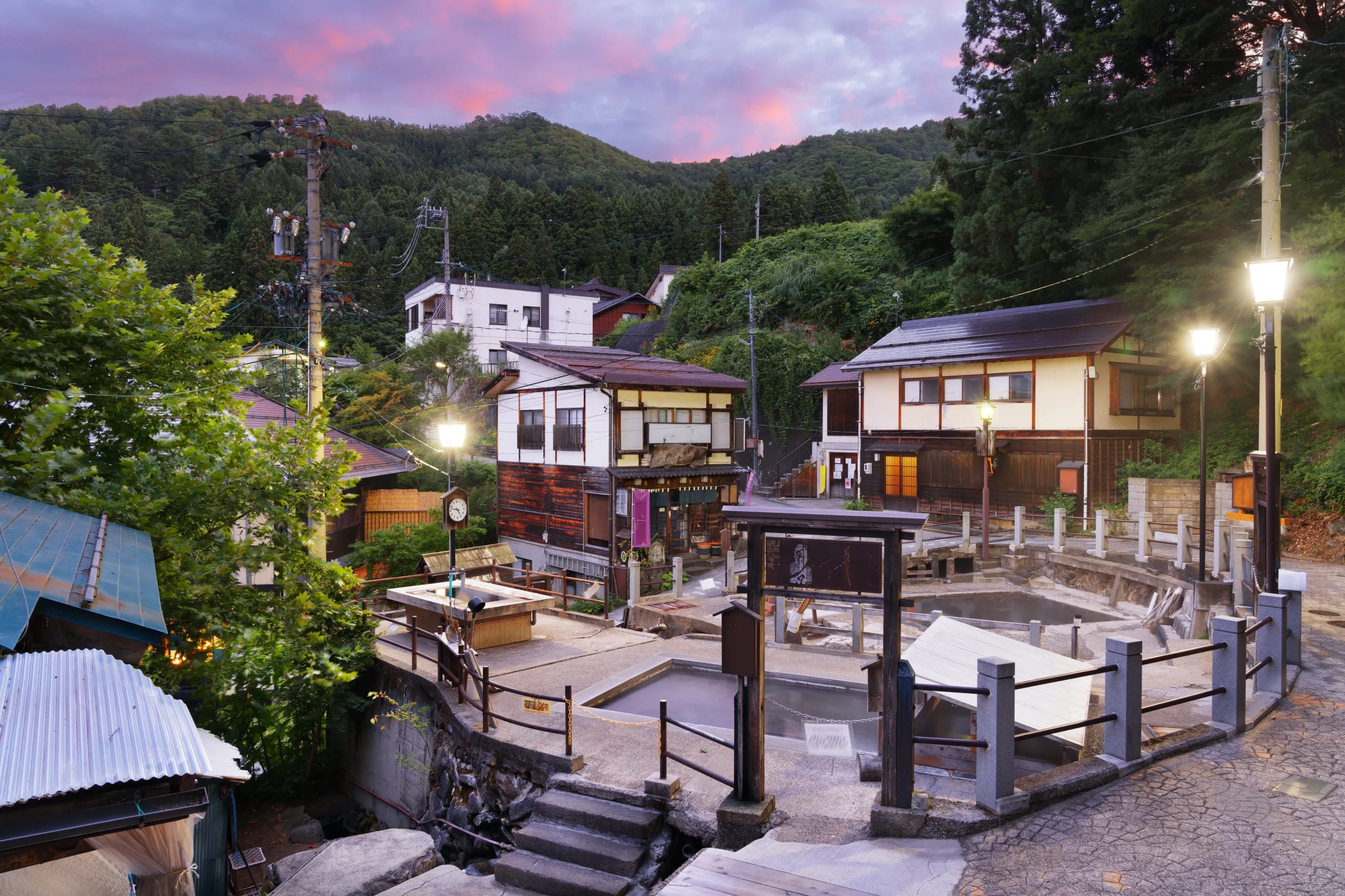
The onsen town where the baths belong to the village, not the inns. Nozawa maintains 13 communal soto-yu run by local residents — free to enter, with a small voluntary donation (roughly ¥100–300) dropped in the box at the door, and no towels or soap provided. The layout stays dense and residential: narrow lanes, wooden houses, small shrines folded into daily life. It’s better known abroad as a ski village, but the onsen culture here has resisted redevelopment, which makes it one of the clearest surviving examples of bathing as routine rather than as a packaged experience. At Ogama, the hottest spring in the village, locals still lower baskets of vegetables and eggs into water close to boiling.
- Access: roughly 3.5 hours from Tokyo.
- Best as: overnight, and easily combined with a ski trip.
- Signature experience: the free soto-yu circuit, and Ogama working as the village kitchen.
Best Onsen Towns on the Tokyo–Kyoto Route
The most efficient onsen stop is the one that doesn’t cost you a detour. If you’re moving between Tokyo and Kyoto — the backbone of most first Japan trips — Hakone (above) is the standout: it sits essentially on the route, delivers the full ryokan-and-Fuji experience, and lets you break a long travel day without backtracking. For a smaller, quieter alternative on the same corridor, look at the Izu Peninsula south of Atami, where the towns get more low-key the farther down you go. And if you’re willing to step off the shinkansen line at Nagoya, Gero trades convenience for pedigree.
The strategy here is simple: rather than treating the onsen night as an extra leg, use it to split the Tokyo–Kyoto journey into two calmer halves.
That is the exact shape of ENJYU JAPAN’s 10-Day Japan in April Tour: four nights in Kyoto, two in a Hakone onsen ryokan with kaiseki dinners and mountain views, then three in Tokyo. If you are travelling in April, the idea is already built.
Gero Onsen | Gifu
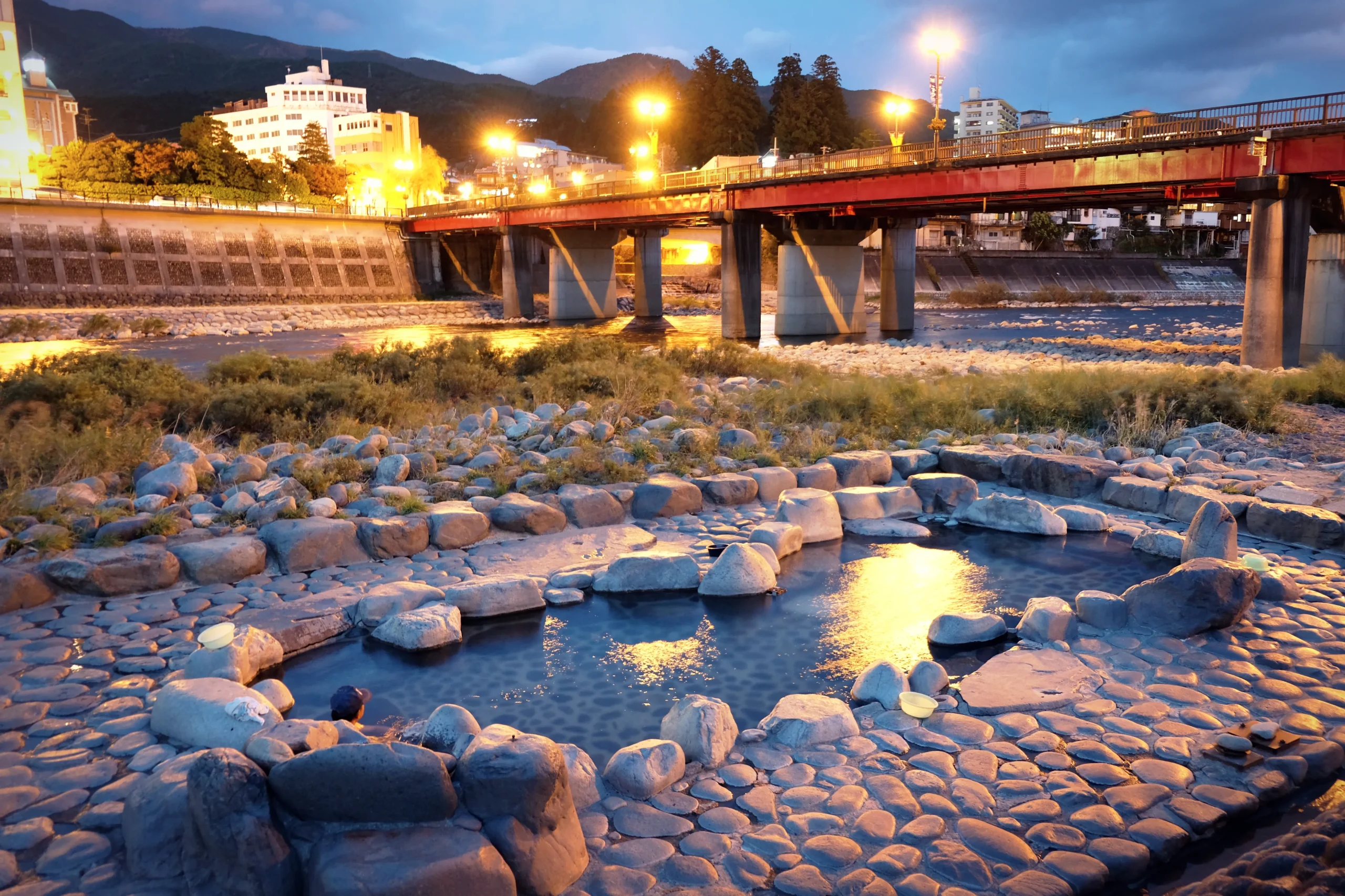
One of Japan’s three most celebrated hot springs, and the one most travelers have never heard of. Gero onsen sits in the mountains of Gifu, reached via Nagoya. The waters are famously smooth on the skin, and free public footbaths are scattered through the small riverside town. It pairs naturally with a visit to Takayama or Shirakawa-go.
- Access: about 4 hours from Tokyo Station by shinkanse and the JR Takayama linen.
- Best as: overnight, often combined with Takayama.
Signature experience: a riverside soak, and the footbath circuit through town.
Best Onsen Towns near Kyoto & Osaka
Kinosaki Onsen | Hyogo
The most reliable answer to the tattoo question. In most onsen towns, policy varies bathhouse by bathhouse and often means a flat refusal — Kinosaki onsen is widely known for welcoming visitors with tattoos across its public baths. Beyond that, it’s a beautifully walkable town built around a soto-yu crawl: seven distinctive bathhouses, each with its own architecture — a cave bath, one styled after a Kyoto palace, another shaped like a lantern. Stay in a ryokan and you get a pass to all seven, then stroll between them in your yukata along a lantern-lit canal. In winter it adds snow crab and Tajima beef.
- Access: roughly 2.5–3 hours by train from Kyoto or Osaka.
- Best as: overnight — this town is designed to slow you down.
- Signature experience: the seven-bath yukata crawl.
- Tattoos: the most tattoo-friendly onsen town in Japan.
Arima Onsen | Hyogo
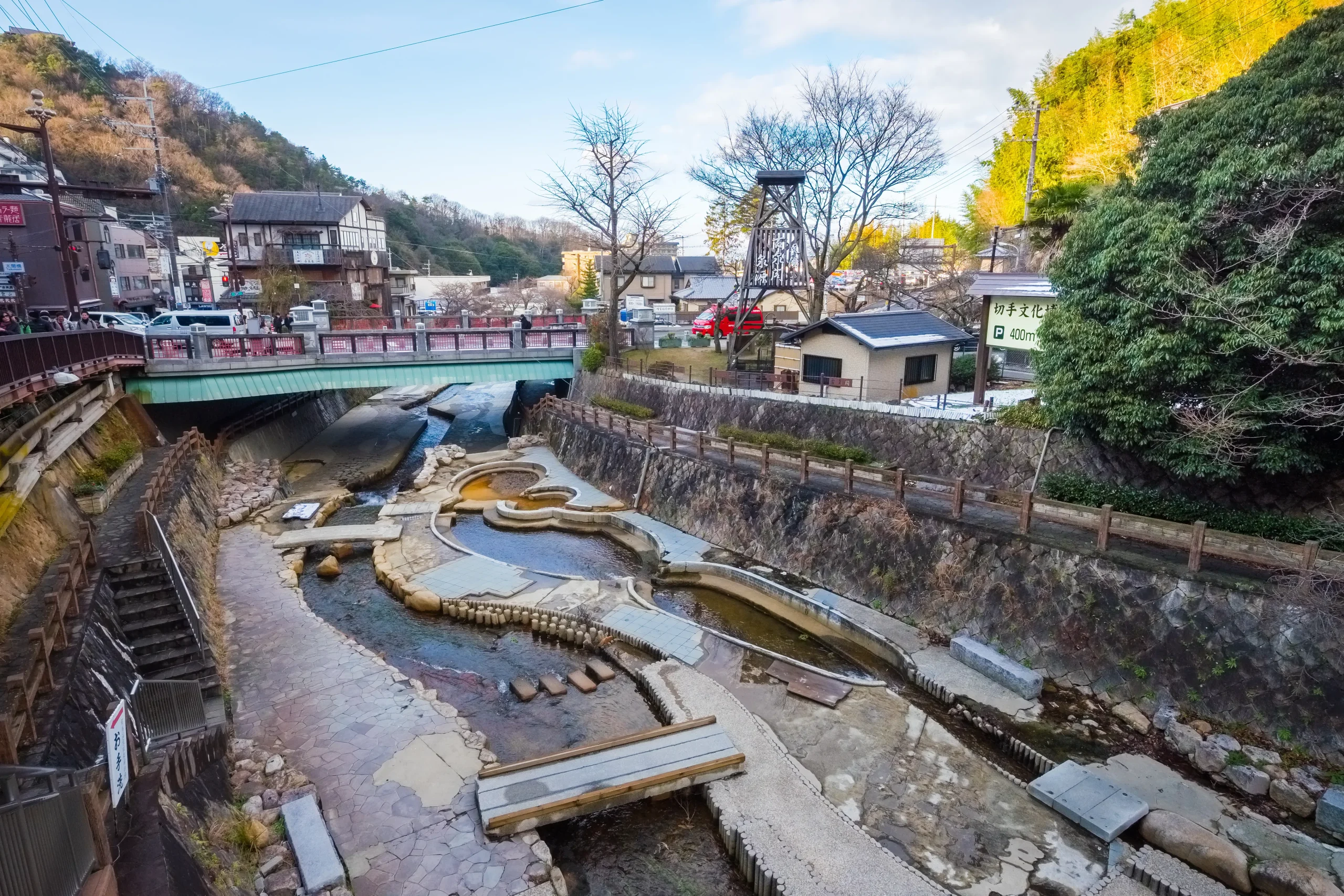
One of Japan’s oldest hot-spring towns and the most convenient soak from the Kansai cities. Arima onsen is known for two distinct waters — the iron-rich kinsen (“gold”) springs and the clear, carbonated ginsen (“silver”) springs — set in a compact old town behind Mount Rokko. Despite its fame it rarely feels overwhelming: you can wander the streets in a yukata between a large public bathhouse and a private ryokan soak.
- Access: around an hour from Osaka, roughly 30 minutes from Kobe.
- Best as: day trip or overnight — genuinely good either way.
- Signature experience: trying the gold and silver springs back to back.
Yunomine Onsen
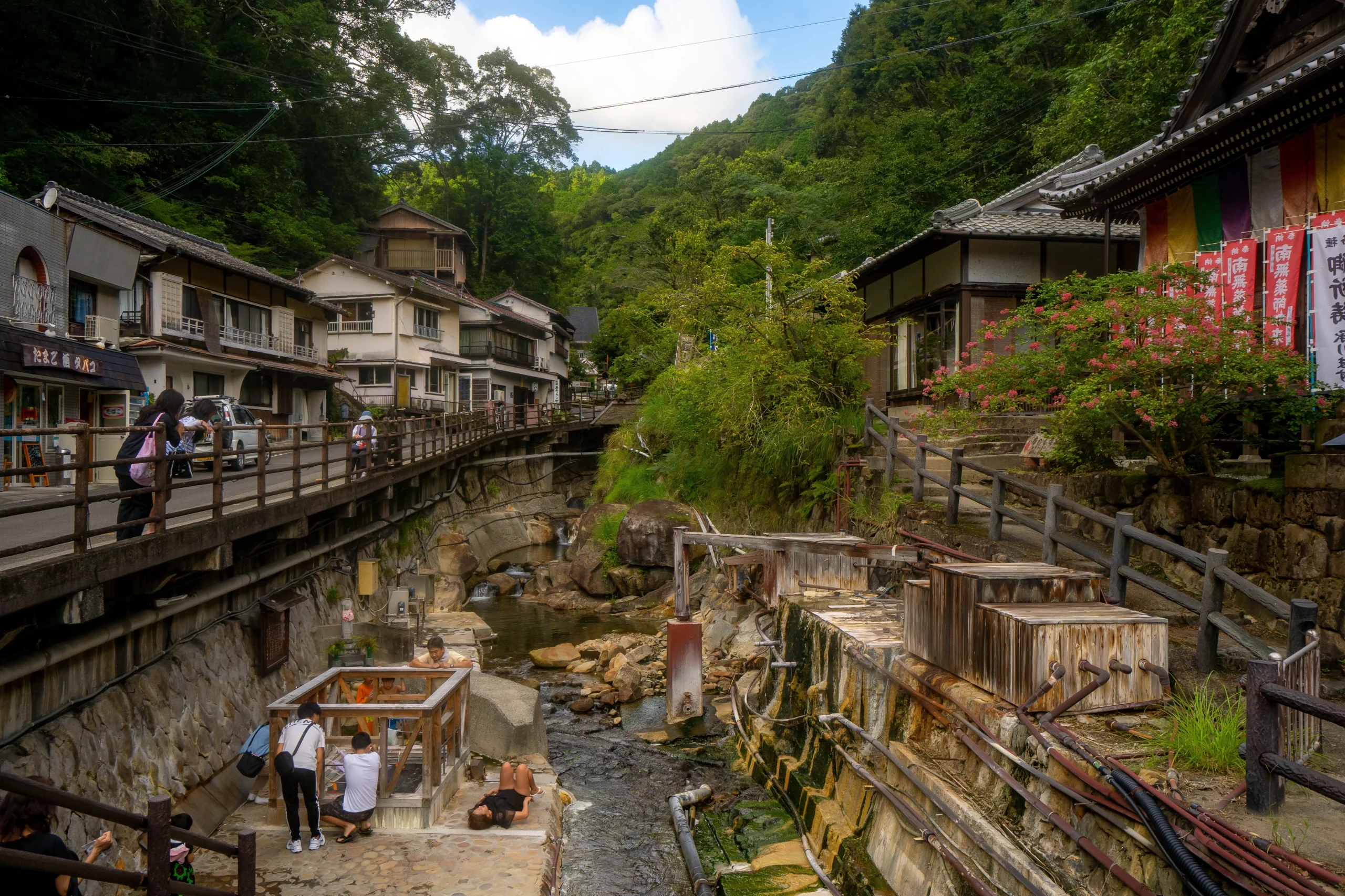
For the most atmospheric, spiritual soak in Japan, head south into Wakayama. Yunomine onsen sits along the sacred Kumano Kodo pilgrimage route and is home to Tsuboyu, a tiny stone hut over a milky stream that’s the only hot-spring bath in the world inscribed as a UNESCO World Heritage site, entered one small group at a time. The surrounding Kumano Hongu area holds several hot-spring hamlets, including one with a vast riverside bath. This is the choice for slow travelers and hikers.
- Access: roughly 4 hours from Osaka by train and local bus.
- Best as: overnight, ideally after hiking a section of the trail.
- Signature experience: booking a slot at Tsuboyu.
Shirahama Onsen | Wakayama
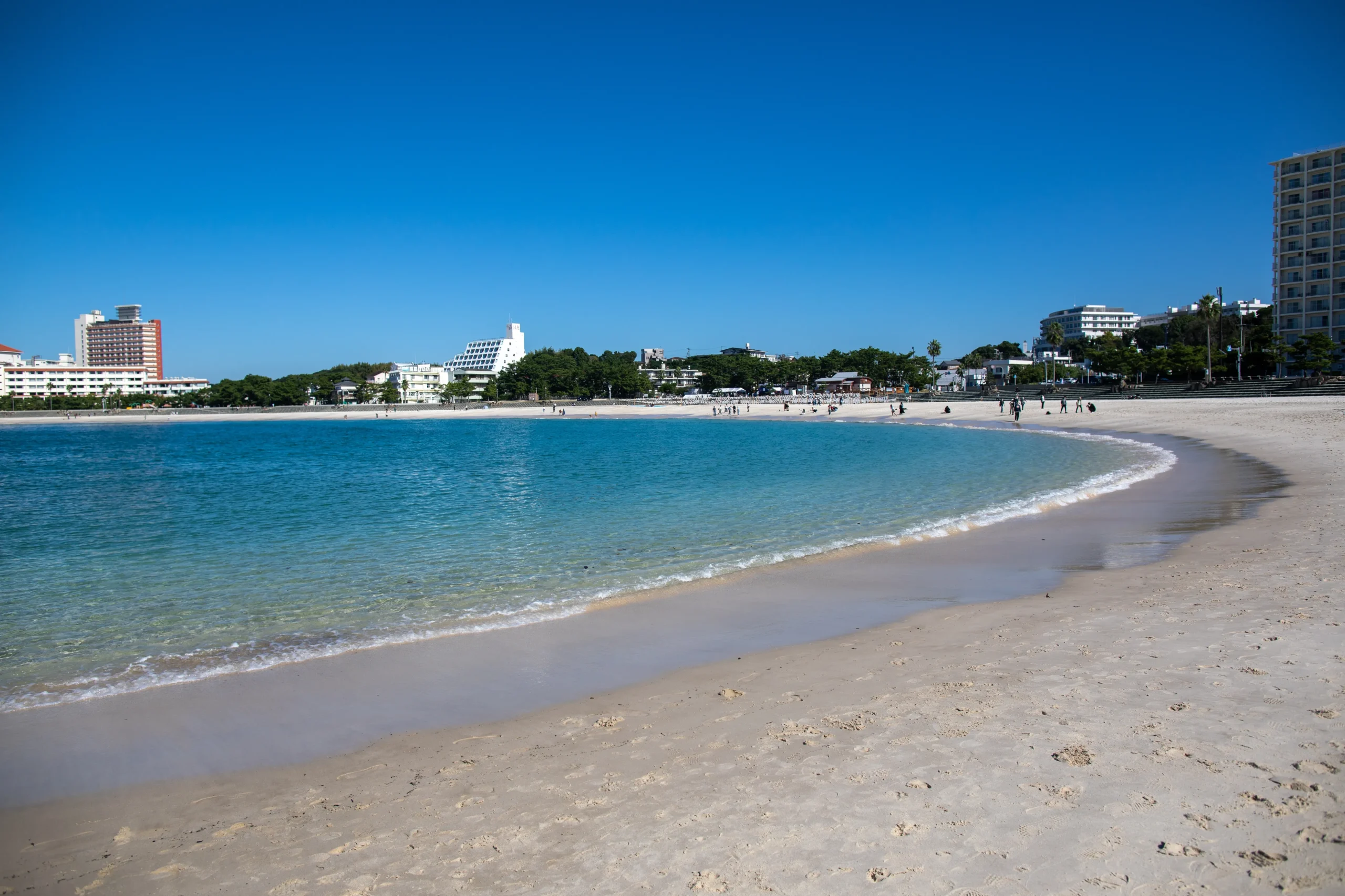
A coastal counterpoint to the mountain towns: white-sand beaches, oceanfront baths, and one of Japan’s oldest bathing traditions on the southern Wakayama coast. Several outdoor baths sit right at the water’s edge, including a famous seaside rock bath used since the Heian period. Good for travelers who want resort-and-beach energy alongside their soak.
- Access: roughly 3 hours by train from Osaka.
- Best as: overnight.
- Signature experience: an ocean-edge bath at sunset.
Onsen Towns Worth the Longer Journey
These aren’t on the way to anything — but for many travelers, one of them becomes the trip’s highlight.
Ginzan Onsen | Yamagata
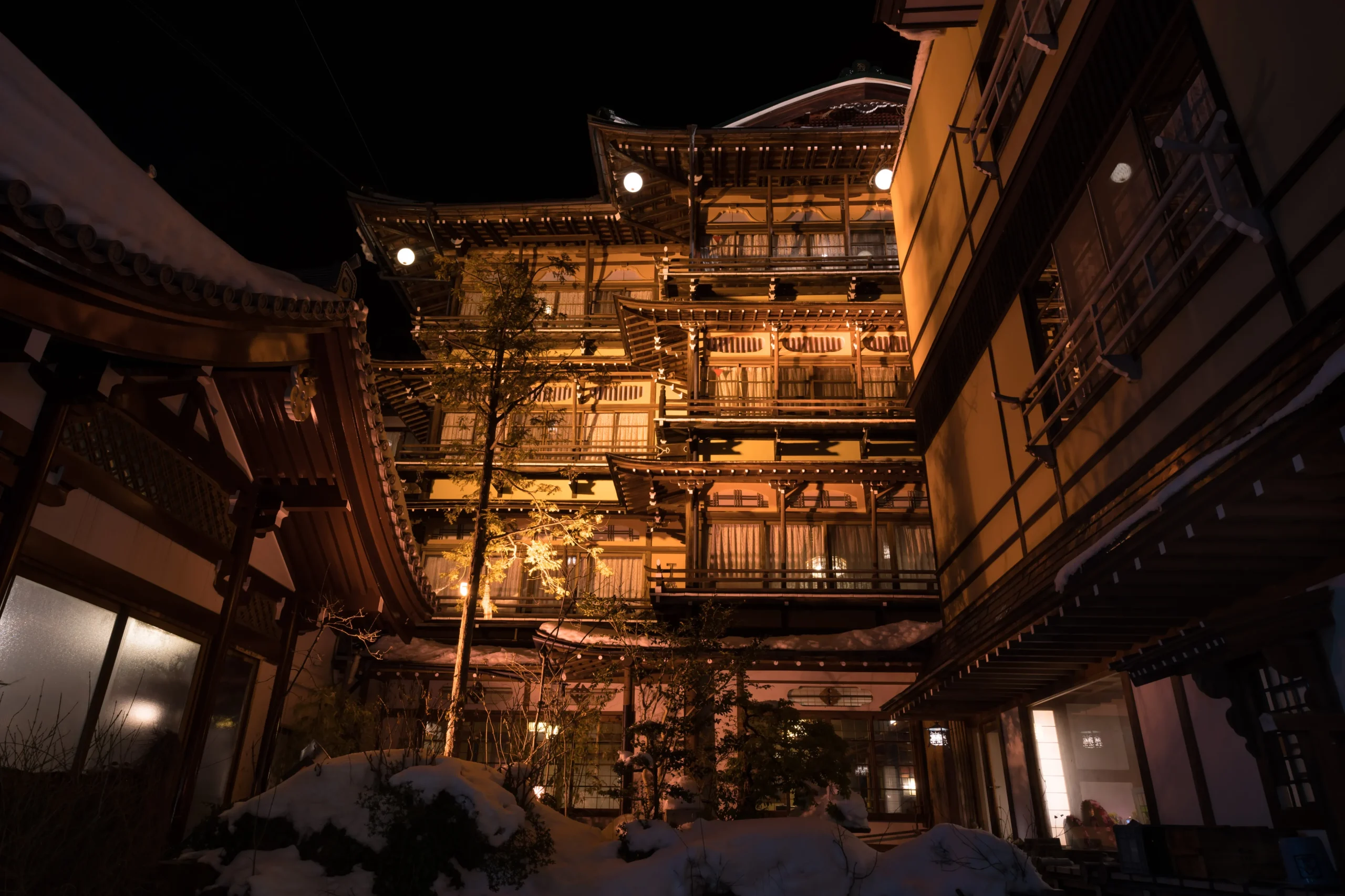
Probably the most photographed onsen town in Japan among international visitors: a narrow river lined with multi-story wooden inns from the Taisho era, gaslit and snow-dusted in winter. It’s small and can be hard to reach, and day-visitor access to baths is limited — so treat it as a book-well-ahead overnight, not a drop-in. Kurokawa Onsen | Kumamoto
Consistently ranked among Japan’s most atmospheric hot-spring towns — a cluster of rustic ryokan and outdoor baths designed to feel like one continuous village rather than competing hotels. Buy a rotenburo meguri pass to hop between open-air baths at several inns.
Read More: Things to Do in Yamagata: Snow Monsters, Sacred Peaks, and More
Yufuin Onsen and Beppu Onsen | Oita
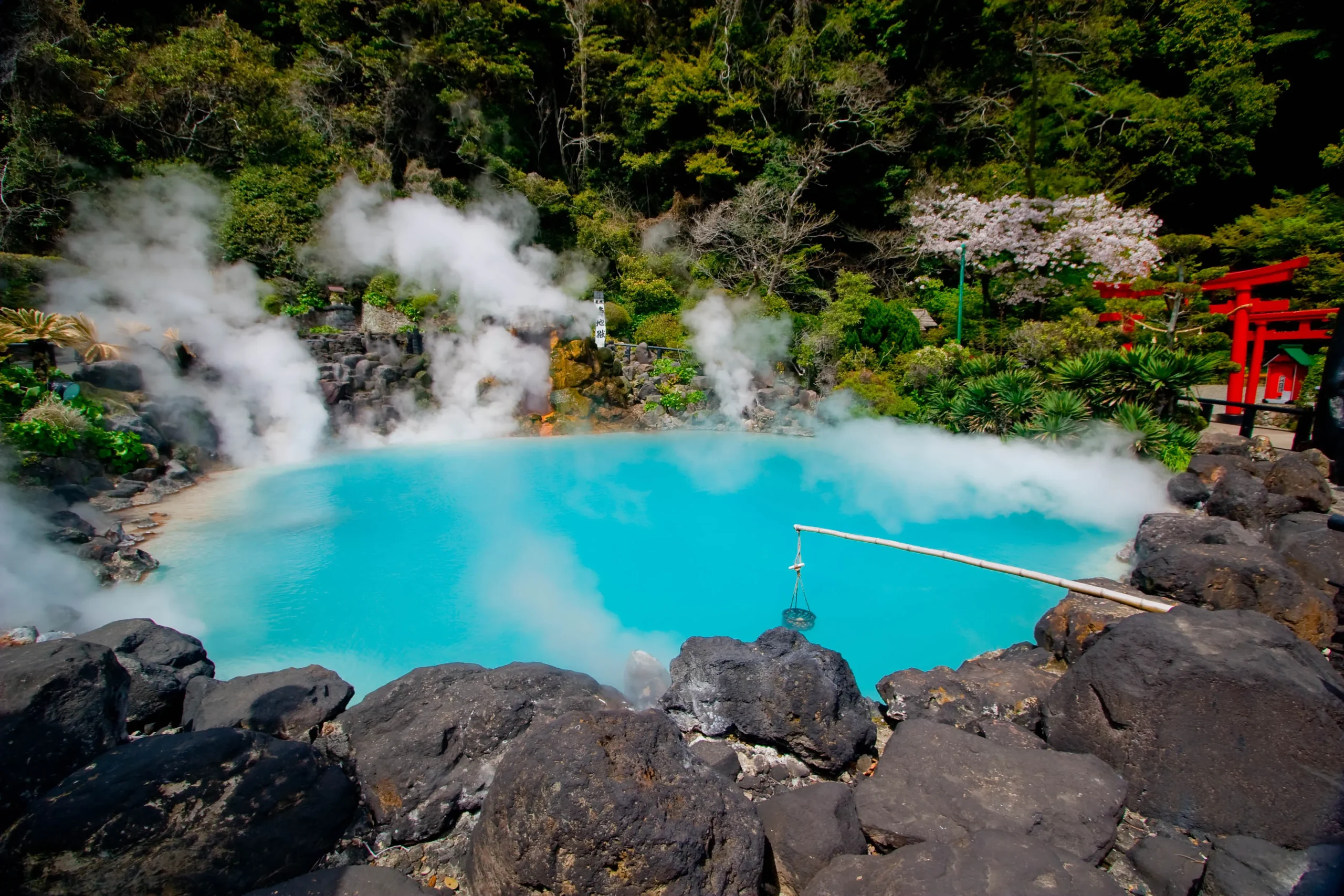
A pair on Kyushu’s east side: Beppu onsen for sheer hot-spring volume and its steaming “hells” to view (not bathe in), and nearby Yufuin for a quieter valley of ryokan, galleries, and rice-paddy scenery — an easy, quirky day trip from Beppu.
Dogo Onsen | Ehime
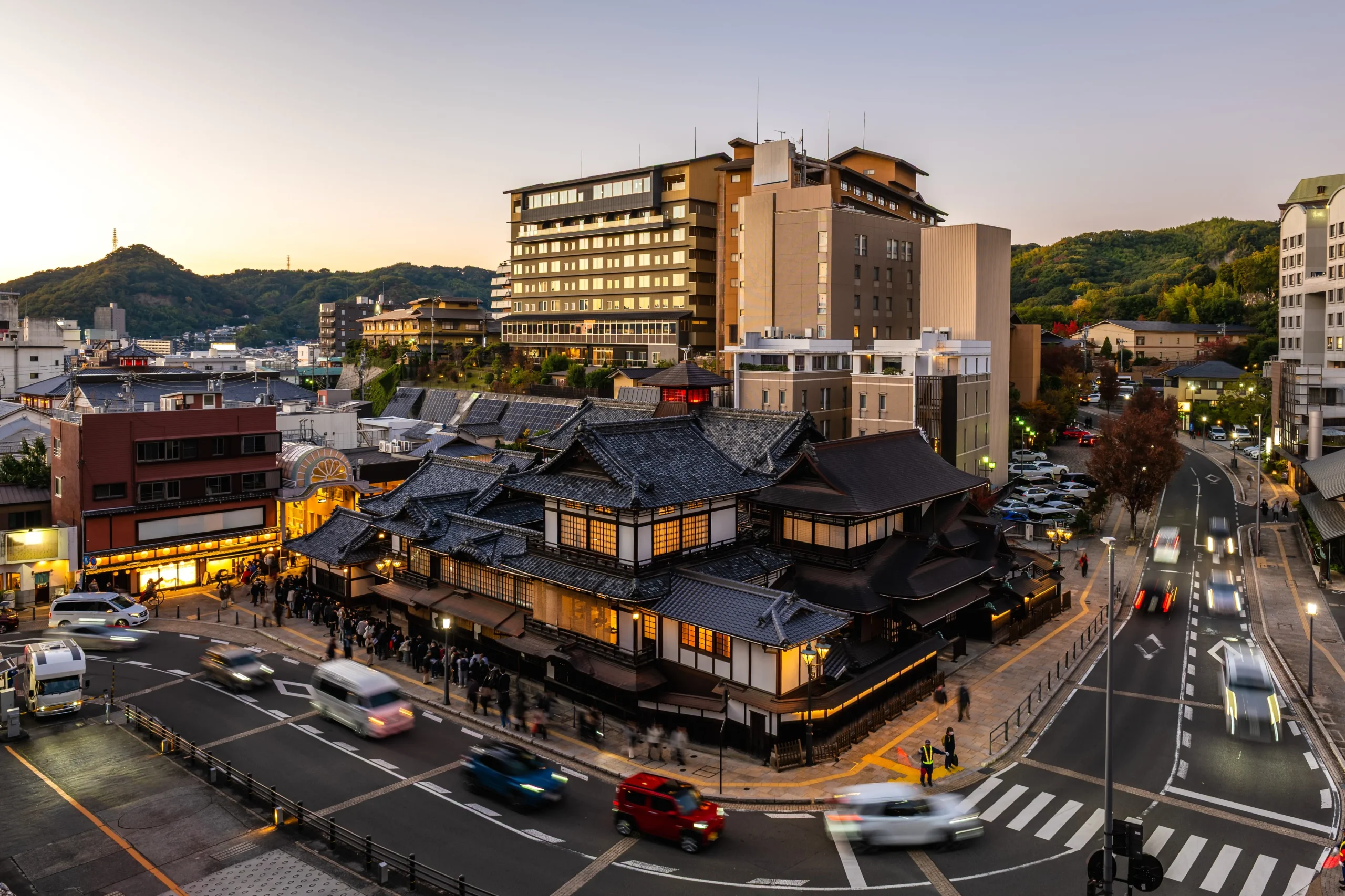
One of Japan’s oldest onsen, mentioned in eighth-century chronicles, anchored by the three-story wooden Dogo Onsen Honkan bathhouse — a building so evocative it helped inspire scenes in beloved Japanese fiction. Retro, storied, and easy to combine with Matsuyama Castle.
Noboribetsu Onsen | Hokkaido
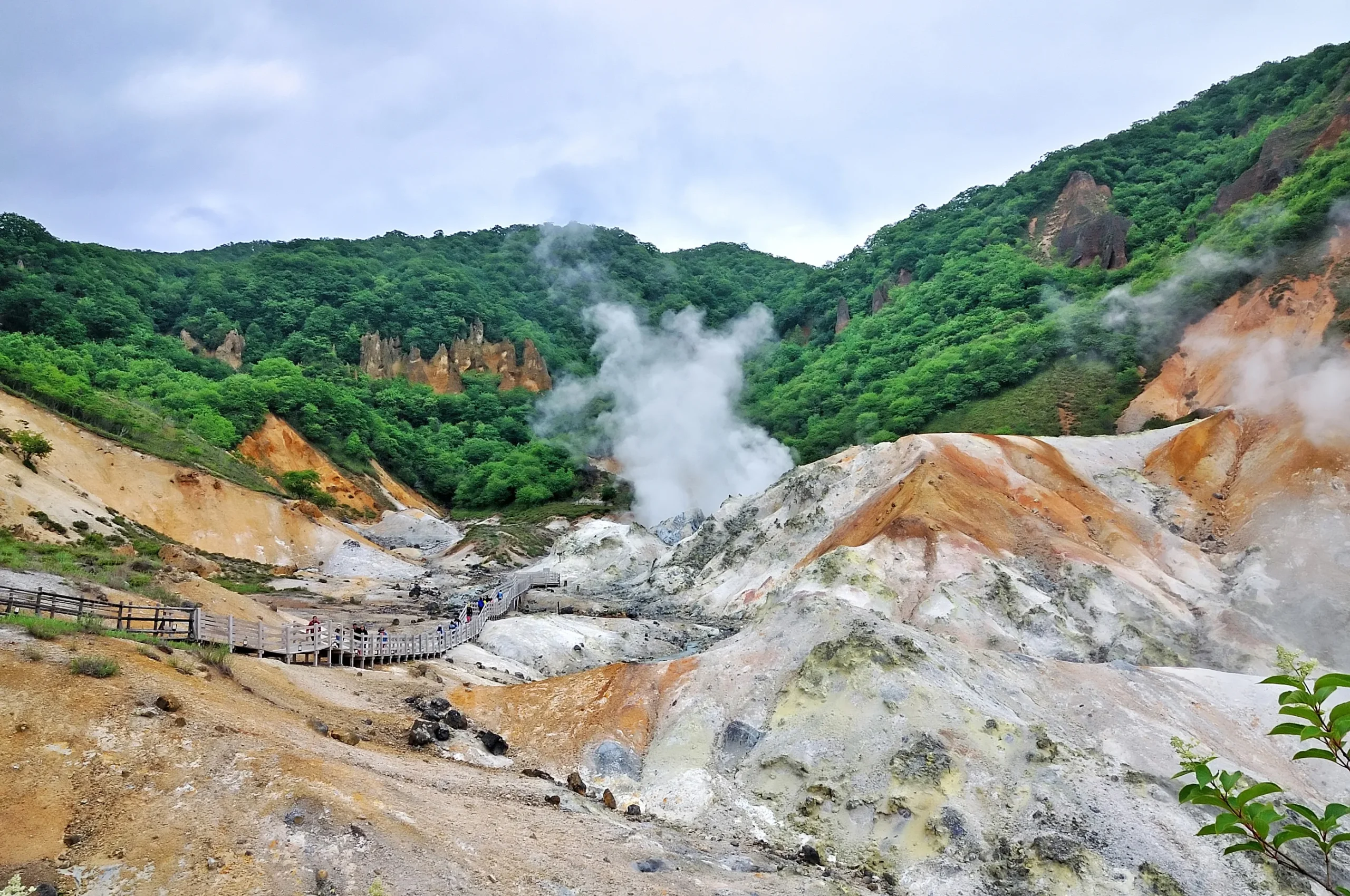
The most dramatic natural spectacle on the list: Jigokudani (“Hell Valley”), a steaming volcanic crater feeding nine different types of spring water into the town’s baths. Pair it with the surrounding national park.
Shibu Onsen and Yudanaka Onsen | Nagano
The base for the famous snow monkeys of Jigokudani Monkey Park. Stay overnight in tiny Shibu Onsen and your inn hands you a key to the town’s nine public bathhouses — all of them closed to day visitors. Few places make the overnight stay this literal a condition of entry.
Onsen Etiquette in 60 seconds
- Wash first. Shower and rinse thoroughly at the seated stations before getting in. The bath is for soaking, not cleaning.
- No swimsuits. Bathing is nude and separated by sex. A small towel is for modesty and washing — keep it out of the water.
- Tie long hair up and keep the towel off your head or folded on the rim.
- Tattoos: still restricted at many facilities, though more allow them each year; cover-up patches sometimes help, and private baths sidestep the issue. Confirm in advance.
- Keep it calm. Quiet voices, no phones, no photos in the bathing area.
Frequently Asked Questions
Can you visit an onsen town if you have tattoos?
Yes, though not everywhere. A growing number of towns and baths welcome tattoos — Kinosaki is the best-known tattoo-friendly example — and booking a ryokan room with a private bath lets you soak regardless of policy. Always confirm with the specific facility before you go.
Can you do an onsen town as a day trip, or do you need to stay overnight?
Both work, but overnight is where onsen towns come alive — the slow evening rhythm, the multiple soaks, the ryokan dinner. Towns close to big cities with strong public bathhouses (Atami, Arima) are the most day-trip-friendly. Smaller villages are better overnight, since day access to baths is sometimes limited.
Which onsen town is best between Tokyo and Kyoto?
Hakone, because it sits essentially on the route and doesn’t cost you a detour — you can break the Tokyo–Kyoto journey with a night there and pick up Mount Fuji views on a clear day. For something quieter on the same corridor, look at the Izu Peninsula south of Atami.
Which onsen town is best for first-time visitors?
Hakone and Kinosaki are the gentlest starts: both are walkable, accustomed to international guests, and easy to navigate. If public bathing feels daunting, book a ryokan with a private in-room bath.
What are the three most famous hot springs in Japan?
By long tradition, Japan’s san-meisen — the “three great springs” — are Arima (near Osaka and Kobe), Kusatsu (north of Tokyo), and Gero (in the Gifu mountains, via Nagoya). The grouping is attributed to a 17th-century scholar and has stuck ever since. Conveniently for travelers, they sit in three different regions, so one of them is almost always within reach of wherever your itinerary already takes you. [VERIFY: attribution of the san-meisen grouping to Hayashi Razan before publishing; cite an authoritative Japanese source.]
If you’re asking which onsen town is the most recognizable rather than the most historically celebrated, the answer differs — Hakone for accessibility and Fuji views, Ginzan for its photogenic Taisho streetscape, Kinosaki for its bath-hopping culture. Which one is “best” still depends on your route and what you want from the stay.
When is the best time to visit an onsen town?
Winter is the classic choice — hot water is most rewarding in the cold, and towns like Kinosaki add snow crab. Autumn foliage and snow-framed baths are the other two standout seasons.
Choosing the Right Onsen Town
Choosing an onsen town is less about finding the best one than about knowing what each town is for. Some are built on accessibility, others on communal ownership, others on the character of the water itself. Once you know which of those you are after, the geography mostly sorts itself out.
What does not sort itself out is the booking. Ryokan in small towns fill months ahead. Tattoo and private-bath policies sit with the individual inn. Ginzan limits day access to its baths, and Shibu closes its public bathhouses to anyone not staying the night — so in those towns the reservation is the experience. And a single onsen night quietly changes which train you take the next morning.
That is the work ENJYU JAPAN does. Tell us where your trip already goes and what you want from the stay — a Fuji view, a bath you do not have to share, snow outside the window — and we will place the right town in the right part of the itinerary, book the ryokan, and arrange the transfers around it.
If you would rather start from something already built
Two of our tours are built around an onsen stay, and the choice between them comes down to the question this guide opened with: is the onsen the trip, or a night inside it?
— three consecutive nights in a luxury ryokan in Hakone, with kaiseki dinners each evening, Hakone Shrine and the torii on Lake Ashi, Owakudani, and a day around Mt. Fuji at Oshino Hakkai and Lake Kawaguchi. Three nights in one ryokan is the version of this most travellers never get: you stop packing, and the rhythm described at the top of this guide — soak, eat, rest, repeat — has time to take hold. Private throughout, with a dedicated English-speaking guide and private car transfers.
— two nights in a Hakone onsen ryokan with kaiseki dinners, set between four nights in Kyoto and three in Tokyo. Here the onsen stay is a chapter in a wider spring itinerary rather than the whole of it.