Nishijin-ori, also called Nishijin textile, is one approachable way to begin understanding Kyoto’s craft culture without needing expert knowledge. Woven from pre-dyed threads, its colors and patterns are built into the cloth itself, which is why it can look so layered and luminous. In this guide, we explain Nishijin-ori, show you what to look for, and help you choose a meaningful way to experience it in Kyoto.
What Is Nishijin-ori?
Nishijin-ori is a type of woven textile produced in the Nishijin district of Kyoto, Japan. It was designated a national traditional craft in 1976, and the tradition includes 12 kinds of Nishijin goods recognized under the Traditional Craft Industries law. What unites them is the method: the threads are dyed before weaving, and the pattern is constructed by interlacing those colored threads directly in the loom.
This is a different logic from dyeing a finished cloth. In printed or hand-painted textiles, such as Kyo-yuzen, where pigment or dye is applied to a surface that already exists. In Nishijin-ori, color and design are woven in at the structural level, thread by thread. Because of this, the finished fabric carries a density and visual depth that is difficult to replicate through surface techniques alone.
Nishijin-ori is also known for small-batch, high-variety production: many specialized workshops, each handling a specific part of the process, collaborating on a single piece. The result is a fabric that takes considerable time and skill to make and that tends to be used for formal and ceremonial purposes, including obi, the wide sash worn with kimono, as well as other formal and ceremonial textiles.
Reference: Nishijin-ori – Kyoto Prefecture (Japanese site)
The Short Origin Story: Why It Is Called “Nishijin”
The name comes from a place, and the place comes from a war. During the Onin War (1467-1477), a prolonged conflict that devastated much of Kyoto, the western military headquarters were stationed in what is now the northwestern part of the city. That area came to be known as Nishijin, meaning “western camp.”
When the war ended, the weavers who had fled the city gradually returned to that same district and resumed their craft. The neighborhood rebuilt itself around textile production, and the name of the old camp stayed attached to the trade. Over centuries, Nishijin became shorthand not just for a location but for an entire tradition of high-quality woven textiles.
Reference: Origin of Nishijin – Nishijin Textile Industry Association
How Nishijin-ori Is Made
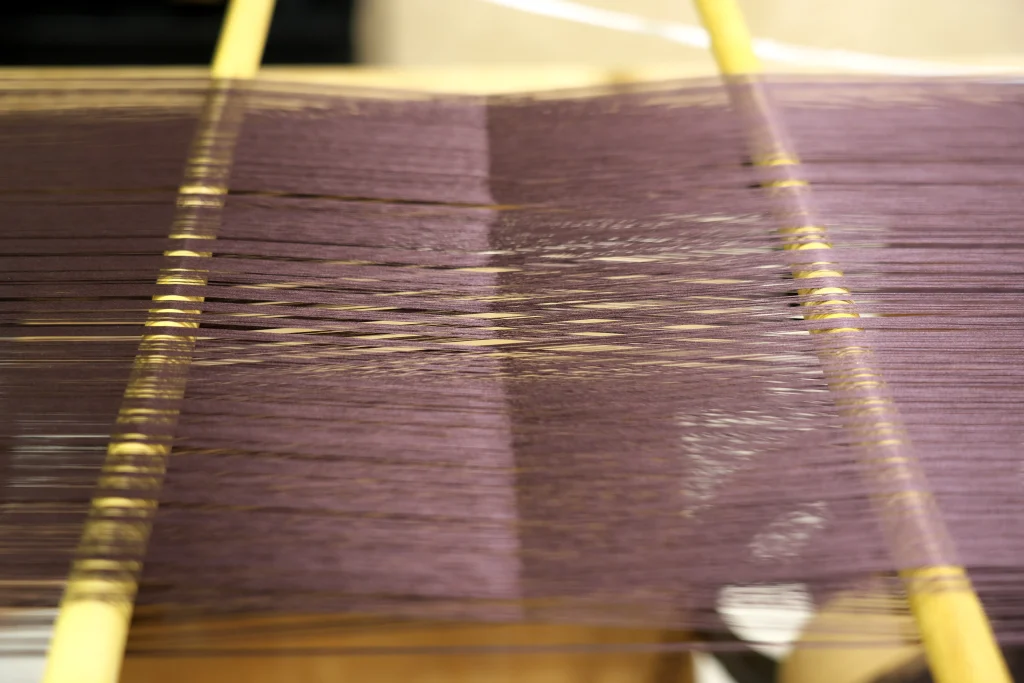
Provided by Nishijin Okamoto
The process begins long before the loom. A designer draws the pattern, and that pattern is then translated into a kind of instruction set for the weaving machine. Historically, this was done using mon-gami, punched paper cards that worked on a principle similar to early computer punch cards, where each hole told the loom which threads to raise for a given row. Today, most workshops use digital data in place of physical cards, but the underlying logic has not changed: the pattern is encoded, and the loom reads it.
Before weaving begins, the threads are dyed to the colors specified in the design. This pre-dyeing step is central to what makes Nishijin-ori what it is. Because the color is set before weaving, much of the visual outcome has to be planned in advance.
The actual weaving is divided among multiple specialists. One workshop may handle thread preparation, another the design translation, another the weaving itself. This division of labor has been part of Nishijin production for centuries and is a key reason the craft can sustain both its precision and its variety. The system looks complex from the outside, but the core idea is straightforward: design the pattern, encode it, weave it in pre-dyed thread, one row at a time.
Reference: The Process of Nishijin – Nishijin Textile Industry Association (Official Website, Japanese)
A Beginner’s Checklist: How to Look at Nishijin-ori
This is where the visit changes. At first glance, even a striking piece can still read simply as fabric. These five points give you something specific to look for.
1. Light and angle
Silk threads and metallic gold or silver yarns reflect light differently depending on the angle. Step to the side of a piece and watch how the pattern seems to shift or come forward. That movement is structural, not printed.
2.Color boundaries
In a printed textile, color edges are relatively clean because they are applied with a brush or screen. In woven cloth, the boundary between two colors is made from the interlock of different-colored threads. Look closely and you may notice subtler transitions where colors meet, because the pattern is built through interlaced threads rather than applied to the surface.
3.The reverse side
Many woven textiles carry a visible record of themselves on the back. The reverse of a Nishijin piece will not be identical to the front, but it will show the working of the pattern, the skipped floats of thread, the structure beneath. Where possible, and where staff allow it, a glance at the back tells you something about the complexity of what is holding the front together.
4.Texture and relief
Some Nishijin techniques create a raised surface where metallic threads or thick silk yarns float above the ground cloth. Run your eye across the surface at a low angle and look for that small topography.
5.Context of use
Notice where you are seeing Nishijin used. Obi (a wide kimono sash), Noh theater costumes, altar cloths, and formal room furnishings are all common applications. The fabric was designed for settings that demand both durability and ceremony, and the weight and structure of the weave reflect that function.
Kyoto’s Culture, Woven: What Nishijin-ori Tells You About the City
Nishijin-ori did not develop in isolation. It grew in a city that was Japan’s imperial capital for over a millennium, surrounded by institutions that required textiles of the highest order: the court, Buddhist temples, Shinto shrines, and the theater traditions attached to all of them. Demand from those institutions shaped what Nishijin weavers learned to make, and over generations, the neighborhood became a concentrated network of specialists, each one refining a narrow part of the process.
That model, many hands on a single piece of cloth with each craftsperson expert in one stage, is distinctly Kyoto in character. The city has long sustained craft industries built on this kind of distributed skill. Nishijin-ori is one of the clearest examples of how that urban structure translates into an object: you are not looking at the work of one person but at the coordinated output of a neighborhood.
How to Experience Nishijin Textiles in Kyoto
There are three main options, and each suits a different kind of visit.
1.Nishijin Textile Center
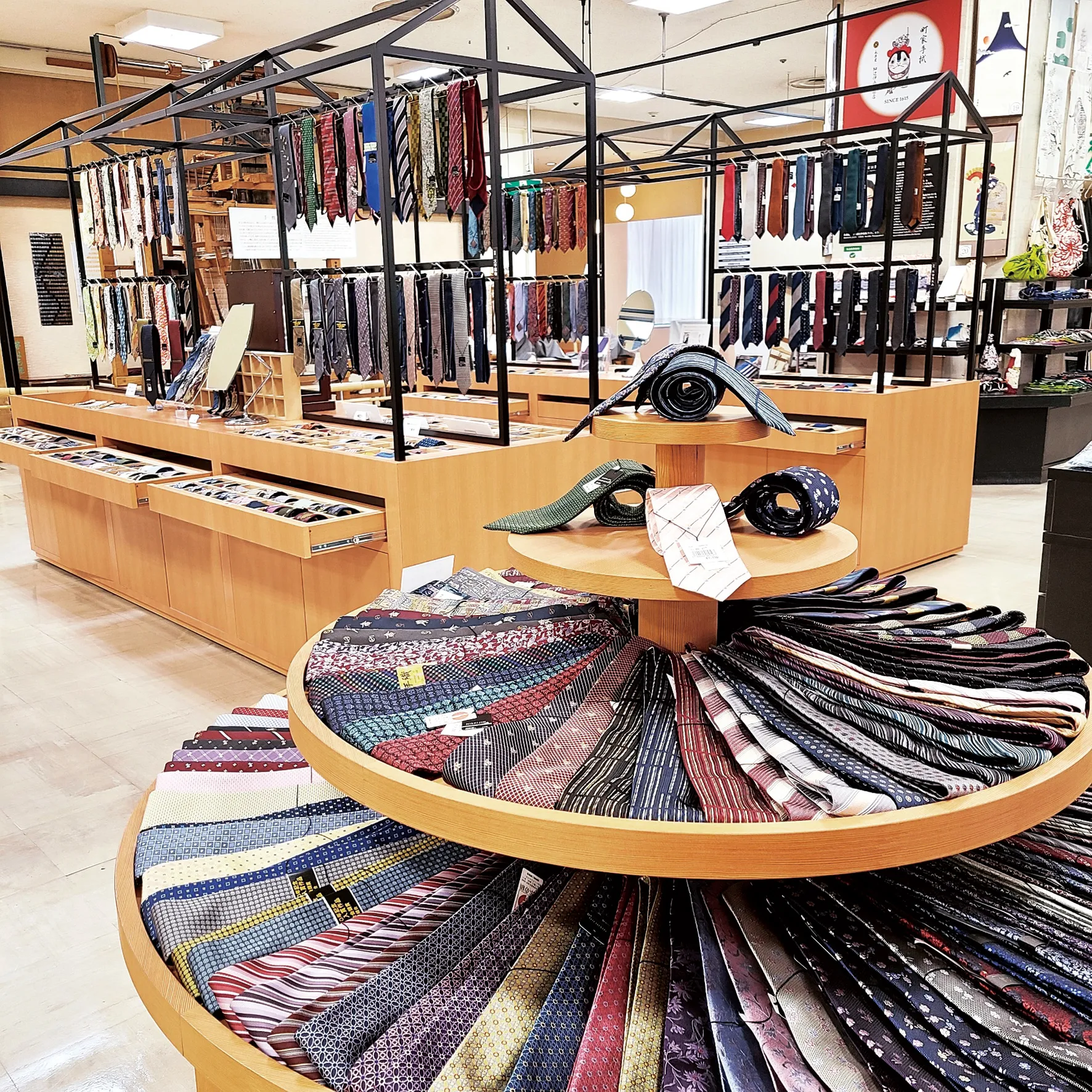
The most accessible starting point is the Nishijin Textile Center, located in the heart of the district. It offers kimono fashion shows, weaving demonstrations, and a hands-on experience section. It is designed as a gateway for visitors who want a broad overview.
2. Orinasukan Museum
A quieter, more detailed stop is Orinasukan Museum, a small handweaving museum within walking distance of the Textile Center. It occupies a traditional Kyoto townhouse and offers both a permanent exhibition and, by reservation, a hands-on weaving experience. The scale is intimate and the pace slower, which makes it easier to ask questions and look carefully. Visitors who want to spend time with the craft rather than move through it quickly will find this a better fit.
3. Kyoto Museum of Crafts and Design
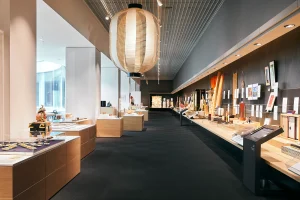
The Kyoto Museum of Crafts and Design will offer more context because it covers a wider range of the city’s traditional industries, including both Nishijin-ori and Kyo-yuzen dyeing. Seeing Nishijin-ori alongside dyeing traditions such as Kyo-yuzen can help clarify the difference between woven and dyed patterns.
If you would rather move through all three with the context already in place, our 8-day Textiles & Crafts Tour threads the Textile Center, Orinasukan, and the Museum of Crafts and Design into a single Kyoto sequence, with hands-on dyeing and braiding added so you try the logic behind the cloth rather than only look at it.
Practical Information
| Name | Address | Opening Hours | Closed |
| Nishijin Textile Center | 414 Tatsumonzencho, Kamigyo Ward, Kyoto | 10:00–16:00 (October–March)
10:00–17:00 (April–September) |
Mondays, New Year holidays |
| Orinasukan Museum | 693 Daikoku-cho, Kamigyo Ward, Kyoto | 10:00–16:00 | Mondays, New Year holidays |
| Kyoto Museum of Crafts and Design | B1F Miyakomesse, 9-1 Okazaki Seishojicho, Sakyo Ward, Kyoto | 10:00–18:00 | Irregular holidays |
A short visit, one facility plus a walk through the surrounding streets, is enough to leave with a genuine impression. A half-day, moving from exhibition to neighborhood to a second venue, gives the understanding more room to settle. The Nishijin district is walkable, and the streets around the weaving workshops retain some of the residential and industrial texture of a working craft neighborhood.
Buying or Not Buying: How to Choose
Nishijin-ori pieces range from small accessories to full kimono fabric, and prices vary accordingly. The decision to buy does not need to be made in advance. If you visit one of the experience venues, there is usually a shop attached.
If you are considering a purchase, a few practical questions are worth asking: What is the piece made from? Silk is common in traditional Nishijin work but not universal. What is it designed to be used for? How should it be stored and cleaned? These questions simply help you judge whether a piece suits your life at home.
One Thing to Remember
Nishijin-ori opens up not through study but through attention. This article gave you a few places to direct your eyes. The rest follows from looking. If you visit Kyoto and find yourself in front of a piece of woven fabric, take some time to appreciate it. The craft rewards that pause in a way that a quick glance does not allow.
For travelers who want Kyoto to feel deeper than a checklist of famous sights, craft stops like these can change the whole experience. Our 8-day Textiles & Crafts Tour is built around exactly that — moving from Kyoto’s Nishijin weaving quarter through hands-on Kyo-yuzen dyeing, kumihimo braiding, and Arimatsu shibori to Tokyo’s fabric districts, guided in English so the details stay with you after you return home. To plan your dates or ask anything about the tour, get in touch through our inquiry form.