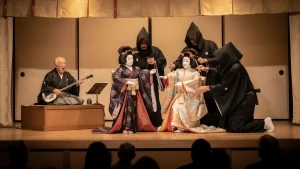
Bunraku is often described as Japanese puppet theatre, but there is much more to it than that simple phrase suggests. On stage, a narrator, shamisen music, and visible puppeteers work together, while the audience follows the story through sound, movement, and the shared focus of the theatre.
For travelers, Bunraku is also easier to approach than it may first appear. You do not need to understand every line of Japanese, and you do not necessarily need to spend an entire day at the theatre. This guide explains what Bunraku is, what to notice during a performance, and how to decide whether it fits into your Japan trip.
What is Bunraku?
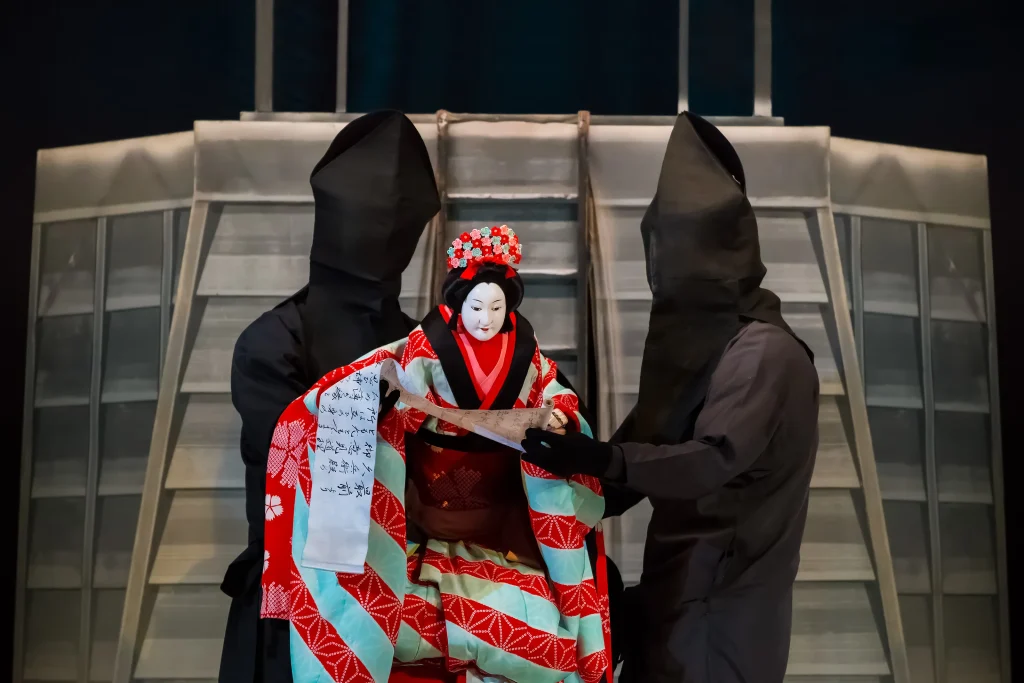
Bunraku is a traditional Japanese performing art formally known as Ningyo Johruri Bunraku. Ningyo means puppet or doll, while Joruri refers to narrative recitation, traditionally performed with shamisen music. In practice, Bunraku brings together three elements: the tayu, who narrates the story and speaks the characters’ lines; the shamisen, a three-stringed instrument that shapes the emotional rhythm; and the puppeteers, who give the characters their physical presence.
That may sound like a lot to take in, but the basic idea is simple. Bunraku is not a small puppet show hidden behind a screen. Its repertory includes historical dramas and stories of loyalty, love, family duty, conflict, and loss. The puppets create a different kind of performance from live acting, where a small tilt of the head or a slow movement of the hand can carry surprising weight.
For a first-time visitor, it can help to think of Bunraku as a story being built in front of you. The voice gives the inner life, the shamisen sets the pressure in the room, and the puppet gives the emotion a body. None of the parts works alone; the interest is in how they meet.
Reference: Ningyo Johruri Bunraku puppet theatre – UNESCO
What You See and Hear on Stage
One of the first things many people notice is that Bunraku does not try to hide how it is made. The puppeteers are visible. The tayu and shamisen player are visible too, usually seated on a platform called the yuka at the side of the stage. Instead of pretending the mechanism is not there, Bunraku lets you see the human effort behind the performance.
The tayu carries a huge part of the drama. One narrator may shift between description, dialogue, grief, anger, hesitation, and humor, sometimes voicing several characters in one scene. Even if you do not understand Japanese, the changes in pace and tone can tell you a lot about the emotional temperature of the story.
The shamisen player does not simply provide background music. The sound can sharpen a moment, hold tension, or make a silence feel heavier. Bunraku uses a futozao shamisen, a thick-necked type with a strong sound suited to dramatic narration.
The puppets are usually operated by three puppeteers. The main puppeteer controls the head and right hand, while the others control the left hand and feet. At first, your eye may jump between the puppet and the people moving it. After a while, many viewers find that the puppet begins to feel like the character, while the puppeteers fade into the structure of the stage. That shift is part of the experience.
Reference: Invitation to BUNRAKU: Performers – Japan Arts Council
Reference: Invitation to BUNRAKU: Stage – Japan Arts Council
Enjoying Bunraku Beyond the Language Barrier
Bunraku can look intimidating from the outside, especially if you are worried about language. It helps to approach it less like a test of comprehension and more like a theatre experience with several layers. Knowing the general plot before you sit down makes a big difference. Once you know who the characters are and what kind of conflict is unfolding, you can pay more attention to voice, rhythm, movement, and the mood in the room.
The small details are often the easiest way in. Watch how a puppet turns toward another character, pauses before moving, or lowers its head. Listen to the tayu’s voice when a scene becomes tense. Notice how the shamisen leaves space, then cuts through it. You may not catch every line, but you can still follow the shape of the performance.
English support can make things easier, but it varies by production. Some performances provide an English synopsis, while an English audio guide may be available for certain programs or parts. The subtitles displayed above the stage may still be Japanese only. If language support matters to you, check the English information for the exact performance before booking rather than assuming the same services are available every time.
Bunraku is still a live theatre tradition rather than something that exists only in museums. Watching it with an audience also gives you a sense of how the voice, music, puppetry, and timing work together in the room.
Reference: Bunraku performances and upcoming events – Japan Arts Council
A Short History: Osaka, Joruri, and Bunraku’s Roots
Bunraku’s roots are closely tied to Osaka and to ningyo joruri, the older name for puppet theatre combined with narrative music. The form developed around the early Edo period, when commercial cities such as Osaka had lively entertainment districts and audiences who enjoyed story-driven performance. It grew in a city of merchants, theatres, writers, performers, and paying audiences.
Two names are especially useful to know. Takemoto Gidayu helped shape the style of dramatic narration associated with Bunraku, and the Takemoto-za theatre opened in Dotonbori in 1684. Chikamatsu Monzaemon, often remembered as one of Japan’s major playwrights, wrote for puppet theatre as well as Kabuki. You do not need to memorize these names to enjoy a performance, but they give some context on why Osaka matters in the story of Bunraku.
Today, the site of the old Takemoto-za theatre is one of the places that connects modern Dotonbori with this older theatre culture. The area is now better known for lights, food, and crowds, but Bunraku gives another way to read Osaka’s history.
Reference: The Site of Takemotoza Theater – Osaka Chuo Ward Official Tourism Portal
Bunraku, Kabuki, and Noh: a Simple Comparison
Bunraku is sometimes mentioned alongside Kabuki and Noh, but the three are quite different in the theatre. Kabuki is actor-centered, with bold makeup, costumes, poses, and stage effects. Noh is older and more minimal, using masks, chant, dance, and controlled movement. Bunraku sits somewhere else: the emotional focus comes through puppets, narration, and shamisen music working together.
| Art form | What you mainly watch | General feel |
|---|---|---|
| Bunraku | Puppets, narrator, shamisen | Detailed, emotional, craft-focused |
| Kabuki | Actors, makeup, costumes, stage effects | Bold, visual, dramatic |
| Noh | Masks, chant, slow movement | Minimal, symbolic, quiet |
Each offers a different way into Japanese theatre. If you are drawn to craftsmanship, storytelling, and the unusual experience of watching the performers create a character in full view, Bunraku may be the most interesting of the three for you.
Read more: Noh and Kabuki: 2 Very Different Ways to Experience Traditional Japanese Theatre
Is Bunraku Worth Seeing on a First Trip to Japan?
Bunraku is not something every first-time visitor needs to fit into an already crowded itinerary. If your time in Osaka is very limited and traditional theatre does not interest you much, there is no reason to force it in.
It may be a particularly good choice if you enjoy theatre, storytelling, craftsmanship, traditional culture, or simply seeing a side of Osaka that is different from its food and nightlife image. The fact that the puppeteers remain visible also makes Bunraku interesting even for people who would not normally think of themselves as puppet-theatre fans. You are watching both the story and the skill required to make the story work.
The important thing is to check the actual program before deciding. Some performances require a substantial block of time, while others are easier to fit around sightseeing.
Where to See Bunraku in Japan
For most travelers, the clearest place to see Bunraku is the National Bunraku Theatre in Osaka. It is in Nipponbashi, about a one-minute walk from Nippombashi or Kintetsu-Nippombashi Station, and close enough to Namba and Dotonbori to combine with a normal day in central Osaka.
Major Bunraku productions generally take place in January, April, July to August, and November, with beginner-oriented performances usually held in June. Bunraku is therefore not something you can assume will be running on any random date.
Programs are often divided into separately ticketed parts, and the length of each part can vary considerably. Some take several hours, while particular seasons may include a shorter part that works more easily as an evening activity.
Selected productions also offer single-act tickets for visitors who want a shorter introduction. These should be treated as a flexible option rather than the basis of an overseas itinerary. At the National Bunraku Theatre, recent single-act arrangements have generally involved limited same-day sales at the theatre rather than advance reservations, and the exact rules can change by program. Check the single-act information for your specific performance before relying on it.
Regular performance tickets can be purchased through the Japan Arts Council online, by phone, or at the theatre ticket office. Collection arrangements depend on the booking method, so follow the instructions shown when you reserve.
If your Osaka dates do not match a performance, the National Bunraku Theatre also has a free exhibition room with rotating displays related to Bunraku. Depending on the exhibition, you may see puppet heads, costumes, instruments, or other material used to explain the art form. It is not a substitute for seeing Bunraku live, but it can still be worth a look if you are already in the area.
Tokyo also has Bunraku performances, but the situation requires more checking. The National Theatre in Tokyo is currently closed for redevelopment, so productions use different venues depending on the run. Rather than looking for one permanent Tokyo Bunraku theatre, check the current Japan Arts Council calendar for the dates of your trip.
Reference: Bunraku at the National Bunraku Theatre – Japan Arts Council
Reference: National Bunraku Theatre, Osaka – Japan Arts Council
Reference: Ticket Information – Japan Arts Council
Adding Bunraku to Your Japan Itinerary
Bunraku works best on a trip when it is not treated as an isolated cultural assignment. Because the National Bunraku Theatre is right by Nippombashi Station, it can fit naturally into a day around Namba, Nipponbashi, Kuromon Market, or Dotonbori.
The main thing to check is time. A full part can take a few hours, so look at the running time rather than assuming that “seeing Bunraku” has one standard duration. If a shorter part or suitable single-act option happens to be available, it may fit comfortably after sightseeing. If the program is longer, it is better to let the theatre become the main event for that part of the day instead of squeezing too much around it.
This is also why checking Bunraku early in the planning process helps. The performance calendar, ticket structure, language support, and running times can all affect how easily it fits your route.
For travelers who specifically want Bunraku to be part of their Osaka experience, ENJYU JAPAN also offers a 4-Day Osaka Bunraku Tour built around the theatre’s performance calendar. The itinerary connects the performance with Bunraku-related places in Osaka as well as other city highlights.
If those dates or that itinerary do not fit your trip, Bunraku can also be incorporated into a Tailor-Made Tour when the performance schedule allows. It does not need to become the center of your whole journey. Sometimes one well-placed performance is enough to show you a side of Osaka that you might otherwise miss.