Yamanaka lacquerware takes its name from the wood, not the coating on top. In Ishikawa’s lacquer country each town is known for a different part of the same object, and Yamanaka is known for the turned wooden body underneath — the bowl before it is ever painted. The workshops that make it, the school that teaches it, and the hot spring that gave it a market all sit in one small town in the Kaga hills, which makes it one of the few Japanese crafts you can watch being turned and then sleep beside. This is about seeing that and planning the stop — the wood, the town, and how to get there — rather than the chemistry of the lacquer itself.
What makes Yamanaka different: the wood, not the lacquer
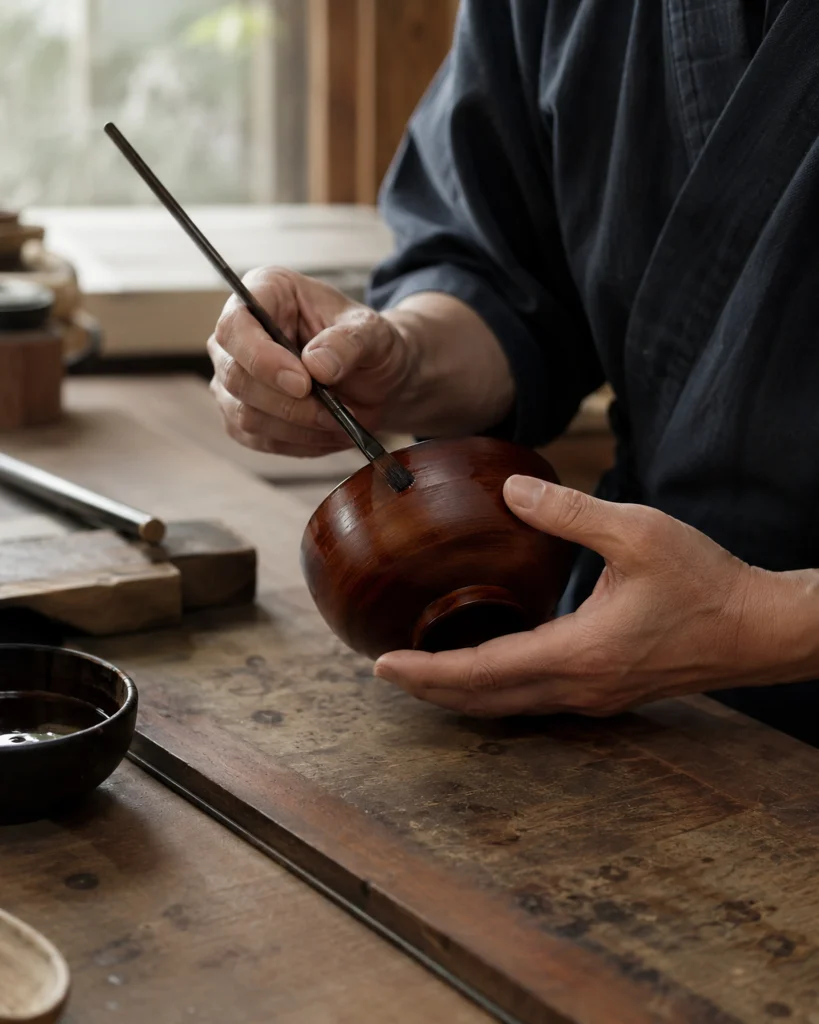
Pick up a Yamanaka bowl and the first thing you notice is that you can see the wood. Where much Japanese lacquerware hides its grain under an opaque, polished surface, the Yamanaka signature is the opposite — a wiped finish that leaves the grain showing, and walls sometimes turned thin enough to pass light. All of that follows from a single decision made before any lacquer touches the wood: how the block is cut from the log.
| Centre | The part it’s mastered | Japanese term |
| Wajima | The lacquering | nuri |
| Kanazawa | The gold decoration | maki-e |
| Yamanaka | The turned wooden body | kiji |
Yamanaka turners use tatekidori, taking the blank in the direction the tree grew, so the grain runs up the wall of the bowl rather than across it. Worked along its growth direction rather than against it, the wood distorts less as it dries and the finished piece resists warping. That stability is what lets a turner cut walls thin enough to glow against a light, and shape tight-fitting lidded vessels a cross-cut blank would struggle to hold. Cut vertically rather than the more common horizontal way, the wood makes for unusually durable ware.
Reference: Yamanaka Lacquer Ware – Art Research Center, Ritsumeikan University
It also explains why Yamanaka produces more turned wood blanks than anywhere else in Japan. Once you can read the grain, a shop window stops being rows of bowls and becomes rows of decisions made at the lathe.
A craft the hot spring created
This craft came together in reverse: it did not begin as an art that later found a home near a spa, it began with the wood. Around the Tenshō era (1573–1592), a band of kijishi — itinerant woodturners who moved from mountain to mountain living off the bowls they turned — crossed over from the neighbouring province of Echizen and settled at Masago, upstream of the spring, for the timber. Turning came first. Lacquering and maki-e were borrowed later, in the Edo period (1603–1868), from Aizu, Kyoto and Kanazawa.
What turned a woodturning settlement into an industry was the spring itself. As the resort grew, the trays, plates and toys the turners made were sold to bath guests as souvenirs, and that souvenir trade is what made Yamanaka a production centre. The onsen did not host the craft so much as create its market.
None of this sits behind glass. One residential block in town is officially registered as the “Lacquerware Estate,” with roughly 370 people living at that address — the craft is written into the postal system, not just the museum case. Yamanaka earned national recognition as a designated traditional craft on 10 May 1975, and its turning lineage is still headed by a Living National Treasure, the title Japan gives a master of an intangible skill it wants kept alive.
Reference: Yamanaka-nuri – Association for the Promotion of Traditional Craft Industries
Where to watch it being made
Most craft towns let you buy the object; Yamanaka lets you watch it being made, and it pays to go in the right order. Start at the Yamanaka Lacquerware Traditional Industry Hall, the town’s public craft hall. Entry is free, it runs a woodturning demonstration on the rokuro, the potter’s-wheel-like lathe the work is shaped on, and it sells the full range — everyday tableware up to museum-grade pieces — at production-area prices, lower than the same work costs further down the line. It is the one place to see the craft and buy it in the same visit.
Next door stands the Ishikawa prefectural technology centre, the only training school for traditional turned-wood work in Japan. On weekdays you can watch trainees at the lathe for free — not a staged demonstration but people actually learning the trade, which is the rarer thing to catch. Then walk down to Yamanaka-za, the public hall beside the bathhouse: entry is free, and its lacquered pillars and gold-decorated coffered ceiling were built by a cumulative 1,500 local artisans, so the building is itself the object on display.
A Turner’s-Eye Checklist: How to Look at a Yamanaka Piece
- Grain direction. It runs vertically, up the wall of the bowl, following the tatekidori cut. 2. The fine turned rings. Look for incised concentric or spiralling lines — kashokubiki, decorative turning, which runs to 22 named patterns across those two families. 3. Thinness. Hold it to the light; a wall thin enough to glow is usubiki, thin-turning, and only the grain direction makes it stable. 4. The finish. A wiped-lacquer surface — fukiurushi — that lets the grain show rather than burying it is the Yamanaka hallmark. 5. Tool marks. Every turner forges his own blades, so no two makers’ cuts are quite the same.
One detail to pin down before you build a day around it: the hall is open 9:30 to 16:30 and closed Wednesdays, though a Wednesday that lands on a public holiday stays open.
Reference: Yamanaka Lacquerware Traditional Industry Hall – KAGA Tabi-Machi Net (Kaga City Tourism) (Official Website, Japanese)
And to save you the disappointment: the individual turners’ workshops are private businesses, not open to walk-ins. The hall, the training centre and Yamanaka-za are the places meant for visitors — not someone’s working shopfloor.
The town the craft made: the gorge, the bridges, the bath
You could see all of that in a morning, which is exactly why the town is worth a night. The craft grew up along a river gorge, and the gorge is the walk. Kakusenkei follows the Daishōji River for about 1.3 kilometres, from Kōrogi-bashi at the upstream end down to Kurotani-bashi, and taking it downstream drops you back near the town centre and the bath at the finish. Three bridges punctuate it: Kōrogi-bashi, built entirely of hinoki cypress; the stone arch of Kurotani-bashi from 1935; and Ayatori-hashi, a 94.7-metre S-curve designed by Hiroshi Teshigahara, who led the Sōgetsu school of ikebana, the art of arranging flowers.
At the lower end sits Kiku-no-Yu, the public bath, whose name — “chrysanthemum bath” — comes from a verse the poet Matsuo Bashō wrote here in 1689 while walking the route he recorded in Oku no Hosomichi, his journal of the deep north. The men’s and women’s baths are two separate buildings standing side by side, so queue at the right door rather than the nearest one.
From spring through late autumn, a kawadoko — a seasonal tea terrace laid out on the riverbank — serves roasted-stem Kaga bōcha tea at the water’s edge. There are no reservations; you simply walk up, and it shuts in rain or when the river runs high. A seat with tea runs 700 yen, or 200 yen if you’re staying at a local inn.
Reference: Kakusenkei Kawadoko – Yamanaka Onsen Tourism Association (Official Website, Japanese)
Getting there, and when to go
Kaga Onsen joined the Hokuriku Shinkansen — the bullet-train line running up the Sea of Japan coast — when the route extended in March 2024. From Tokyo it is roughly two hours fifty on a Kagayaki service, which reads like a commitment. The more useful number is the small one: Kaga Onsen is only 15 to 18 minutes from Kanazawa by Shinkansen. If Kanazawa is already on your route, Yamanaka is less a special expedition than an easy overnight down the same line.
| Site | Access & what you do | Hours | Admission · closed |
| Yamanaka Lacquerware Traditional Industry Hall | CANBUS loop stop 17 or local bus; woodturning demo and shop at production-area prices | 9:30–16:30 | Free · closed Wed (open if a public holiday) and New Year |
| Ishikawa Prefectural Yamanaka Lacquerware Industry Technology Center | Adjoins the hall, ~24 min bus from Kaga Onsen Stn; watch trainees at the lathe (weekdays) | Exhibit rooms 9:00–17:00; training floor 10:00–16:00 | Free · closed weekends, holidays, and 3/21–4/7, 8/1–8/20, 12/25–1/10 |
| Yamanaka-za | Beside Kiku-no-Yu (stop 19); lacquered maki-e hall, with local geiko — the regional word for a geisha — dancing on weekend and holiday afternoons | 8:30–22:00 | Free entry (dance ¥700) · open daily |
| Kiku-no-Yu public bath | Beside Yamanaka-za; soak where Bashō did — men’s and women’s are separate adjoining buildings | 6:45–22:00 | ¥500 · closed 2nd & 4th Tue (next day if a holiday) |
From the station you finish by bus, and the last mile has a few catches worth knowing first. The CANBUS sightseeing loop circles the Kaga hills in one direction only — a day ticket is 1,300 yen, a single ride 500. The local route bus is cheaper and faster, but it takes a contactless credit card and not a transport IC card, so the Suica or ICOCA that carried you from Tokyo is dead weight here. You take a numbered ticket as you board and drop it with your fare in the box by the driver as you leave. And not every service runs the whole line: for Kiku-no-Yu and Kōrogi-bashi, you want a Kayano-bound bus.
Reference: Yamanaka Onsen Route Bus – KAGA Tabi-Machi Net (Kaga City Tourism) (Official Website, Japanese)
Then the timing, which is genuinely back-to-front. The training floor where you watch trainees turn is open weekdays only, and closes for three seasonal breaks — roughly 21 March to 7 April, 1 to 20 August, and 25 December to 10 January. Those windows cover cherry-blossom season, Obon and the New Year — the exact weeks most visitors come are the weeks the lathes sit idle. Come on a weekday in late May or October instead, and there will be people at work.
Reference: Ishikawa Prefectural Yamanaka Lacquerware Industry Technology Center – Ishikawa Tourism Federation (Official Website, Japanese)
There is one exception worth planning around. On 3 and 4 May, two back-to-back national holidays inside Golden Week, the makers’ cooperative runs the Yamanaka Lacquerware Festival from 9 a.m. to 5 p.m. on the plaza between the bathhouse and Yamanaka-za — the one weekend a year the turners sell straight off the street at production-area prices, with extra shuttle buses laid on for it. It is also the single busiest travel week in the country, so the trade-off is real: the best direct-from-maker prices against the heaviest crowds Japan sees all year.
Reference: Yamanaka Lacquerware Festival – Yamanaka Onsen Tourism Association (Official Website, Japanese)
A bowl made to be used
For all its history, Yamanaka ware is made to be used. The town’s signature piece is a plain wiped-lacquer bowl that shows its grain rather than hides it, turned thin and sold where it was made at production-area prices — something you eat from, not something you shelve. The deeper ground on urushi itself — how the lacquer is worked, how to choose a piece, how to care for one at home — belongs to a fuller guide.
Read More: Japanese Lacquerware
If you are already routing a longer trip through Kanazawa, Kaga Onsen is fifteen minutes down the same line — an easy overnight where you can watch a bowl being turned and then soak in the bath Bashō praised. If a slower, craft-led detour like this suits the trip you have in mind, ENJYU JAPAN can build it into a Tailor-Made Tour.