January in Japan isn’t one month. It’s three. Until the fifth, the country is with its families and the bullet trains run without unreserved seats. The ninth to the eleventh is a long weekend, and everything moves again. Then, from the twelfth, it all drains away, and what’s left is the emptiest, snowiest, best-value Japan of the year. The snow, incidentally, is not the gamble people think it is. The dates are.
The Snow Question, Answered Honestly
Most January guides answer “does it snow in Japan?” with a shrug and a photograph. Here’s the flat version: go north and snow isn’t a possibility, it’s the floor you walk on. Stay in Tokyo or Kyoto and it settles now and then — a rare chance rather than a given.
The two ends of that are further apart than people expect. In an average January, Sapporo has snow lying on the ground on 31 days — the whole month. Tokyo gets a day of snowfall reaching 1 cm roughly once every eighteen months.
Kyoto is where the misreading happens. Snow is observed falling in Kyoto on about 16 days in an average January, which is half the month. Snow actually lying 1 cm deep happens on about 1.3 days. The photographs of a white Kinkaku-ji are real — it does settle there, most winters, for a day or so. You just can’t book which day.
So the planning question in January isn’t whether to chase snow or dodge it. It’s how many nights you put on the snowy side of the country. Which raises the obvious follow-up: how dependable is that side, really?
What the Last Six Years Actually Did
Rather than argue about it, here is what fell on Sapporo in each of the last six Januaries.
| January | Sapporo snowfall, month total |
| 2021 | 137 cm |
| 2022 | 182 cm |
| 2023 | 117 cm |
| 2024 | 161 cm |
| 2025 | 80 cm |
| 2026 | 242 cm |
| 30-year normal | 137 cm |
Read it carefully, because it doesn’t say what a warming-world story would say. There’s no trend. It scatters. 2025 came in at about 60% of normal; the very next January delivered nearly double. Three times as much snow fell in 2026 as in 2025.
But look at the floor. The worst of those six years still dropped 80 cm on the city in a single month — more snow than most readers see in an entire winter at home. So the answer to “will there be snow” is yes, and has been yes six years running. What’s actually uncertain is the quantity, not the existence.
The picture changes at lower altitude, and it’s worth being straight about that. The Shirakawa-go light-up now runs on four nights a year, and the village office gives its reasons plainly: shorter daylight, and a shortage of snow linked to a warming climate. That’s not a travel writer’s framing. That’s the organisers themselves declining to assume the snow will be there.
The useful split, then: in Hokkaido and the high ground of Nagano and Niigata, snow is something you can design an itinerary around. In the lower valleys, it’s something to hope for with a fallback in your pocket.
Three Different Januaries
The month has three distinct shapes in 2027, and they want completely different things from you.
January 1–8: The Country Is at Home, And That’s Rather the Point
January 1, 2027 falls on a Friday, so the New Year holiday runs straight into the weekend and much of the country is off until Sunday the third.
The most concrete signal of where the pressure sits comes from the railways. JR Central and JR West run every Nozomi between Tokyo and Hakata as all-reserved — no unreserved cars whatsoever — from December 25, 2026 through January 5, 2027. That’s the operator publishing its own crowding forecast. Hikari, Kodama, Mizuho and Sakura keep their unreserved seats throughout.
The “everything closes” line you’ll read elsewhere is not accurate. Shrines are at their busiest of the year. Museums each make their own call, some shutting for several days and others opening on January 1 with a special programme. Many small independent places do take three or four days off. Nothing shuts uniformly; the first few days simply need checking rather than assuming.
What you get in exchange exists nowhere else on the calendar: a country visibly doing the same thing at the same time.
January 9–11: The Hinge
Coming of Age Day is always the second Monday, which puts it on January 11 in 2027 and makes the ninth to the eleventh a three-day weekend. Japan travels.
Don’t assume the New Year rush is over by then. Those exact three days are a second all-reserved window for the Nozomi — no unreserved seats, again, on every train between Tokyo and Hakata.
And the calendar stacks. Toka Ebisu in Osaka runs the ninth, tenth and eleventh. The January sumo tournament opens on the tenth. The first of Shirakawa-go’s four light-up nights is the eleventh, and it is reservation-only — turning up on the day gets you nothing.
Both choices are defensible. Aim at this weekend and you catch three things at once. Step around it and everything gets easier. What doesn’t work is arriving inside it having decided neither.
January 12–31: The Quiet Window
From the twelfth, the pressure lifts. The all-reserved period ends, rooms open up, and the country stops travelling.
Nothing about the programme thins out, though. Sumo runs to the twenty-fourth. The fire festival is the fifteenth, the To-ji market the twenty-first, Nara’s hillside burn the fourth Saturday. Shirakawa-go lights up on the seventeenth, twenty-fourth and thirty-first. A major exhibition opens in Tokyo on the nineteenth.
And the snow deepens rather than retreats — late January into early February is the coldest stretch of Sapporo’s year.
If this article has a single recommendation, it’s January 12 to 29.
What’s On in January 2027
The month is not thin. It’s dense — but almost every item is pinned to a date, so where you sit in the month decides what you see.
| Dates (2027) | Event | Where |
| From Jan 1 | Hatsumode at Meiji Jingu | Tokyo |
| Jan 9–11 | Toka Ebisu | Osaka |
| Jan 10–24 | Grand Sumo January Tournament | Tokyo |
| Jan 11, 17, 24, 31 | Shirakawa-go Light-up | Gifu |
| Jan 11-15 | Nozawa Onsen Dosojin Fire Festival | Nagano |
| Mid-Jan onward | Motobu Yaedake Cherry Blossom Festival | Okinawa |
| Mid-Jan onward | Snow sculptures under construction | Hokkaido |
| Jan 19 – Mar 14 | Special exhibition: The Tale of Genji | Tokyo |
| Jan 21 | Hatsu-Kobo market at To-ji | Kyoto |
| Jan 23 (4th Sat) | Wakakusa Yamayaki | Nara |
Hatsumode | Tokyo
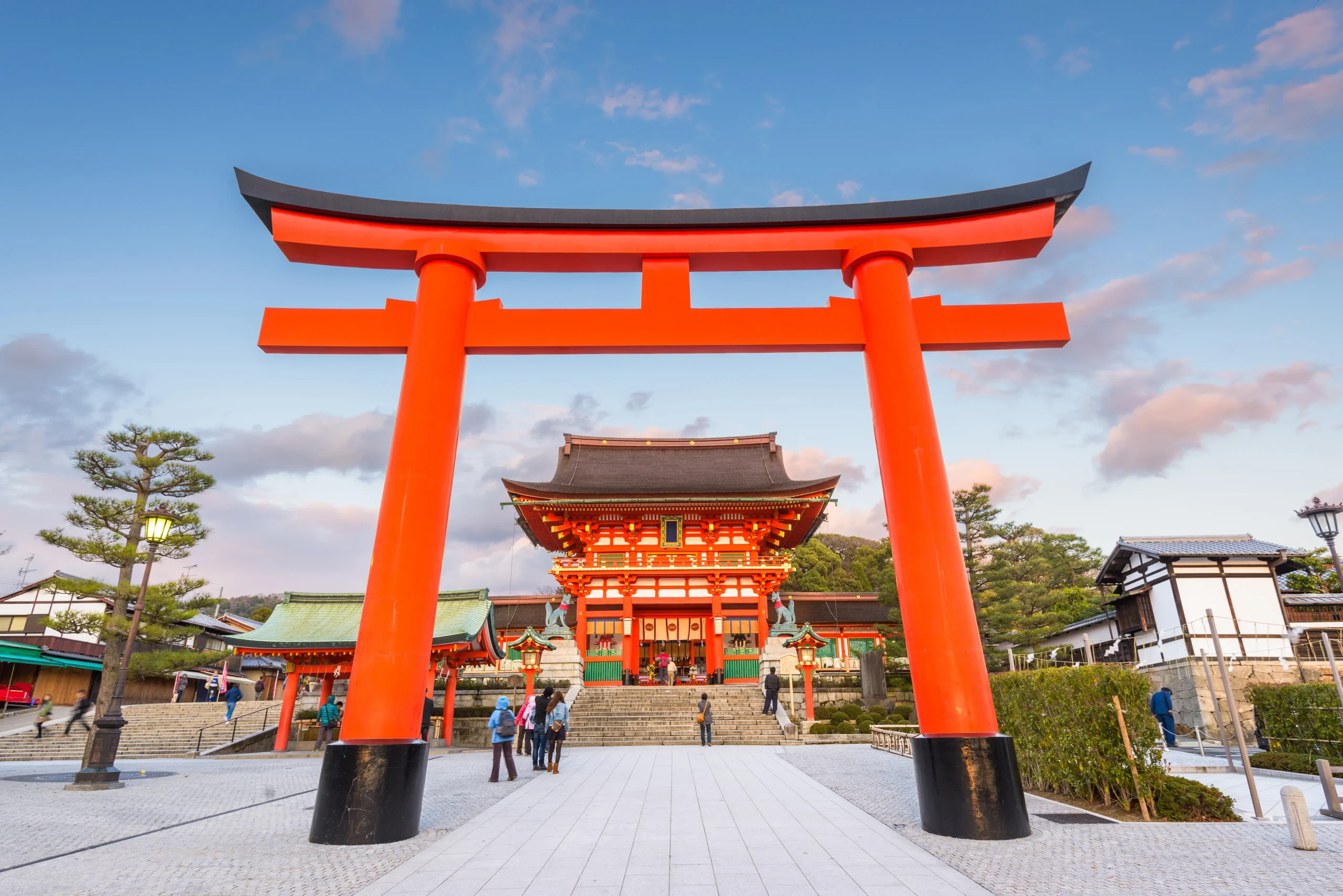
The first shrine visit of the year peaks January 1–3 and then continues quietly all month. Meiji Jingu asks people to spread out and publishes exactly when not to come: 10 p.m. on New Year’s Eve through 3 a.m., and anything after 10 a.m. during the first three days. From January 5, only the Yoyogi entrance opens. Early morning, or after the fifth — the shrine has already answered the question for you.
Reference:Meji Jingu Hatsumode
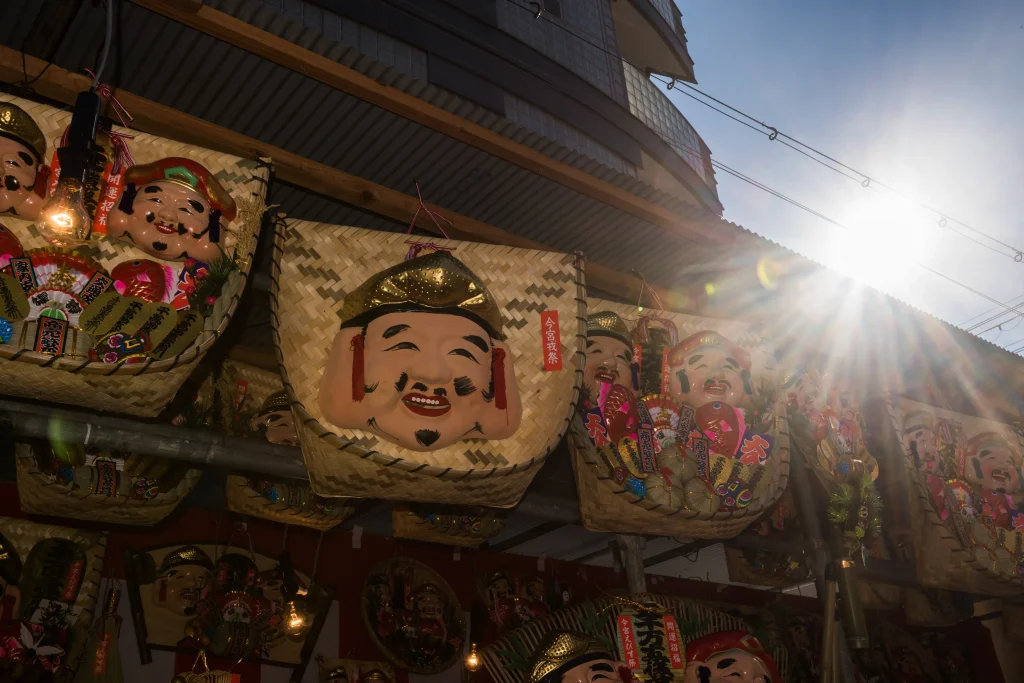
Toka Ebisu | Osaka
Three days of asking Ebisu for a good business year at Imamiya Ebisu Shrine — the ninth is the eve, the tenth the main day, the eleventh the closing. The dates never move, which in 2027 drops the whole thing onto the long weekend. It is loud in exactly the way the first days of January are quiet.
Reference:Toka Ebisu
Grand Sumo January Tournament | Tokyo
Fifteen days at Ryogoku Kokugikan, January 10 to 24, so anyone in Tokyo mid-month overlaps it whether they planned to or not. Tickets go on sale December 5, 2026, and the ranking sheet that tells you who’s fighting comes out on the twenty-first.
Reference:Grand Sumo January Tournament
Shirakawa-go Light-up | Gifu
The thatched village lit after dark, on four nights only: January 11, 17, 24 and 31. It’s fully reservation-based with ticketed entry, and there is no walking up on the night. Reservation details were still being worked out as of Sep-2026 and go live on the association’s site from September. On light-up days, daytime coach access closes off in the afternoon.
Reference:Shirakawa-go Light-up
Nozawa Onsen Dosojin Fire Festival | Nagano
Every January 15, designated an Important Intangible Folk Cultural Property in 1993. Men in their unlucky year defend a huge timber shrine while the rest of the village attacks it with fire. The part that decides whether you see it: admission tickets go only to Nozawa Onsen residents and to guests staying overnight in the village. You book the bed first, or you don’t go. In 2027 it falls on a Friday.
Motobu Yaedake Cherry Blossom Festival | Okinawa
While Honshu waits for spring, roughly 7,000 kanhizakura open along four kilometres of road climbing Yaedake, a 453-metre hill in northern Okinawa. Motobu Town runs it from mid-January into early February and calls it Japan’s earliest — a claim the calendar supports. The town posts bloom updates as they happen, and a shuttle runs to the park.
Snow Sculptures Under Construction | Hokkaido
The Sapporo Snow Festival itself is February 4–11, 2027, so a January trip misses it. But the frames go up in Odori Park in late December, get packed with snow in early January, and are stripped and rough-cut from mid-month. Come in the second half of January and you get the sculptures being made, at close range, with almost nobody watching.
Special Exhibition: The Tale of Genji | Tokyo
Opens at Tokyo National Museum on January 19 and runs to March 14 — a proper indoor afternoon for the second half of the month, and one of the few things on this list that a cold snap can’t take away from you.
Reference:Tokyo National Museum – The Tale of Genji
Hatsu-Kobo Market | Kyoto
To-ji holds a market on the twenty-first of every month, and January’s is the year’s first, which makes it the big one. Over a thousand stalls of antiques, old tools, old clothes and food; around 200,000 people across the day; held in the rain. January 21, 2027 is a Thursday.
Wakakusa Yamayaki | Nara
The fourth Saturday of January, which in 2027 should be the twenty-third. Around 600 fireworks go up, and then roughly 300 local firefighters set 33 hectares of hillside alight above the old capital. Nara Prefecture confirms the date closer to the time.
Reference:Wakakusa Yamayaki
What the Weather Actually Does
Sapporo and Naha in January are two different countries.
| City | Avg. daily high | Avg. daily low | Sunshine hours | Snow on the ground |
| Sapporo | −0.4°C / 31°F | −6.4°C / 20°F | 90 | ~31 days |
| Tokyo | 9.8°C / 50°F | 1.2°C / 34°F | 193 | ~1 day |
| Kyoto | 9.1°C / 48°F | 1.5°C / 35°F | 124 | ~1 day |
| Naha | 19.8°C / 68°F | 14.9°C / 59°F | 93 | none |
January normals, 1991–2020.
Two of those columns tend to reset expectations.
Tokyo is cold, but it is not grey. At 193 hours of sunshine it is one of the brightest months Tokyo gets, and with under 60 mm of rain, one of the driest. Cold, dry and blue is excellent walking weather once you’ve got the coat right.
Naha inverts it. The temperature is genuine — you’ll carry the coat rather than wear it. But 93 hours of sunshine is less than half of Tokyo’s, and the Meteorological Agency describes Okinawa’s winter without any softening: cloud and rain that keep arriving, because cold continental air picks up moisture crossing the warm East China Sea, and January sunshine there falls under 100 hours. Warm and sunny are separate purchases in Japan in January.
Packing falls out of the table rather than a checklist. Layers you can strip, because trains, shops and hotels are heated hard and you will be indoors and outdoors a dozen times a day. Boots with grip if you’re going north, where the ground stays covered for the whole month.
If the Snow Isn’t the Point
Not everyone books a winter trip for winter, and January doesn’t ask you to.
Japan’s cherry season has already started
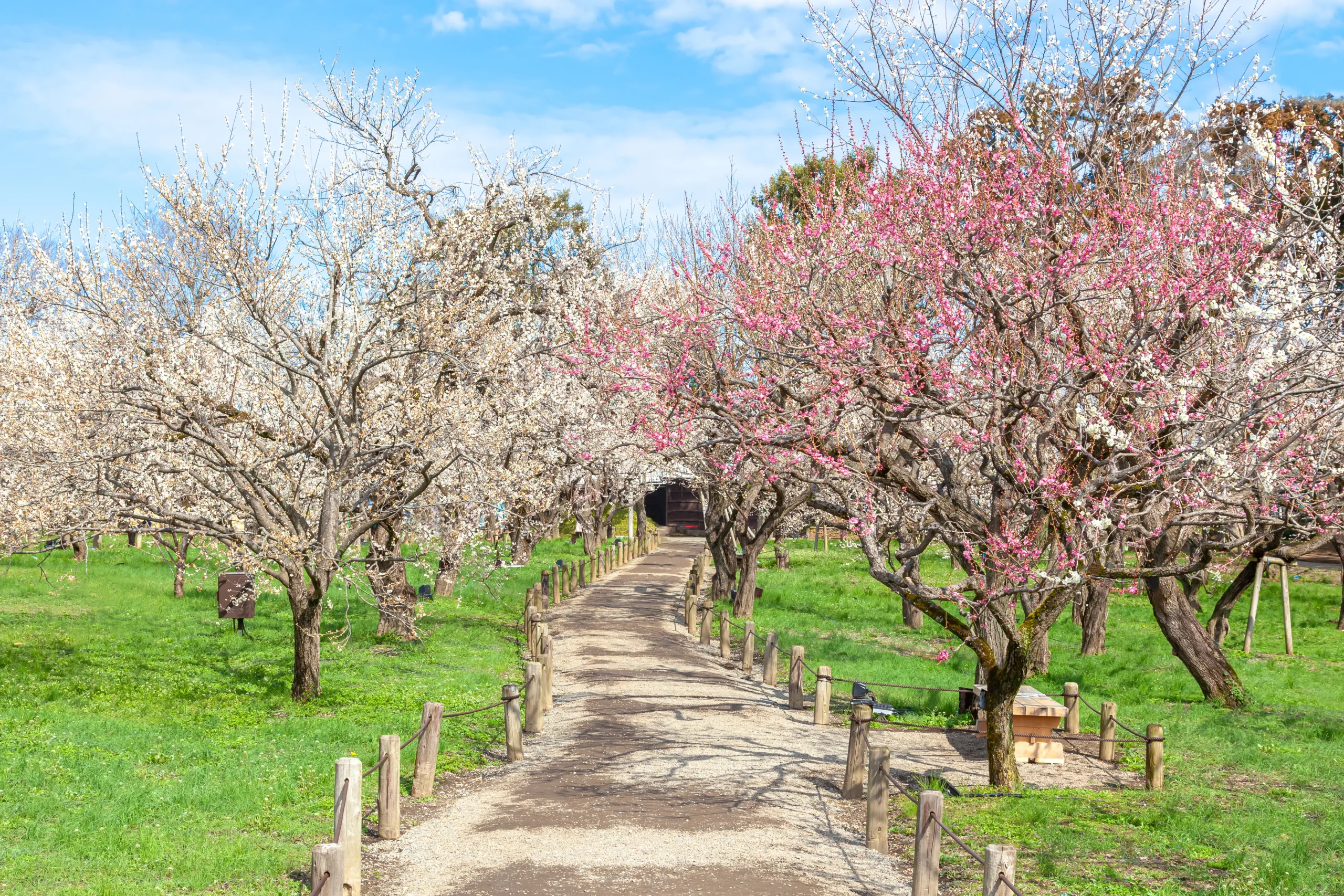
Not with the Somei-yoshino everyone photographs — those open in Tokyo around March 24 on the thirty-year average, and in Sapporo around May 1. But the kanhizakura in Okinawa open, on average, on January 16. Over the last six years the Meteorological Agency logged Naha’s first blossoms on January 4, 11, 7, 13, 5 and 18. The season doesn’t begin in spring. It begins now, at the other end of the country, in a different colour.
Yaedake is where that becomes a place you can stand in. Be honest with yourself about the light, though: those 93 sunshine hours apply to the blossoms too, and the postcard version with a blue sky behind it is not the average day.
If blossoms aren’t it either
And if neither snow nor blossoms is the draw, January still has a thousand stalls at To-ji, fifteen days of sumo, a major exhibition, and the simple fact of having the country to yourself. As for the onsen — the reason hot water is worth crossing the world for in January is not mystical. It’s that the air outside is below freezing.
Booking and Timing
January is emptier, and that part is true: hotel occupancy nationwide ran at 53.1% in January 2026, against 61.8% averaged across 2025 as a whole.
But “off-season” describes the country, not your hotel, and three exceptions catch people. Tokyo ran at 78.9% that same month — the highest of any prefecture. The New Year days are among the busiest of the year. And snow regions run backwards to everywhere else: January is their peak, in demand and in rates.
The other half of timing has nothing to do with price. Several things in January close before you arrive:
- Shirakawa-go light-up — reservation-only across four nights, no walk-ins. Booking details go live from September 2026.
- Nozawa Onsen fire festival — you need a bed in the village. There is no other way in.
- Sumo tickets — on sale from December 5, 2026.
- Nozomi reserved seats — general sale one month ahead at 10 a.m.; Smart-EX and Express Reservation open a year out.
One lever worth knowing about: reserved-seat fares change with the season, so shifting a departure by two days often makes the same journey both cheaper and easier to book.
Planning a January Trip with Room to Move
Notice that none of these dates are pulling in the same direction. The fire festival wants you in one specific village on the fifteenth. Shirakawa-go offers four nights and no walk-ins. Sumo starts on the tenth. The Nozomi has no unreserved seats until the fifth, then none again from the ninth to the eleventh. The snow festival is in February.
And underneath all of it, the snow itself swings from 80 cm to 242 cm depending on which year you happen to book. Room to move isn’t a nice sentiment in a January itinerary — it’s what that number requires.
That’s the work we do at ENJYU JAPAN. A Tailor-Made Tour is built backwards from the dates that won’t move, and our regional guide network means a thin snow year, or a light-up you couldn’t get a place on, has an answer already waiting in the same valley. If January 2027 is on your mind, we’d be glad to think it through with you.