Ainu history is not only a story from Japan’s distant past. The Ainu are an Indigenous people of the north, closely connected with Hokkaido, with their own language, culture, memories, and modern lives. For travelers, even a little of this history changes their perspective of the island: place names, museum displays, robes, carved tools, rivers, and fishing traditions start to feel connected and different from other parts of Japan. This guide follows the arc from northern cultural roots and Ezochi trade networks to modern recognition and cultural revival.
The Ainu Are Not Only a Story from the Past
Some first-time visitors to Japan assume the Ainu belong entirely to history: a people who existed once, left artifacts behind, and faded away. That is not the case. Ainu people live in Hokkaido and across Japan today, and recent decades have brought legal recognition, a national museum, and renewed cultural visibility.
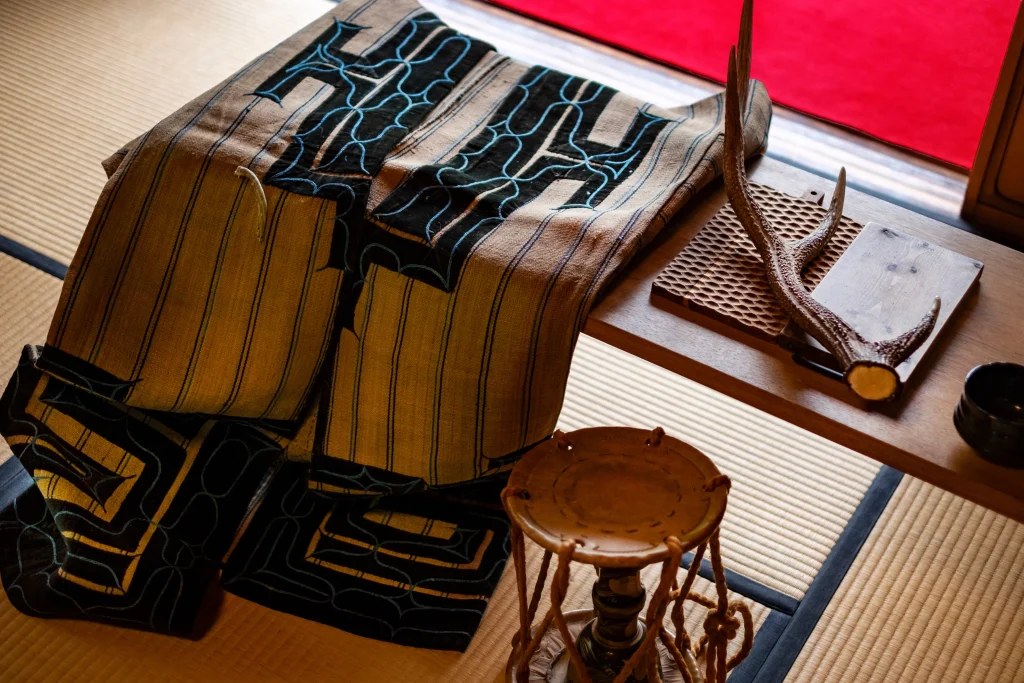
Stand in front of an Ainu robe or carved prayer stick in a Sapporo museum, and the difference from what you may have seen in Kyoto, Nara, or Tokyo is immediately visible. The patterns and forms belong to a northern tradition with its own history. Knowing the outline behind those objects makes the encounter more interesting than reading a caption cold.
Who Are the Ainu? Exploring Indigenous Roots
The Ainu are an Indigenous people of northern Japan and its surrounding region, historically connected with Hokkaido, Sakhalin, the Kuril Islands, and northern Tohoku. They developed their own language, unrelated to Japanese rather than a dialect of it, along with distinct clothing, housing, oral literature, and spiritual life.
In the traditional Ainu worldview, spiritual beings called kamuy inhabit animals, plants, tools, and natural phenomena, and ceremonial life involves maintaining good relations with them.
How many Ainu people live in Japan today is difficult to say. A 2023 Hokkaido government survey counted 11,450 people within its scope, but the survey covers only people in Hokkaido who identify themselves through local survey channels. It does not represent a full national population count.
The Formation of Ainu Culture in Northern Japan
People have lived in Hokkaido for tens of thousands of years, but Ainu culture took shape much later, through layers of northern history rather than one simple origin point.
After the Jomon period (dated from approximately 14,000 BCE to 300 BCE), Hokkaido followed a different path from Honshu. While rice farming spread through much of the main islands, northern communities continued hunting, fishing, and gathering, developing into what archaeologists call the Satsumon culture. The Okhotsk culture also arrived along Hokkaido’s northern coast, bringing maritime practices and bear ceremonialism. Genetic research suggests Okhotsk people contributed to Ainu ancestry alongside older Jomon-related roots.
By the medieval period, something recognizably Ainu had begun to take shape through exchange across Hokkaido, Sakhalin, the Kurils, and the Asian continent. Rather than looking for a single origin, it is more accurate to see Ainu culture as part of a northern historical current running alongside the better-known temple and castle history of Honshu.
Trade, Diplomacy, and Resistance in Ezochi
Before it was called Hokkaido, the island and its surrounding region were known to the Japanese as Ezochi. For centuries, Ainu communities there were not isolated or passive. They traded salmon, kelp, animal pelts, and sea products south in exchange for rice, iron goods, lacquerware, and cotton from Wajin, ethnic Japanese from Honshu. Ainu goods also moved through networks reaching beyond Japan.
The Japanese presence in the far south of Ezochi grew into the Matsumae domain, which held a shogunate-granted monopoly on Ainu trade from the early 1600s. Over time, that monopoly changed the relationship. Trade terms worsened, contract fisheries pulled Ainu labor into harsh conditions, and exchange between peoples moved closer to control by one side.
The Ainu did not simply accept this. Uprisings associated with Koshamain in the 15th century, Shakushain in 1669, and Menashi-Kunashir in 1789 show how tense these relations became. Before modern Japan absorbed Hokkaido, Ainu communities had their own networks, leaders, conflicts, and political agency.
The Transformation of Hokkaido in Modern Japan
The turning point came in 1869, when the new Meiji government renamed Ezochi as Hokkaido and began developing it as part of the modern Japanese state. Settlers from Honshu arrived, land was surveyed and allocated under new ownership systems, and Ainu communities were reclassified as subjects of Japan without having chosen that change.
The consequences were deep. Traditional livelihoods built around salmon fishing and deer hunting were restricted as the state regulated rivers and forests. The 1899 Hokkaido Former Aborigines Protection Act, a historical law whose name is now recognized as outdated and discriminatory, pushed Ainu families toward farming on often-poor land and folded Ainu children into a Japanese-language school system. Ainu language, dress, and customs came under pressure, and over generations the language nearly stopped being passed down at home.
This is essential context for modern Hokkaido. Museums, language classes, cultural centers, and public recognition exist today because so much was damaged or nearly lost, and because Ainu families kept knowledge, skills, and identity alive through it anyway.
Recognition, Recovery, and Questions Still Open
Japan’s official stance began shifting within living memory. In 2008, the national Diet passed a resolution recognizing the Ainu as an Indigenous people. In 2019, the Ainu Policy Promotion Act wrote that recognition into law, prohibiting discrimination against Ainu people and establishing support for cultural promotion, community development, and tourism.
The most visible result opened in 2020: Upopoy, the National Ainu Museum and Park in Shiraoi. It is Japan’s national center for Ainu culture, with a museum, performance spaces, workshops, and a memorial site beside Lake Poroto. Because it is within reach of Sapporo by train, it is an easy place to add Ainu history to a Hokkaido itinerary.
Reference: About Upopoy – National Ainu Museum and Park
Recognition has not settled every question. Debates around Indigenous rights, traditional salmon fishing, and the return of ancestral remains held by universities remain sensitive. Travelers do not need to take a position on each issue, but it helps to know that Ainu history is still being discussed in the present tense, not filed away as heritage.
Ainu Culture Today: Living, Changing, and Visible
Ainu culture today is not something preserved only behind glass. Traditional Ainu dance was inscribed on UNESCO’s Representative List of the Intangible Cultural Heritage of Humanity in 2009, and performances continue in Shiraoi, the Akan area, and elsewhere. Musicians play the mukkuri, a bamboo mouth harp, and the tonkori, a long stringed instrument from Sakhalin Ainu tradition. Embroidery and woodcarving continue as living crafts, with patterns that become easier to recognize once you have seen them closely.
Reference: Traditional Ainu Dance – UNESCO
Language revival is also underway through classes, broadcasting, and university programs, though fluent native speakers are now very few. At Upopoy, the permanent exhibition presents language, worldview, daily life, history, and trade from Ainu perspectives. That matters because, for much of the modern period, others did the telling.
Some readers may have first encountered Ainu culture through the manga and anime Golden Kamuy, which brought wider attention to Ainu language and daily life. It can be a useful entry point, but the actual history is broader than any pop-culture version. Seeing real objects in a museum, such as robes, tools, and carved prayer sticks, makes the distinctiveness of this northern tradition plain in a way no screen can.
How Ainu History Enriches Your Hokkaido Trip
Most travelers come to Hokkaido for nature: flower fields, powder snow, national parks, open roads, and wide skies. Ainu history adds another layer to the same landscape. Many Hokkaido place names, including Sapporo itself, are commonly linked to Ainu-language origins, so the map you use is partly a record of older ways of reading the land.
A morning at Upopoy, the Hokkaido Museum in Sapporo, or another public cultural facility can sit naturally alongside hiking, hot springs, and food-focused travel. The point is not to turn a vacation into a study trip. Hokkaido rewards travelers who see it as a region with its own history and living communities, not only as Japan’s northern scenery.
Read more: What to Do in Hokkaido in 2026: Top Places, Events and Foods
A Thoughtful Way to Travel Deeper in Hokkaido
You do not need to master Ainu history before visiting. Even a little context can make Hokkaido feel more layered. Through its Tailor-Made Tour service, ENJYU JAPAN can help shape a route that brings together nature, regional history, museums, and Indigenous culture. Ainu history may be one afternoon of a wider trip, or part of a slower journey through the island’s cultural landscape.