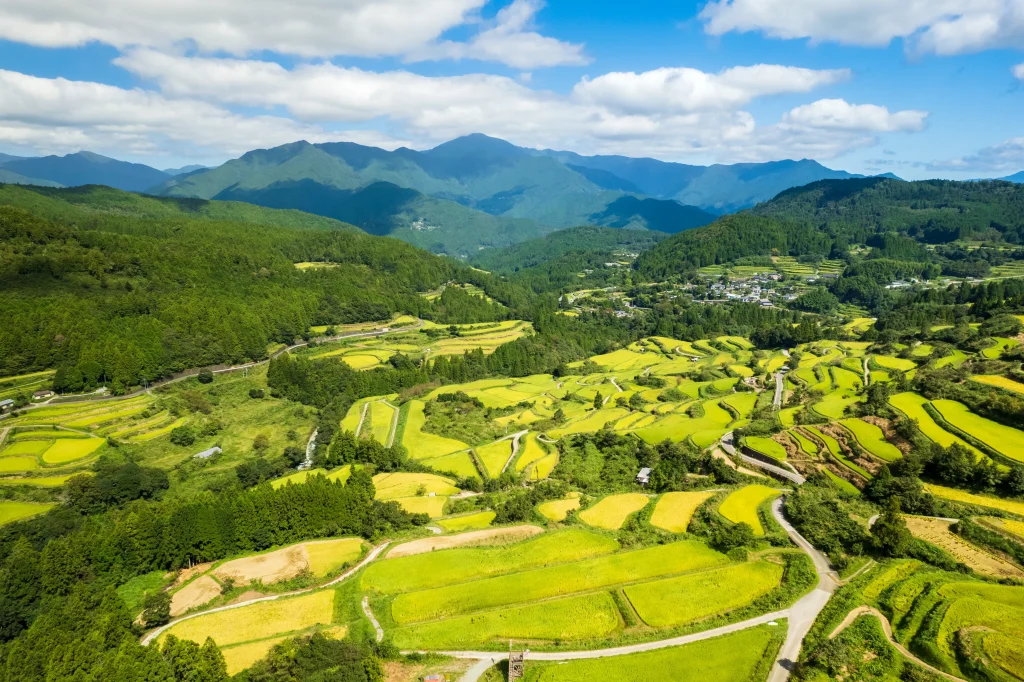
Few landscapes capture rural Japan as completely as its rice terraces. Carved into mountain slopes over centuries, these tiered paddies — known in Japanese as Tanada — are equal parts farmland, engineering marvel, and living scenery. In spring they shimmer like mirrors; in summer they glow deep green; in autumn they turn to gold before the harvest. For travelers who want to see a quieter, older Japan beyond the cities, they’re among the most rewarding places you can go.
This guide covers what Japanese rice terraces actually are, the best places to see them (from world-famous names to hidden gems most visitors never reach), when to go for each season’s mood, and how to get there — including the terraces you can visit without renting a car.
What Are Japanese Rice Terraces?
A rice terrace is simply a rice paddy built on a slope instead of flat ground. Because Japan is roughly two-thirds mountains, farmers historically had little level land to work with — so they shaped hillsides into stepped, water-holding fields that follow the natural contour of the land.
Two Japanese words come up constantly, and knowing them makes any terrace visit richer:
- Tanada — “terraced paddies,” the general term for stepped rice fields on a slope.
- Senmaida — literally “a thousand rice fields,” used for the largest, most dramatic terraces made up of countless small paddies. (In practice, the count is symbolic rather than exact.)
Wet-rice farming needs a steady, even water level, which is hard to maintain on a hillside. So terraces are built downhill from a reliable water source — a spring, a pond, or snowmelt channeled carefully from field to field. The result is a landscape that is entirely handmade, maintained paddy by paddy, often by the same families for generations.
Why Rice — And Rice Terraces — Matter So Much In Japan
Rice has been cultivated in Japan for more than two thousand years, and its importance goes far beyond the dinner table. It sits at the center of Japanese identity, cuisine, and religion. In Shinto belief, rice seedlings are associated with Kami (spirits) whose favor ensures a good harvest — which is why so many festivals across the country revolve around planting and reaping.
That spiritual weight is part of why terraces feel so evocative. Many have been farmed the same way for hundreds of years, and several appear on the government’s official list of the 100 Terraced Rice Fields of Japan (Nihon no Tanada Hyakusen), a designation created to help preserve these landscapes and the rural communities that maintain them. When you stand at a terrace overlook, you’re often looking at a scene people have valued — and painted, and photographed — for centuries.
Best 13 Rice Terraces in Japan
1. Shiroyone Senmaida | Ishikawa
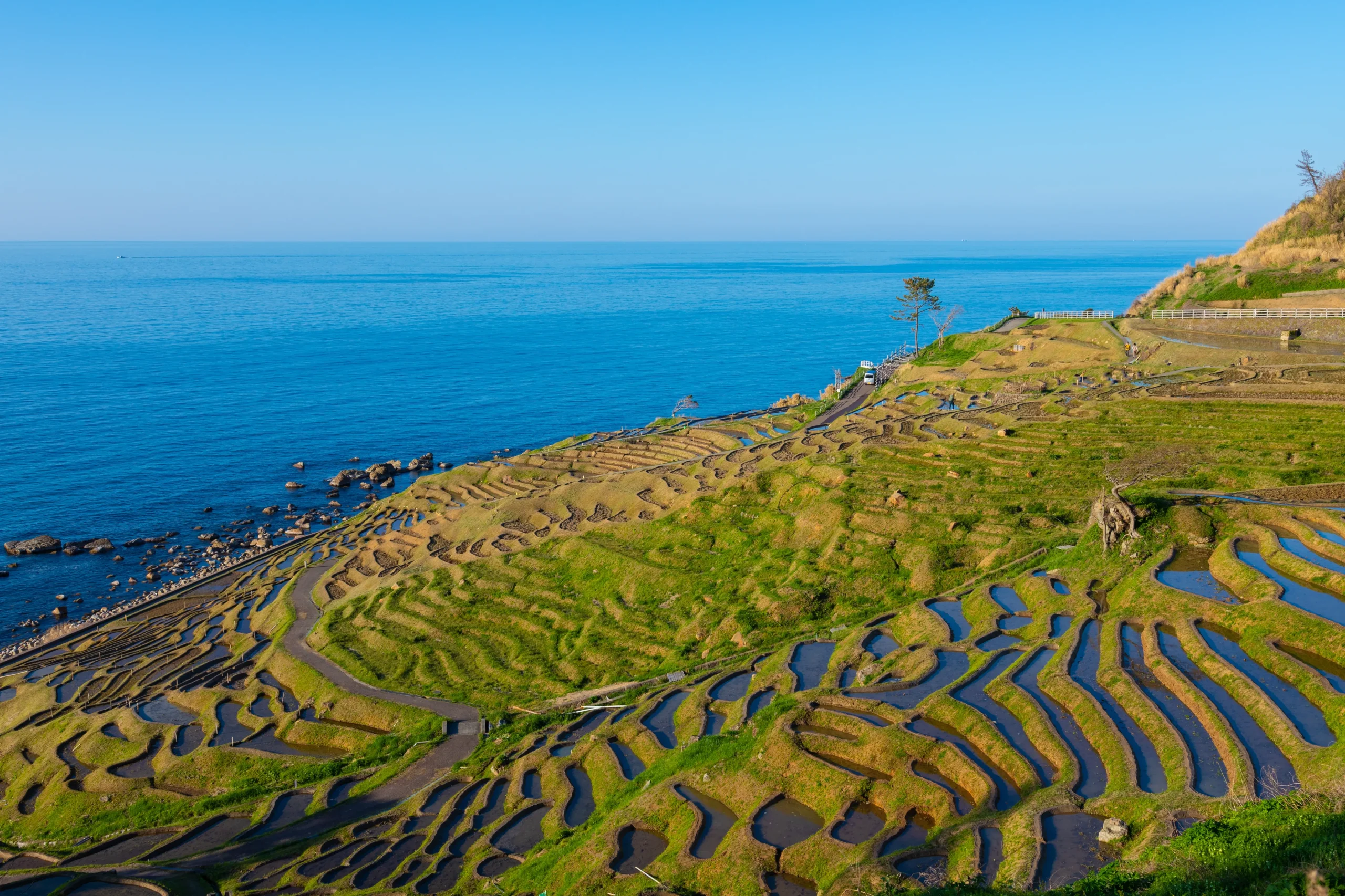
On the Noto Peninsula, Shiroyone Senmaida is Japan’s most celebrated terrace: 1,004 small paddies of wildly varying sizes stepping down a hillside straight toward the Sea of Japan. The fields are too narrow and irregular for machinery, so farmers and volunteers plant and harvest by hand — part of why the wider Noto landscape is recognized by the UN as a Globally Important Agricultural Heritage System.
Please read this before planning around it. The 2024 Noto Peninsula earthquake cracked roughly 80% of the paddies, and torrential rain that September damaged the irrigation channels. Restoration is ongoing, and only a portion of the fields have been replanted. The winter LED illumination Aze no Kirameki has not been held since the earthquake. The viewpoint and roadside station are open, and the sweep of terraces down to the sea is still remarkable — but go with accurate expectations, and know that visiting supports a community still rebuilding.
Getting to Shiroyone Senmaida
There is no train station in Wajima. From Kanazawa Station, take the Wajima express bus (3 hrs), then the Machino Line local bus to Shiroyone Senmaida (30 min). By car, about 2 hours 30 minutes from Kanazawa.
2. Hoshitoge no Tanada | Niigata
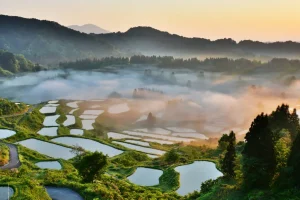
In the Tōkamachi area of southern Niigata, Hoshitoge’s roughly 200 paddies spread across the slope like fish scales. Twice a year — from snowmelt through planting in spring, and from late October until the first snow — the fields fill with water and become mirrors. On early mornings in late June and September, the terraces sometimes float in a sea of clouds; photographers are in position before sunrise for it. The site was designated a Connecting Rice Terraces Heritage site in 2022.
Getting to Hoshitoge no Tanada
Shinkansen to Echigo-Yuzawa, transfer to the Hokuhoku Line for Matsudai, then 20 minutes by taxi. The access road is closed by snow from roughly mid-November to late April.
3. Maruyama Senmaida | Mie
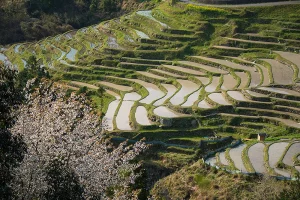
In Kiwa-chō, Kumano, Maruyama Senmaida is a story of recovery as much as scenery. Records from 400 years ago count some 2,200 paddies; depopulation and farming policy shrank that to just 530. A local preservation society and a 1994 town ordinance brought it back to roughly 1,340 today. The terraces climb a 160-meter drop on the southwest face of Mt. Shirakura, framed by the Kii mountains, and the view is widely called the finest in the country. In early summer the Mushi Okuri event lights candles across the fields after dark. Maruyama also runs an owner system, where participants join hand-planting and harvesting each year.
The observation deck above the terraces sits on the old Tōri-tōge trail — part of the Kumano Kodō pilgrimage route — so the climb up is worth doing for its own sake.
Getting to Maruyama Senmaida
About 30 minutes by car from JR Kumano-shi Station. Buses run to Tōri-tōge-iriguchi but are infrequent and leave a 40-minute walk.
4. Hamanoura Senmaida | Saga
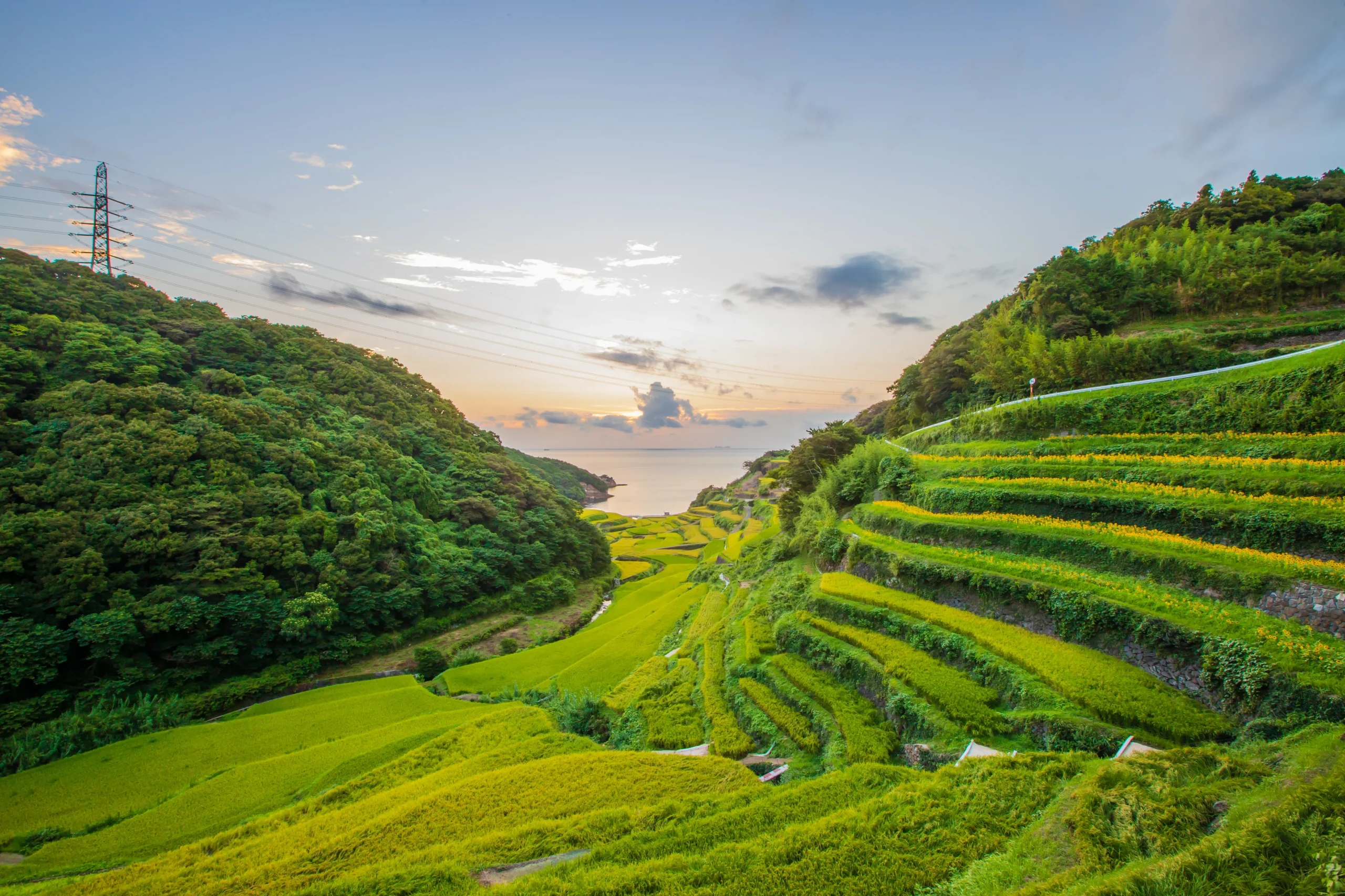
In Genkai Town, 283 stone-walled paddies rise from the coast across 11.5 hectares like a staircase out of the sea — terraces inherited continuously from the Sengoku and Edo periods. The signature window is mid-April to early May, when the paddies are flooded and the sun sets through the middle of the terrace, turning water and sea the same orange. The observation deck above the fields is the vantage point, and sunset is the whole point of coming.
Getting to Hamanoura Senmaida
30–40 minutes by car from Karatsu. By bus, take the Shōwa Bus Ariura Line from Karatsu Bus Center and transfer toward Genkai Energy Park (50–60 min total).
5. Oyama Senmaida | Chiba
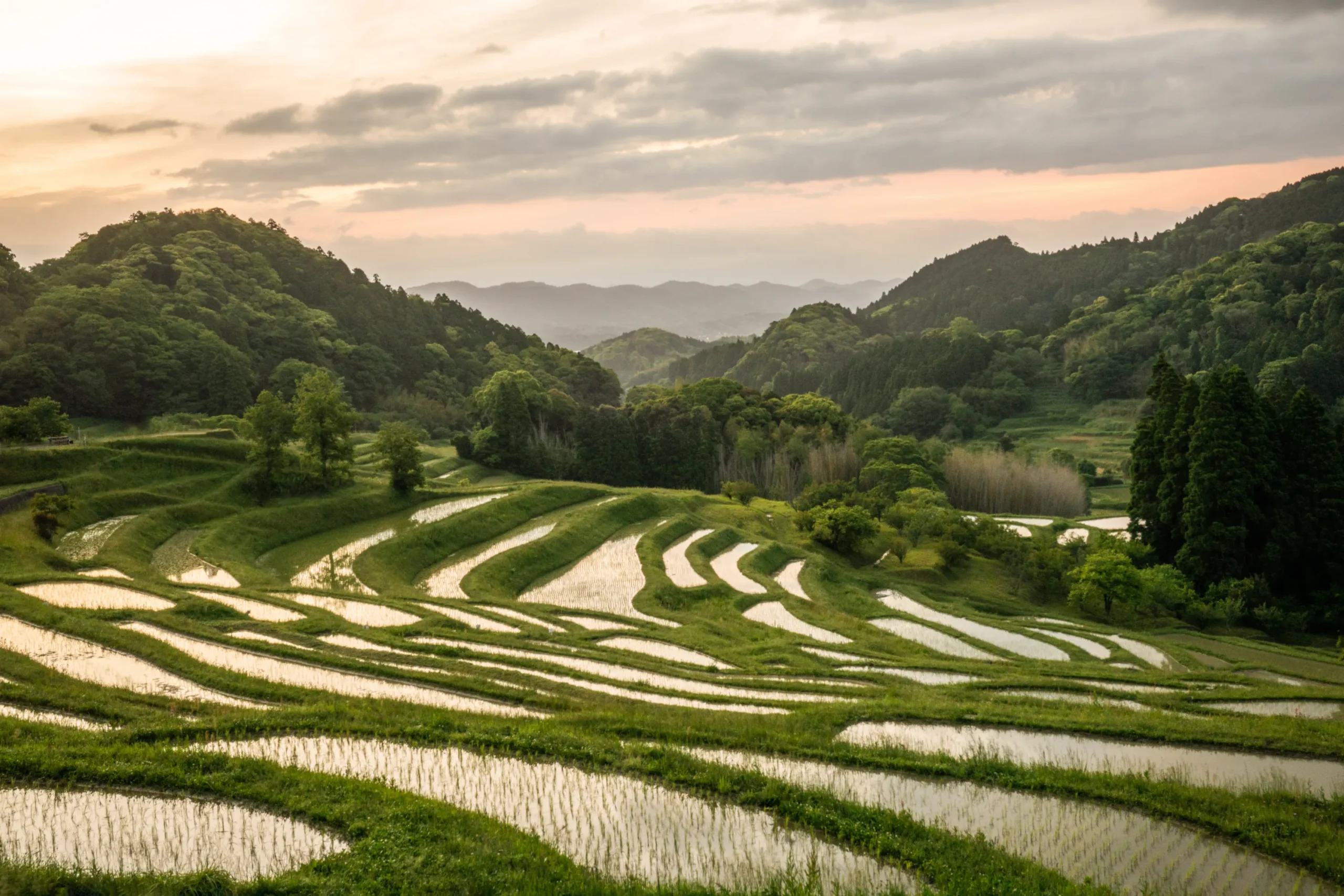
Around 375 paddies step across a 32,000 m² slope at the foot of the Mineoka range — the only Chiba site on the 100 Terraced Rice Fields of Japan list, and about 90 minutes from Tokyo by car. It’s also Japan’s only fully rain-fed terrace, watered by rainfall alone rather than a diverted river, which makes it unusually rich in wildlife. It’s at its best in the June rainy season, when the paddies brim and reflect the sky.
Getting to Oyama Senmaida
Bus from JR Awa-Kamogawa Station to Oyama Senmaida-iriguchi (25 min), then 30 minutes on foot. A direct Axy-gō express bus also runs from Tokyo Station (2 hrs).
6. Aragijima | Wakayama
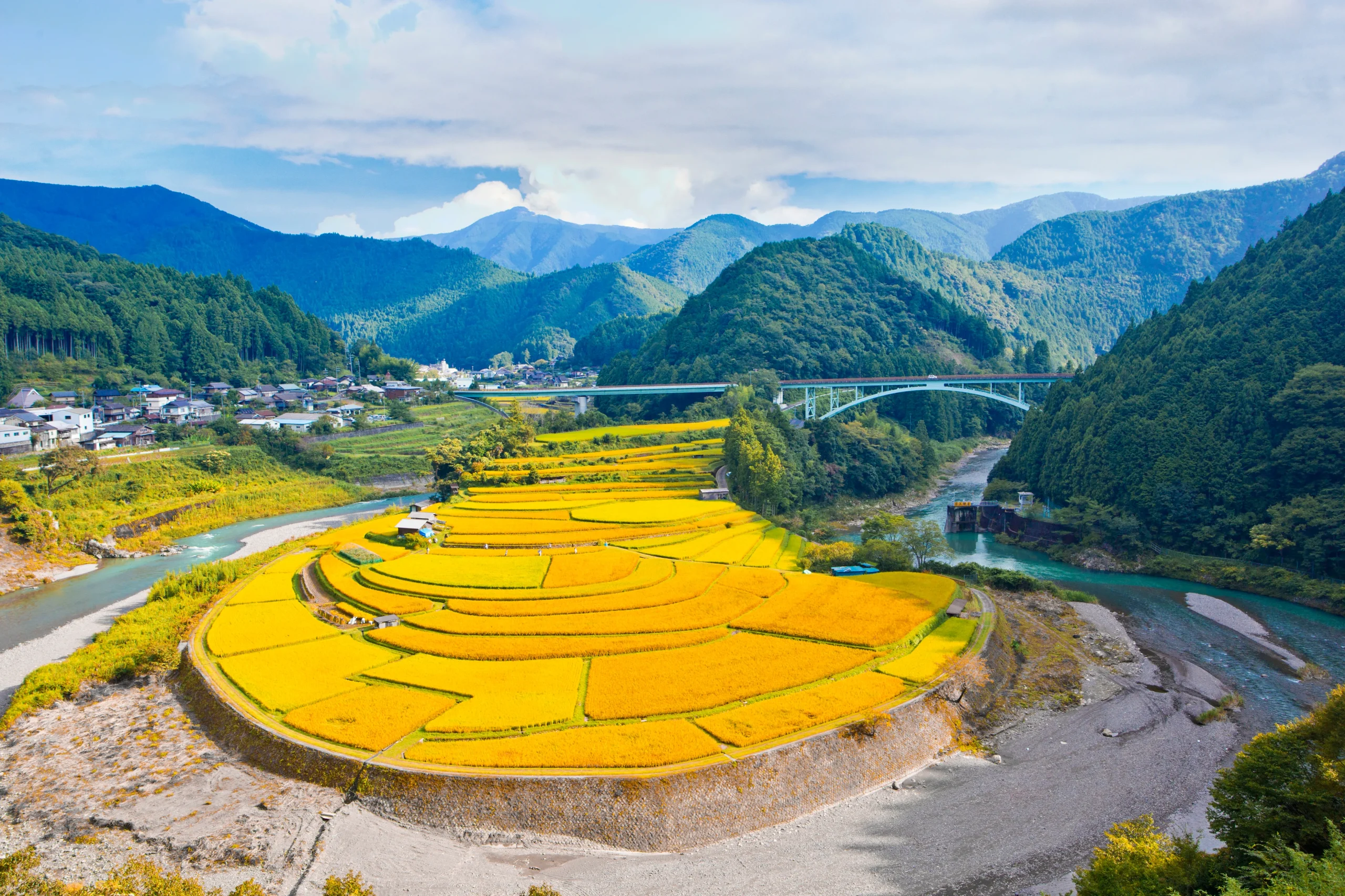
In Aridagawa, Aragijima is a fan of 54 paddies across 2.4 hectares, laid over a tongue of land inside a hairpin bend of the Aridagawa River — a shape carved by the river itself and farmed since the early Edo period. It joined the 100 Terraced Rice Fields list in 1999, and in 2013 the surrounding landscape became Wakayama’s first nationally designated Important Cultural Landscape. Six households still work it. Entering the terraces isn’t permitted; you view Aragijima from the observatory across the river.
Getting to Aragijima
Bus from JR Fujinami Station to the Mita stop (1.5 hrs)
7. Terasaka Tanada | Saitama
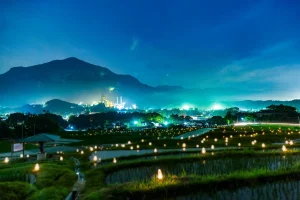
Saitama’s largest terrace sits at 230–270 m in the eastern Chichibu basin, spreading 400 m east to west with about 4 of its 5.2 hectares in rice — roughly 250 paddies, with Mt. Bukō filling the view straight ahead and reflecting in the flooded fields. Jōmon-period remains have been found on the site, though rice cultivation here is thought to have begun in the Kamakura period.
Two events are worth planning around: a one-night Hotaru Kagaribi festival in early July, when about 500 torch fires burn from dusk into the night, and a late-September spider lily festival, when roughly two million red blooms line the ridges beneath the golden ears.
Getting to Terasaka Tanada
A 15-minute walk from Yokoze Station on the Seibu Chichibu Line — about 80 minutes from Ikebukuro by limited express. The only terrace here you can reach with no car at all. Walking onto the ridge paths between paddies is prohibited.
8. Shikamura Tanada | Yamagata
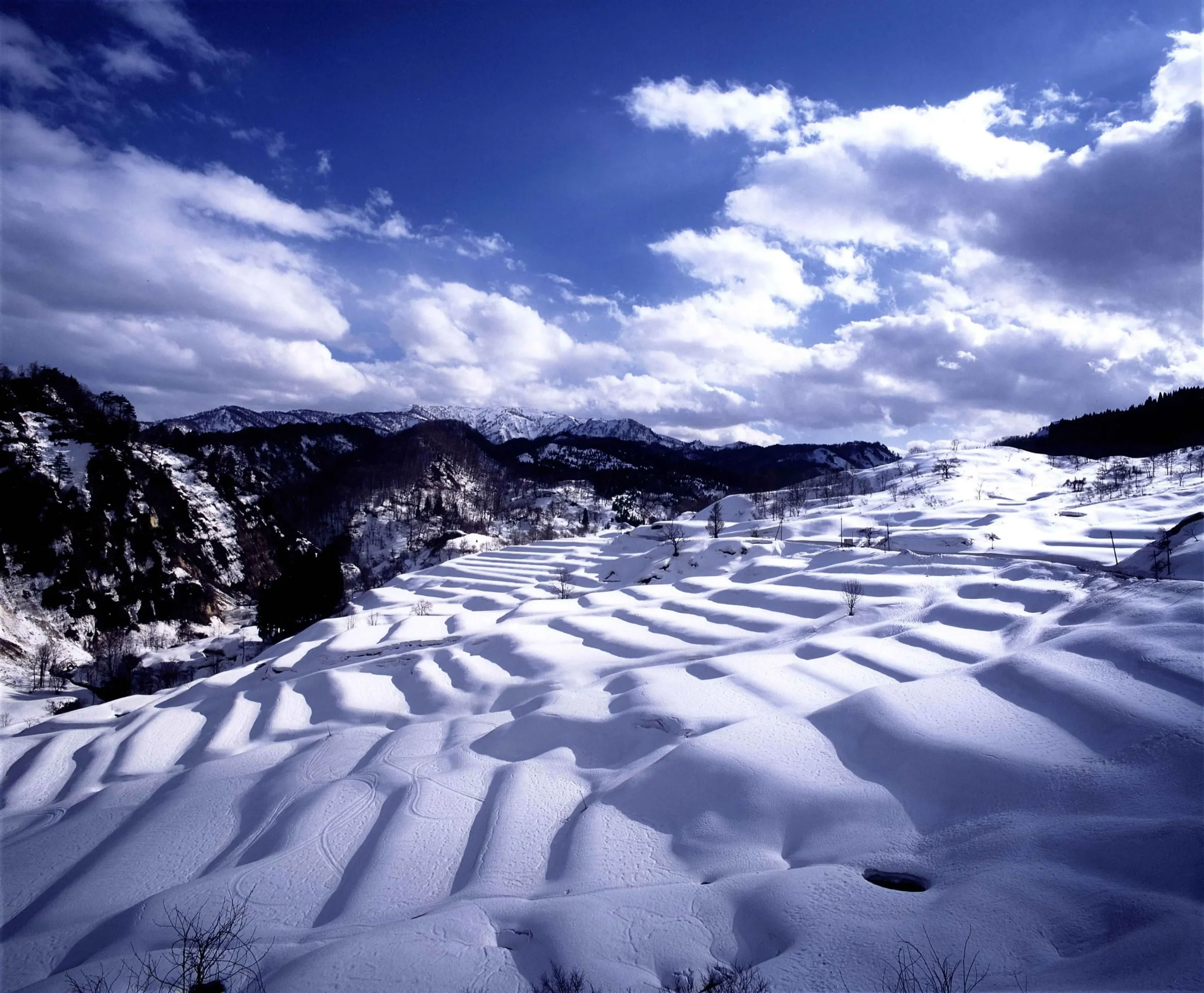
Shikamura is the collective name for four hamlets — Toyomaki, Takinosawa, Numanodai and Hirabayashi — whose paddies total roughly 1,900 across about 120 hectares, the largest scale in Tōhoku. This is one of Japan’s snowiest regions, with 2 m of snow in a normal winter and up to 4 m in a hard one, and the meltwater from Mt. Gassan and Mt. Hayama is a large part of why the rice here is so good. The classic view is the panorama from the monument above Toyomaki, looking across the valley to Takinosawa.
On the first Saturday of August, about 1,200 candle flames are lit across the terraces for a piano-and-ocarina concert.
Getting to Shikamura Tanada
35–40 minutes by car from JR Shinjō Station. There’s no regular bus; a shuttle runs on concert day only. Inaccessible in winter due to snow.
9. Tsuzura Tanada | Fukuoka
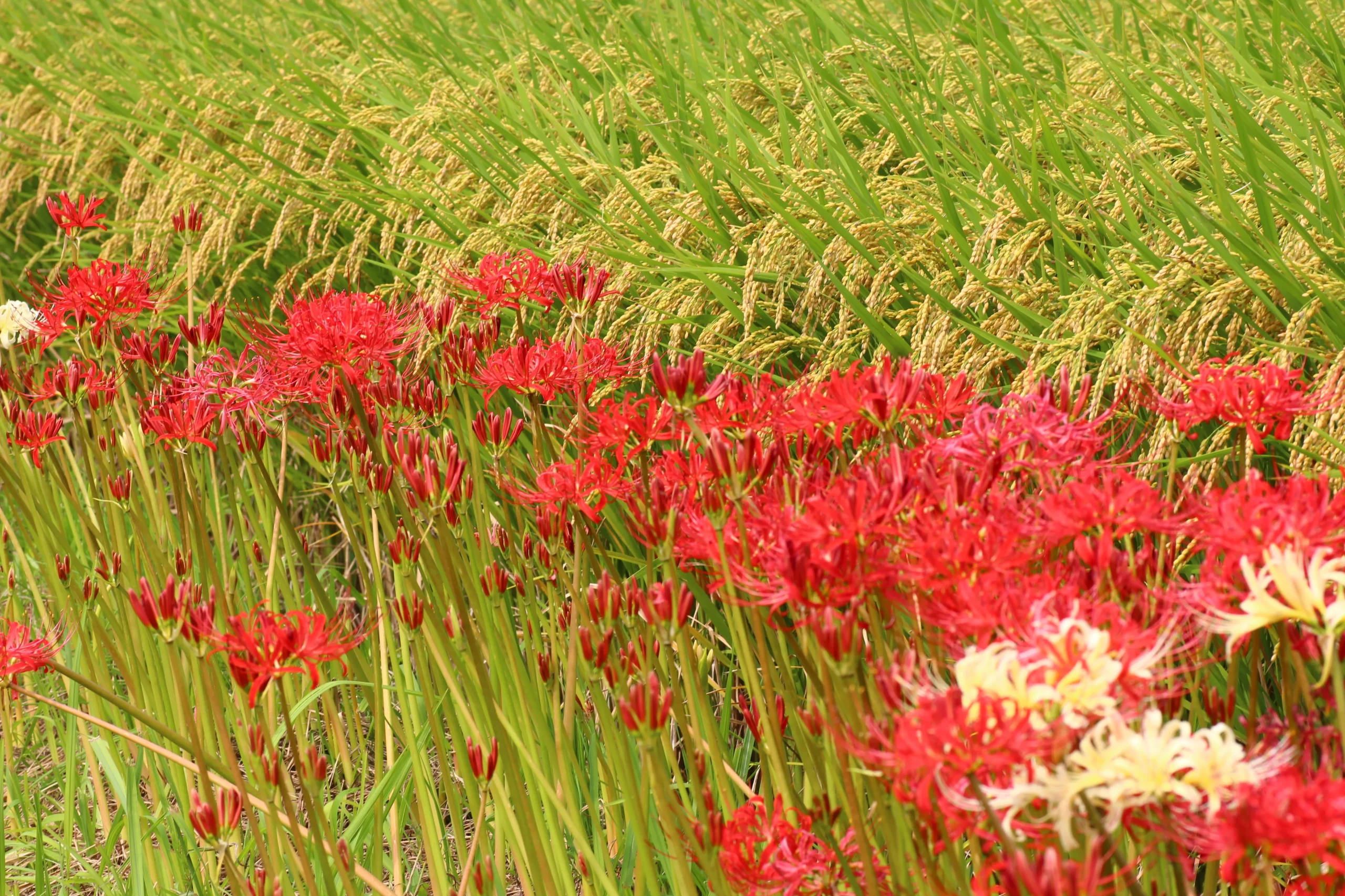
In the Shingawa-Tsuzura area of Ukiha, about 300 paddies step across roughly 7 hectares of hillside. In early autumn, some 500,000 spider lilies redden the ridges against the gold of pre-harvest rice, usually peaking mid-to-late September, when the town holds a festival. Look closely and some of the stonework is visibly newer — the terraces were rebuilt by the community after torrential rain destroyed sections in 2013.
Getting to Tsuzura Tanada
30 minutes by car from JR Ukiha Station; no practical public transport. Approach roads are too narrow for cars to pass, so use the designated parking.
10. Yōne no Tanada | Kōchi
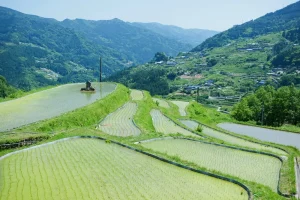
In the hamlet of Yōne (八畝) on the slopes of Mt. Kajigamori, this is a terrace sometimes called “the rice fields in the sky.” It sits at around 500 meters on steep stone walls, and from the upper part of the hamlet you look across the Minami-Ōō River valley to the terraces of Nuta on the opposite side — a vast scene that almost no one outside Kōchi knows about.
Its signature feature is small and strange and stays with you: a shrine to Hachiman stands in the middle of the fields, on the one patch of ground left uncultivated. The paddy’s owner keeps farming around it in part so that photographers who travel this far aren’t disappointed. There’s an unexpected second season, too — a local group has been converting abandoned plots into a peony garden, so from early May you can see flooded terraces and fields of peonies in the same frame.
Getting to Yōne no Tanada
10 minutes by car from JR Toyonaga Station — not Ōsugi Station, despite what some guides suggest. The hamlet isn’t visible from Route 32 or the railway at all.
11. Obasute | Nagano
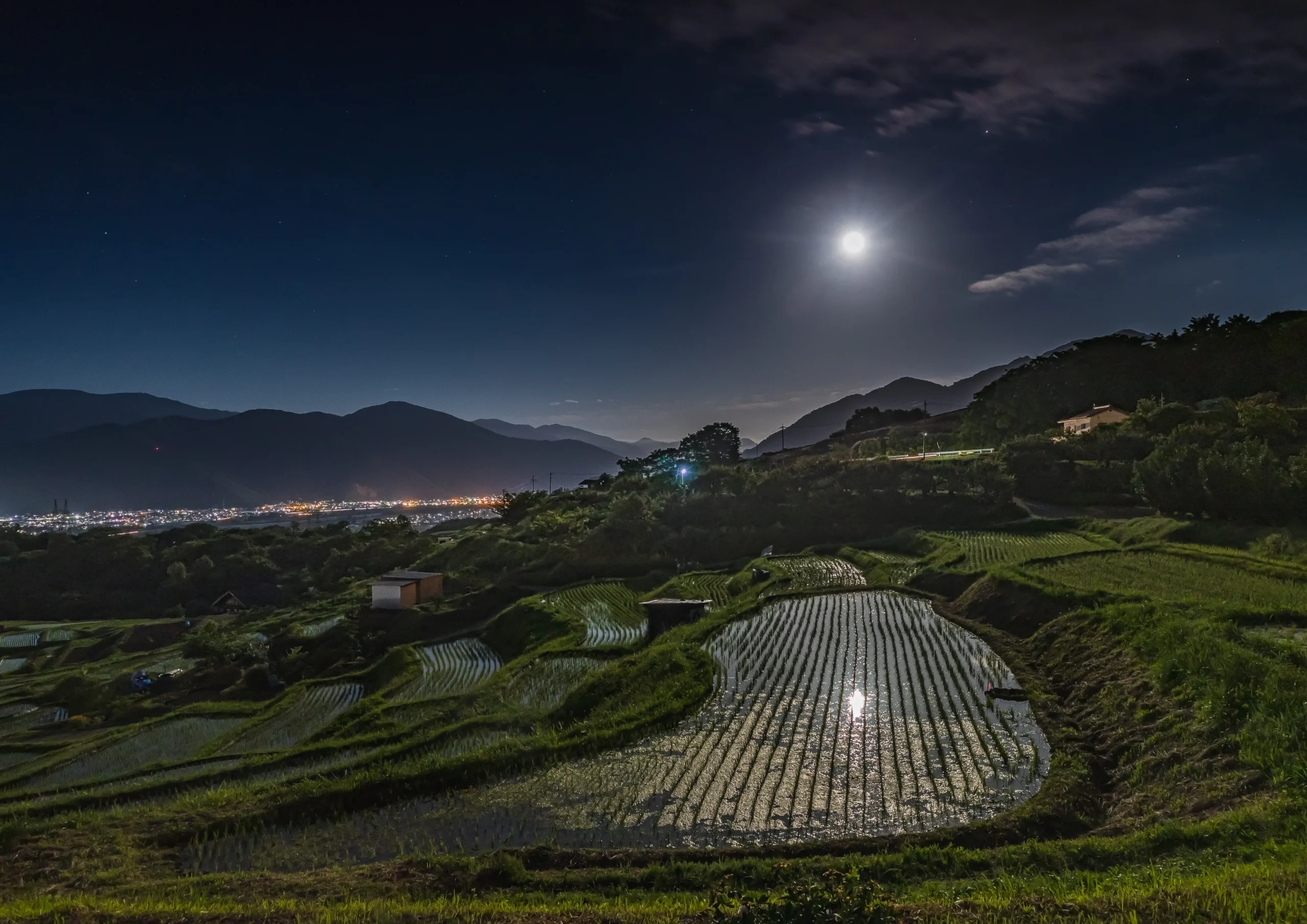
The Obasute terraced rice fields, located in Chikuma City, Nagano Prefecture, are situated on slopes at an altitude of 460 to 560 meters, offering a sweeping view of the Zenkoji Plain. The nighttime scenery is its greatest charm due to the phenomenon known as “Tagoto no Tsuki” (Moon on Each Rice Field), where the full moon reflects on the water-filled paddies, creating a magical landscape that has been celebrated in poetry and paintings since ancient times.
When visiting Obasute, time your trip around the full moon to experience the enchanting “Tagoto no Tsuki”.
Getting to Obasute
5-minute walk from JR Obasute Station (Shinonoi Line); about 20 minutes to the main viewpoint.
12. Oidani | Shimane
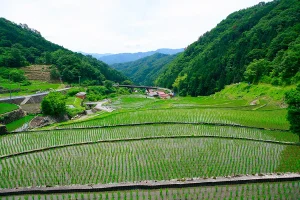
Ōidani terraced rice fields, located in Yoshika Town, Kanoashi District, Shimane Prefecture, is a historical terraced rice field. It is said to have been built approximately 600 years ago, from the late Muromachi period to the Edo period, and its historical value is highly regarded.
From the observation deck, you can take in a panoramic view of the expansive terraced fields, which are so vast they cannot fit entirely into a single photograph. In the winter, a lighting event with 2,800 LED lights is held, allowing you to enjoy illuminations in the crisp, clear air.
Getting to Oidani
About 30 minutes by car from Muikaichi IC.
13. Onigi Tanada | Nagasaki
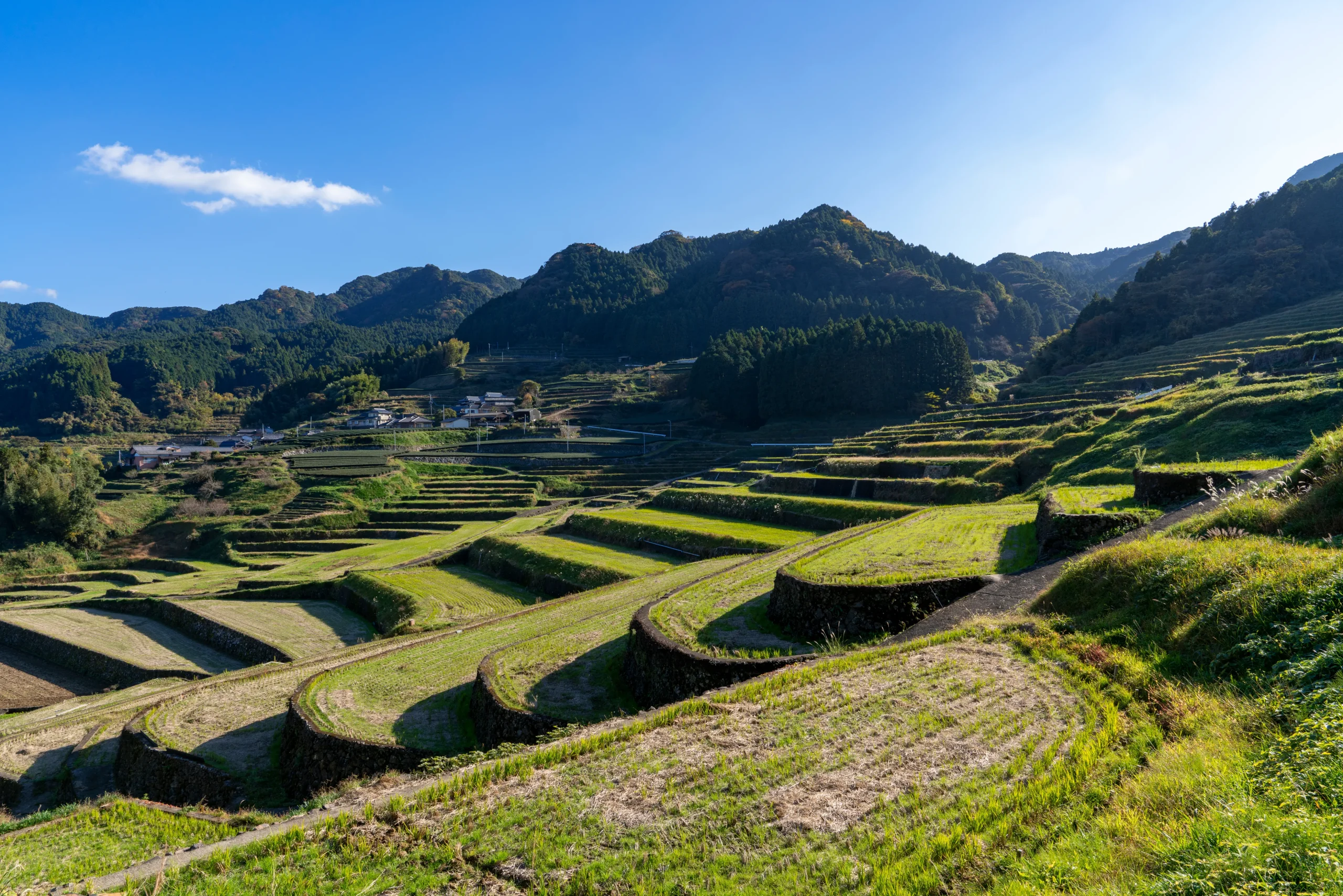
Onigi Tanada, located in Hasami Town, Higashisonogi District, Nagasaki Prefecture, is a historical terraced rice field that dates back to the mid-Edo period. The terraced rice fields, built with stone ridges, cascade down the horseshoe-shaped slopes of the base of the Kokūzō Volcano, creating a popular and inviting sight.
Nearby, at the Onigi Processing Center, you can purchase rice grown in the terraces as well as locally made miso. This offers a valuable opportunity to experience Japan’s food culture through the region’s specialty products.
Getting to Onigi Tanada
20 minutes by car from JR Arita Station.
Comparing Access to Japan’s Rice Terraces
Most of Japan’s great terraces sit deep in the countryside, and public transport to them ranges from infrequent to nonexistent. The table tells you which ones you can realistically do without driving.
| Terrace | Nearest station | Car needed? |
| Shiroyone Senmaida | (no rail — Wajima bus terminal) | Recommended |
| Hoshitoge | Matsudai | Recommended |
| Maruyama Senmaida | JR Kumano-shi | Yes |
| Hamanoura | JR Karatsu | Recommended |
| Oyama Senmaida | JR Awa-Kamogawa | No |
| Aragijima | JR Fujinami | Recommended |
| Terasaka Tanada | Seibu Yokoze | No |
| Shikamura | JR Shinjō | Yes |
| Tsuzura Tanada | JR Ukiha | Yes |
| Yōne no Tanada | JR Toyonaga | Yes |
| Obasute | JR Obasute | No |
| Oidani | JR Nichihara | Yes |
| Onigi Tanada | JR Arita | Yes |
When To Visit: A Season-By-Season Guide
Rice terraces are worth seeing year-round, but each season offers a completely different mood:
| Season | What you’ll see | Best for |
| Spring (Apr–May) | Fields flooded for planting; paddies act as mirrors reflecting sky and mountains | Reflection photography, fresh-green scenery |
| Early summer (Jun) | Rainy-season fields brim with water; lush new growth | Mirror reflections, fewer crowds at some spots |
| Summer (Jul–Aug) | Deep green rice at full height; evening firefly and candle events at some terraces | Vivid green landscapes, festivals |
| Autumn (Sep–Oct) | Golden rice before harvest; spider lilies at some spots; morning mist at Hoshitoge | Golden-hour and mist photography |
| Winter (Nov–Mar) | Bare or snow-covered terraces; nighttime LED illumination at Shiroyone | Snowscapes, illuminations |
A useful rule of thumb: for mirror reflections, aim for the flooded planting window in spring and early summer; for golden fields, aim for autumn just before harvest.
How To Visit Rice Terraces
The single biggest planning challenge is transport: many of Japan’s most beautiful terraces are deep in the countryside and awkward to reach without a car. A few practical tips:
- If you don’t want to drive, prioritize station-accessible terraces. Terasaka (-15 minutes on foot from Yokoze Station) and the Tokamachi-area terraces near Hoshitoge are among the more public-transport-friendly options. Oyama Senmaida is the most convenient from Tokyo.
- Check the last return train or bus early — not at the end of the day. Rural stations can be quiet, and a missed connection can turn into a long, expensive taxi ride.
- Consider renting a car for a terrace-focused day. For remote spots like Shiroyone or Hoshitoge, a car removes most of the stress of connections and lets you catch the best light at sunrise or sunset. Note that most visitors need an International Driving Permit, typically obtained before arriving in Japan.
- Time your visit around the light. Sunrise (for mist and reflections) and sunset (for golden light over sea-facing terraces) are dramatically better than midday.
Rice Terrace Etiquette: Visiting Respectfully
Rice terraces aren’t scenic installations — they’re working farmland, and many are privately owned or maintained by small, aging communities. A few simple courtesies go a long way:
- Stay on marked paths and viewpoints; never walk into or between paddies.
- Don’t disturb crops, water channels, or equipment.
- Park only in designated areas, especially during busy cherry-blossom or harvest periods.
- Be considerate with photography around homes and private land, and keep noise down.
Visiting respectfully helps ensure these landscapes — and the people who keep them alive — are still here for the next traveler.
Frequently Asked Questions
When Is The Best Time To See Rice Terraces In Japan?
For mirror-like reflections, visit during the spring–early summer flooding and planting window. For golden fields, visit in autumn just before harvest.
Can I Visit Rice Terraces Without A Car?
Yes, though options are limited. Terasaka in Saitama is about a 15-minute walk from Yokoze Station, Oyama Senmaida is the easiest from Tokyo, and the Tokamachi terraces near Hoshitoge are reachable by train plus a short taxi ride.
Which Rice Terrace Is Closest To Tokyo?
Oyama Senmaida on the Bōsō Peninsula in Chiba is the most convenient marquee terrace from Tokyo. Terasaka in Chichibu is another day-trip-friendly option.
Summary
In this article, we introduced 13 prominent terraced rice field spots across Japan that you should visit during your trip. Each of these terraced rice fields has its own unique charm, whether it’s the beautiful seasonal landscapes, distinctive terrain, or local traditional events. Visiting these terraced fields will allow you to immerse yourself in Japan’s traditional landscapes and fully experience its rural life and food culture. We hope you get to experience the beauty and depth of Japanese culture by visiting the terraced rice fields introduced here, making your trip to Japan a truly special memory.