June has the worst reputation of any month on Japan’s travel calendar, and also one of the strongest cases behind it. Tsuyu, the rainy season, settles over most of the country for about six weeks starting in early June, which is exactly why hotel prices drop, crowds thin out, and hydrangeas take over temple gardens across the country. This guide is honest about the rain, specific about where it does and doesn’t reach, and practical about turning a June 2027 trip into an advantage rather than a compromise.
Is June a Good Time to Visit Japan?
Yes, with one condition: the traveler needs to understand what “rainy season” actually means in Japan before building an itinerary around avoiding it entirely. Tsuyu produces grey skies and frequent showers, not the all-day monsoon downpours the phrase suggests to many first-time visitors; Tokyo typically records rain on 10 to 14 of June’s 30 days, and many of those showers last a few hours rather than the full day. Temples, museums, food culture, and city sightseeing continue largely unaffected, while outdoor mountain scenery and long rural routes are the parts of a trip most exposed to real disruption.
In exchange for that manageable risk, June delivers the lowest Tokyo hotel rates of the year, some of the thinnest crowds at major sights outside Hokkaido’s peak summer season, and a flower found nowhere else on the calendar in the same abundance: the hydrangea. For a traveler whose dates are fixed to June regardless of preference, this is a genuinely good month rather than a consolation prize.
What Tsuyu Actually Means: Japan’s Rainy Season Explained
Tsuyu is written with characters meaning “plum rain,” a reference to the fact that the season coincides with the ripening of Japanese plums, and it is also called minazuki, or “month of water,” in the traditional Japanese calendar. Meteorologically, Tsuyu is a stationary weather front that settles over the main islands for roughly six weeks, producing a pattern of humid, overcast days interrupted by clear breaks rather than continuous rain.
Because the front moves gradually from south to north over the course of late spring and early summer, Tsuyu does not begin or end on the same date everywhere in Japan; understanding this regional staggering, covered in detail below, is the single most useful piece of context for deciding where to go and when.
Japan’s Weather in June 2027, Region by Region
Okinawa enters Tsuyu earliest, typically in early May, and often exits by late June, meaning the islands may already be clear of the rainy season by the time a June trip begins. For Kyushu, Shikoku, and most of Honshu, including Tokyo, Kyoto, and Osaka, Tsuyu typically starts in the first week of June and continues into mid-July; daytime temperatures in these cities generally run from 19 to 28°C (66 to 82°F), with humidity building steadily as the month progresses. The Tohoku region, further north, tends to see the rainy season begin later, in mid-to-late June, giving it a shorter wet window than the cities further south.
Hokkaido is the clear exception on the map, the island escapes Tsuyu almost entirely, staying dry, mild, and notably clear throughout June, a contrast striking enough that locals refer to the deep blue summer skies over Sapporo as “Sapporo Blue.” For a traveler whose dates are fixed and who wants a guaranteed run of good weather rather than a gamble on breaks between showers, Hokkaido is the most reliable answer available anywhere in the country this month.
Read more: Hokkaido in Summer: Weather, Lavender, Festivals & How to Plan Your Trip
What to Pack for Japan in June
A compact, sturdy umbrella matters more in June than in almost any other month, and buying one after arrival is genuinely reasonable, since convenience stores across Japan stock inexpensive, functional umbrellas specifically because sudden showers are common during Tsuyu. Lightweight, quick-drying clothing handles the rising humidity better than heavier fabrics, and a light rain jacket is generally more practical than a poncho for a day that alternates between indoor sightseeing and short walks between train stations.
Waterproof or quick-drying shoes are worth prioritizing over anything requiring careful upkeep, since pavement puddles and sudden downpours are a normal feature of the season rather than an occasional inconvenience; packing a spare pair of socks for a day with extensive walking is a small addition that meaningfully improves comfort by the evening.
Hydrangeas: The Flower That Turns Rain Into a Reason to Travel
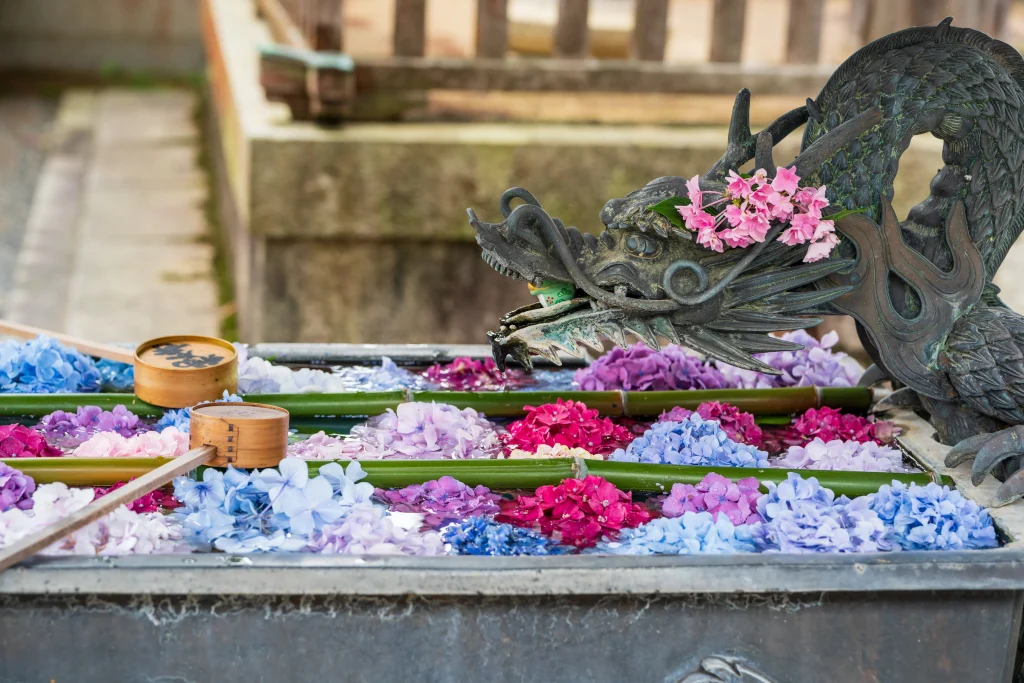
Ajisai, or hydrangeas, bloom specifically because of the humidity and rainfall that define Tsuyu, reaching peak bloom through most of June before wilting once the season’s cooler, cloudy skies give way to full summer heat in early July. Kamakura’s Meigetsuin Temple, nicknamed “Ajisai-dera,” or “Hydrangea Temple,” is the best-known destination for this bloom, with over 2,500 hydrangea bushes lining the stone approach to its main hall in a shade so distinctive it has its own name, “Meigetsuin Blue,” referring to the hime ajisai, or princess hydrangea, variety that makes up most of the display. Visiting on a weekday morning shortly after the temple’s extended June opening hours begin, rather than a weekend afternoon, is the clearest way to avoid the crowds that regularly stretch back toward Kita-Kamakura Station during peak bloom.
Beyond Kamakura, the Hakone Tozan Railway earns the nickname “Ajisai Train” each June, as its mountain tracks run through tunnels of hydrangeas dense enough to brush the train windows, offering a way to experience the flower in motion rather than only on a temple visit. In Kyoto, Mimurotoji Temple adds a further variation, with tens of thousands of hydrangea plants covering a hillside garden in a display large enough to feel more like a landscape than a single temple’s flower bed.
Fireflies and Iris Gardens: June’s Quieter Traditions
Two smaller June traditions reward travelers willing to look past the headline hydrangea displays. Hotaru, or firefly viewing, has a genuinely brief window in early June, when parks and gardens across the country, including Hotel Chinzanso Tokyo’s historic garden and Fussa Hotaru Park an hour west of central Tokyo, release or host fireflies for a few nights of viewing that end almost as quickly as they begin. Because the window is measured in days rather than weeks, checking a specific venue’s schedule immediately before travel, rather than assuming any June visit will coincide with it, is essential for anyone planning specifically around this experience.
Iris gardens offer a longer, more forgiving alternative: the inner garden of Tokyo’s Meiji Jingu Shrine and Katsushika’s Horikiri Shobuen, the garden that inspired several famous ukiyo-e woodblock prints, both reach peak bloom in June, with wooden walkways crossing directly over ponds of purple and white iris blossoms. Both offer a quieter, less crowded counterpart to the hydrangea temples, appealing specifically to travelers who have already covered Kamakura on a previous trip.
Building a Trip That Rain Can’t Ruin
The most effective way to protect a June itinerary from Tsuyu is treating indoor and semi-indoor activities as the default plan for any given day, rather than a backup reserved for when rain actually starts. Museums, department store food halls, covered shopping arcades such as Osaka’s Dotonbori or Kyoto’s Nishiki Market, indoor onsen, and craft workshops all function normally regardless of the forecast, while outdoor-heavy plans, a long hike, a garden requiring extended walking, a day built around a single viewpoint, are the ones worth checking the morning’s radar before committing to. Kyoto’s moss temples, including the famously restricted Saihoji, are a specific exception worth knowing about: their moss gardens are widely considered at their richest, most vivid green during Tsuyu rather than in spite of it, turning a rainy morning into the actual ideal condition for that particular visit.
Structuring each day with one weather-flexible activity and one that specifically benefits from the season’s humidity and cloud cover, rather than planning as though June were a dry month with occasional interruptions, is what separates a trip that Tsuyu genuinely disrupts from one that simply absorbs it.
Where to Go in Japan in June: Hokkaido’s Dry-Season Advantage
For a traveler asking specifically where to go in Japan in June, the honest answer depends on the priority: those chasing hydrangeas and cultural sightseeing should stay within the Tokyo-Kyoto-Osaka core, accepting Tsuyu as a manageable backdrop, while those who want guaranteed clear skies and outdoor scenery should look to Hokkaido instead. June in Hokkaido offers noticeably drier, brighter conditions than May’s lingering mountain snow or July’s building heat, making it a genuine “golden window” for road trips, lavender-adjacent early blooms, and long days outdoors without Tsuyu’s humidity anywhere in the forecast.
Combining both halves of a trip, a few days in Tokyo or Kyoto for hydrangeas and city sightseeing followed by a stretch in Hokkaido for reliable outdoor weather, lets a June itinerary capture the season’s specific rewards while sidestepping its single biggest risk for the portion of the trip that depends most on clear skies.
The Cheapest Month? Crowds, Prices, and June’s Missing Holiday
June is one of only two months in the Japanese calendar, alongside December, with no national holiday at all, meaning there are no three-day weekends to concentrate domestic travel demand the way Golden Week or Obon do. Combined with Tsuyu’s reputation keeping many casual travelers away, this makes June’s hotel rates in Tokyo and Kyoto meaningfully lower than the surrounding months, and major sights noticeably less crowded than during April’s cherry blossoms or the peak of summer.
For a traveler specifically drawn to the idea of an inexpensive Japan trip but worried that rain will undermine the experience, this is the actual trade-off in plain terms: a real but manageable chance of interrupted outdoor plans, exchanged for lower prices, thinner crowds, and a flower season that exists nowhere else on the calendar in the same scale.
Pick your priority, hydrangeas and low prices in the cities, or guaranteed clear skies in Hokkaido, and build your June 2027 dates around whichever trade-off matches what you actually want from the trip.