July asks more of visitors than almost any other month in Japan: real heat, real humidity, and the tail end of a rainy season that hasn’t quite finished with the country yet. In exchange, it delivers a festival calendar unmatched by any other single month, including a thousand-year-old parade that takes over an entire city and the only weeks of the year Mount Fuji’s summit is officially open to climbers. This guide covers Japan’s July climate, its festivals, and whether the trade-off is actually worth making.
Is July a Good Time to Visit Japan?
Yes, with a clear condition attached: July rewards travelers who come specifically for its festivals and are prepared for genuine heat, rather than those hoping for comfortable sightseeing weather. The month splits into two distinct halves. Early July still carries the tail end of Tsuyu, Japan’s rainy season, bringing humid, grey days and sudden downpours to most of Honshu. Once the rainy season lifts, typically around July 19 to 20 in the Kanto region, the second half of the month turns into full summer, with sunshine, cicadas, and daytime temperatures regularly above 30°C.
That second half is when July’s real appeal shows itself: Mount Fuji opens to climbers, Kyoto’s Gion Matsuri reaches its climax, and fireworks festivals begin lighting up rivers across the country almost every weekend. A traveler who times a trip for late July, after the rain clears, gets access to experiences genuinely unavailable in cooler months, at the cost of heat that demands real planning around it.
Japan’s Climate in July: Two Very Different Halves of the Month
Understanding July’s weather means understanding it is not one climate but two, separated by a single, somewhat unpredictable transition date. In Tokyo, Kyoto, and Osaka, average highs run from roughly 30 to 32°C (86 to 90°F) for the month overall, but that average obscures the real experience: early July’s rain and 75 to 80 percent humidity feels noticeably different from late July’s dry, intense heat, even at similar temperatures. Okinawa’s rainy season ends earlier, typically by late June, putting the islands into full summer well before the mainland. Hokkaido, by contrast, barely experiences Tsuyu at all, staying noticeably cooler and drier than the rest of the country throughout July.
This regional split matters directly for trip planning: a traveler whose itinerary is confined to Tokyo, Kyoto, and Osaka should expect the humid-to-hot transition described above, while a trip that includes Hokkaido can sidestep much of July’s discomfort entirely. Typhoon activity typically remains low in July compared to the peak season in late summer and early autumn, though it is not impossible and is worth checking in the days before departure.
Gion Matsuri: A Thousand-Year-Old Festival That Fills All of July
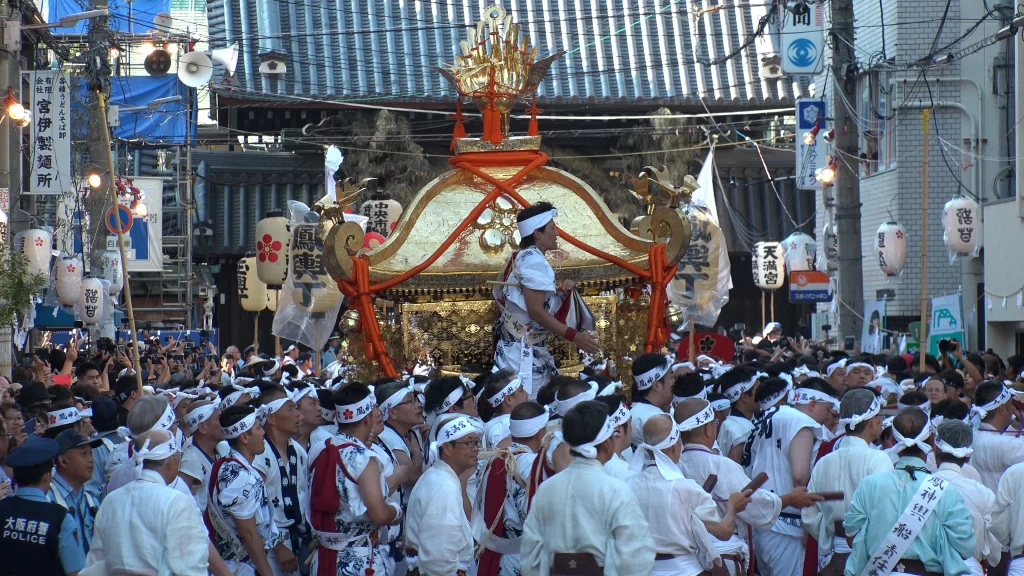
Kyoto’s Gion Matsuri runs for the entire month of July, making it less a single event than a monthlong backdrop to any Kyoto visit during this period. The festival traces back to 869 CE, when a purification ritual was held to appease a vengeful deity believed to be causing plague, and it has continued in some form for over 1,100 years since, making it one of the oldest continuously observed festivals in Japan. Its centerpiece is the Yamaboko Junko, a parade of towering wooden floats, some reaching 25 meters tall and weighing several tons, hauled through central Kyoto’s streets on the two grand parade days: Saturday, July 17 and Saturday, July 24, 2027.
The evenings immediately preceding each parade, known as Yoiyama, when the floats are illuminated by lanterns and lined with food stalls, are widely considered the festival’s most atmospheric stretch, arguably more rewarding to experience than the parades themselves for a first-time visitor. Because Gion Matsuri fills the entire city for the whole month, even a Kyoto visit with no specific festival day planned will likely encounter some part of it, a detail worth knowing before assuming a trip has simply missed the festival by a few days.
Read more: Gion Matsuri 2027: Schedule, Highlights, and the Best Ways to Enjoy
Mount Fuji’s Climbing Season Opens July 1
Mount Fuji’s summit is officially closed to climbers for roughly ten months of the year; July 1 marks the opening of the Yoshida and Subashiri trails, with the Fujinomiya and Gotemba trails following on July 10, and all four remaining open through early September. This narrow window exists because winter snow and ice make the mountain genuinely dangerous outside it, meaning July is one of only two months, alongside August, when reaching the 3,776-meter summit is officially sanctioned and supported by open mountain huts and staffed stations.
Climbers who reach the crater rim before dawn are rewarded with goraiko, the sunrise viewed from Fuji’s summit, an experience specific enough to have its own name in Japanese rather than being described as an ordinary sunrise. Because all four trails now require advance online registration and a per-person entry fee, arranging permits before arrival, rather than assuming walk-up access, is essential for anyone planning a July climb.
Read More: Beyond the View: What to Do Around Mt. Fuji in 2026
Fireworks Season Begins: Sumida River and Tenjin Matsuri
July marks the opening of hanabi, or fireworks, season, when rivers and waterfronts across Japan host large-scale displays almost every weekend through late summer. Tokyo’s Sumida River Fireworks Festival, expected around July 31, 2027, launches roughly 20,000 fireworks over two competing display sites along the river, a rivalry between pyrotechnic groups dating back to the Edo period that still shapes the choreography of the show today. In Osaka, Tenjin Matsuri, held July 24 to 25 and ranked among Japan’s three greatest festivals alongside Gion Matsuri and Tokyo’s Kanda Matsuri, closes with a fireworks display set against a river procession of illuminated boats.
Because these festivals draw large domestic crowds on top of the usual summer tourist numbers, arriving several hours before a fireworks display to claim riverside space, or booking one of the paid viewing areas released in advance, makes a meaningful difference to the experience at either event.
Tanabata: The Star Festival Most Visitors Miss
Tanabata, Japan’s star festival, falls on July 7 in most of the country, commemorating a folk legend in which two star-crossed deities, Orihime and Hikoboshi, are permitted to meet only once a year, crossing the Milky Way on this single date. Visitors write wishes on colorful strips of paper called tanzaku and hang them from bamboo branches displayed in shopping streets, train stations, and shrine grounds nationwide, a decoration specific enough to Tanabata that its appearance is itself a signal the festival is underway.
Because several regions, most notably Sendai’s large-scale Tanabata Festival, celebrate the holiday according to the old lunar calendar in early August rather than July 7, travelers specifically seeking the largest Tanabata celebrations should confirm which version of the date applies to their destination rather than assuming July 7 covers every regional celebration.
Escaping the Heat: Hokkaido’s Lavender Fields and the Japanese Alps
For travelers who want July’s cultural calendar without its full heat load, Hokkaido offers the clearest escape on the map. Furano’s lavender fields reach peak bloom in mid-to-late July, carpeting hillsides in purple against noticeably cooler, drier air than anywhere on Honshu, and the scent is often noticeable from the surrounding paths before the fields themselves come into view. The Japanese Alps, including the mountain town of Kamikochi in Nagano Prefecture, offer a similar altitude-based relief, with daytime temperatures running several degrees cooler than the lowland cities even in the height of summer.
Because both destinations require additional travel time from the Tokyo-Kyoto-Osaka core of most itineraries, they suit travelers with a week or more in Japan rather than a short city-focused trip, but for those with the time, they offer a genuinely different, cooler version of the same July calendar.
Read more: Hokkaido in Summer: Weather, Lavender, Festivals & How to Plan Your Trip
Two Smaller Traditions Worth Knowing About
Beyond the headline festivals, July carries two smaller customs that rarely make it onto standard itineraries but reveal something specific about the season. Umi no Hi, or Marine Day, a national holiday falling on the third Monday of July (July 19 in 2027), creates a three-day weekend that traditionally marks the unofficial opening of Japan’s beach season, when coastal towns and swimming spots see their first major crowds of visitors since the previous summer. Doyo no Ushi no Hi, generally falling in late July, is the day Japanese tradition holds unagi, or grilled freshwater eel, should be eaten to combat natsubate, the seasonal fatigue brought on by summer heat, a custom said to date back to an Edo-period scholar’s advertising suggestion that has endured for more than two centuries.
Neither tradition requires special planning or tickets, but both offer a specific window into how Japan itself treats the arrival of full summer, distinct from the larger festivals that dominate most July guides.
July vs. August: Which Should You Actually Choose?
For travelers weighing July against August specifically, the deciding factors are heat, crowds, and which festivals matter most. August is generally hotter and more humid than July across most of the country, and it includes Obon, the mid-August holiday period when domestic travel congestion peaks nationwide as families return to ancestral hometowns, making trains, flights, and hotels noticeably more expensive and harder to book. July, by contrast, carries the tail of the rainy season in its first half but offers Gion Matsuri, which runs only in July, alongside the opening of Mount Fuji’s climbing season and the first weekends of the fireworks season.
For a traveler whose priority is Kyoto’s signature festival, July is the only option, since Gion Matsuri does not extend into August. For a traveler focused purely on Mount Fuji or general fireworks-watching, both months work equally well, making the choice more about avoiding Obon’s crowds (a point in July’s favor) than about any single unmissable event.
Decide which of July’s specific draws matters most for your trip: Gion Matsuri, a Fuji sunrise, or a lavender-covered Hokkaido hillside. Then build your dates around the second half of the month, once the rainy season has genuinely lifted.
Read more: Japan in August: Festivals, Cool Escapes, and a Summer to Remember