If sumo’s unfamiliar titles have left you wondering where to begin, let us first put them in order. Professional sumo has six divisions, with Makuuchi at the top. Within Makuuchi are five ranks: Yokozuna, Ozeki, Sekiwake, Komusubi and Maegashira. Yokozuna is the highest rank in the sport.
These positions appear on the banzuke, the official ranking list published before each Grand Sumo tournament. It helps explain what a wrestler is working towards, not simply how famous he is. One may be defending Ozeki status; another may be approaching the salaried divisions. With a little preparation, you may find yourself more drawn into each bout, knowing what is at stake for the wrestlers.
Sumo Ranks at a Glance: Six Divisions, Five Makuuchi Ranks
The easiest way to understand sumo’s hierarchy is to distinguish a division from a rank. A division is a broad competitive level. The five titles within Makuuchi describe positions inside the highest division, rather than five additional divisions.
The Six Divisions in Order
The table below shows the six divisions from highest to lowest. Wrestlers in Makuuchi and Juryo are called sekitori, a status reserved for the top two divisions.
| Order | Division | Sekitori status | Usual bouts per tournament |
| 1 | Makuuchi | Yes | 15 |
| 2 | Juryo | Yes | 15 |
| 3 | Makushita | No | 7 |
| 4 | Sandanme | No | 7 |
| 5 | Jonidan | No | 7 |
| 6 | Jonokuchi | No | 7 |
A honbasho, or official Grand Sumo tournament, lasts 15 days. Makuuchi and Juryo wrestlers normally compete once each day. Those in the four lower divisions usually take seven bouts across the tournament, rather than appearing every day. Seven is the normal programme, although exceptional scheduling can alter that total.
All six divisions belong to professional sumo. Those below Juryo are not amateur competitors, nor are they necessarily young beginners. The lower divisions also include experienced wrestlers seeking promotion or a return to a previous position. Division tells you their current standing, not their age or entire career.
The Five Ranks within Makuuchi
Makuuchi has a capacity of 42 wrestlers, arranged among five ranks. Their order becomes straightforward once you place them inside the division.
| Order | Rank | Meaning within Makuuchi |
| 1 | Yokozuna | The highest rank in sumo |
| 2 | Ozeki | Immediately below Yokozuna |
| 3 | Sekiwake | Below Ozeki |
| 4 | Komusubi | Below Sekiwake |
| 5 | Maegashira | Numbered positions below the upper ranks |
Maegashira positions have numbers: Maegashira 1 is above Maegashira 2, and so on. A smaller number means a higher position. The key distinction is that Yokozuna belongs within Makuuchi, while Juryo sits below the whole Makuuchi division.
What Each Makuuchi Rank Means
The five ranks indicate more than a place in a table. They carry different expectations, which help explain why the same result can have different consequences for two competitors.
Yokozuna and Ozeki
Yokozuna is sumo’s highest rank, not another name for the current tournament champion. Once promoted, a Yokozuna cannot be demoted. Sustained poor results instead bring an expectation of retirement. His position combines exceptional competitive standing with responsibility for representing the sport.
A participating Yokozuna’s separate dohyo-iri, or ring-entering ceremony, makes that status visible. Wearing a thick white rope above his embroidered ceremonial apron, he performs with two wrestler attendants. The controlled arm movements and raised-leg stamps distinguish this ceremony from the group entrances of other sekitori. It is a visible expression of rank, rather than an ordinary bout.
Ozeki is the second-highest rank. Unlike Yokozuna, an Ozeki can be demoted following poor tournament results. Alongside competing for championships, he must earn the results needed to retain Ozeki status. That objective can remain important even after the title is beyond reach.
Sekiwake, Komusubi and Maegashira
Sekiwake and Komusubi are the upper ranks immediately below Ozeki. Strong results over several tournaments can bring a wrestler into consideration for Ozeki promotion. One successful tournament, however, does not establish an automatic right to advance.
You may hear the collective term sanyaku. Traditionally, it covers Ozeki, Sekiwake and Komusubi. Some commentary uses it more narrowly for Sekiwake and Komusubi. You do not need to memorise that variation immediately; recognising the individual ranks is more useful for a first visit.
Maegashira comprises the remaining Makuuchi positions. These wrestlers still compete in the highest division, and some have previously held higher ranks. Those near the top generally face more highly ranked opponents, although tournament performance can influence later pairings. Starting rank helps explain a competitor’s challenge, but it does not predict every opponent.
What Does “Kore yori Sanyaku” Mean?
On the final day of a Grand Sumo tournament, you may hear the announcement “Kore yori sanyaku”. It marks the start of the last three scheduled Makuuchi bouts, including the day’s final bout. It does not mean that wrestlers holding the three sanyaku ranks are only now beginning to appear.
Before these bouts, the six participating wrestlers step onto the ring in groups of three, first from the East and then the West. Each group forms a triangle and stamps in unison. This ceremony is called sanyaku soroi-bumi. Yokozuna can also take part, so the announcement refers to the closing programme rather than a strict list of ranks.
How to Read the Banzuke Without Reading Japanese
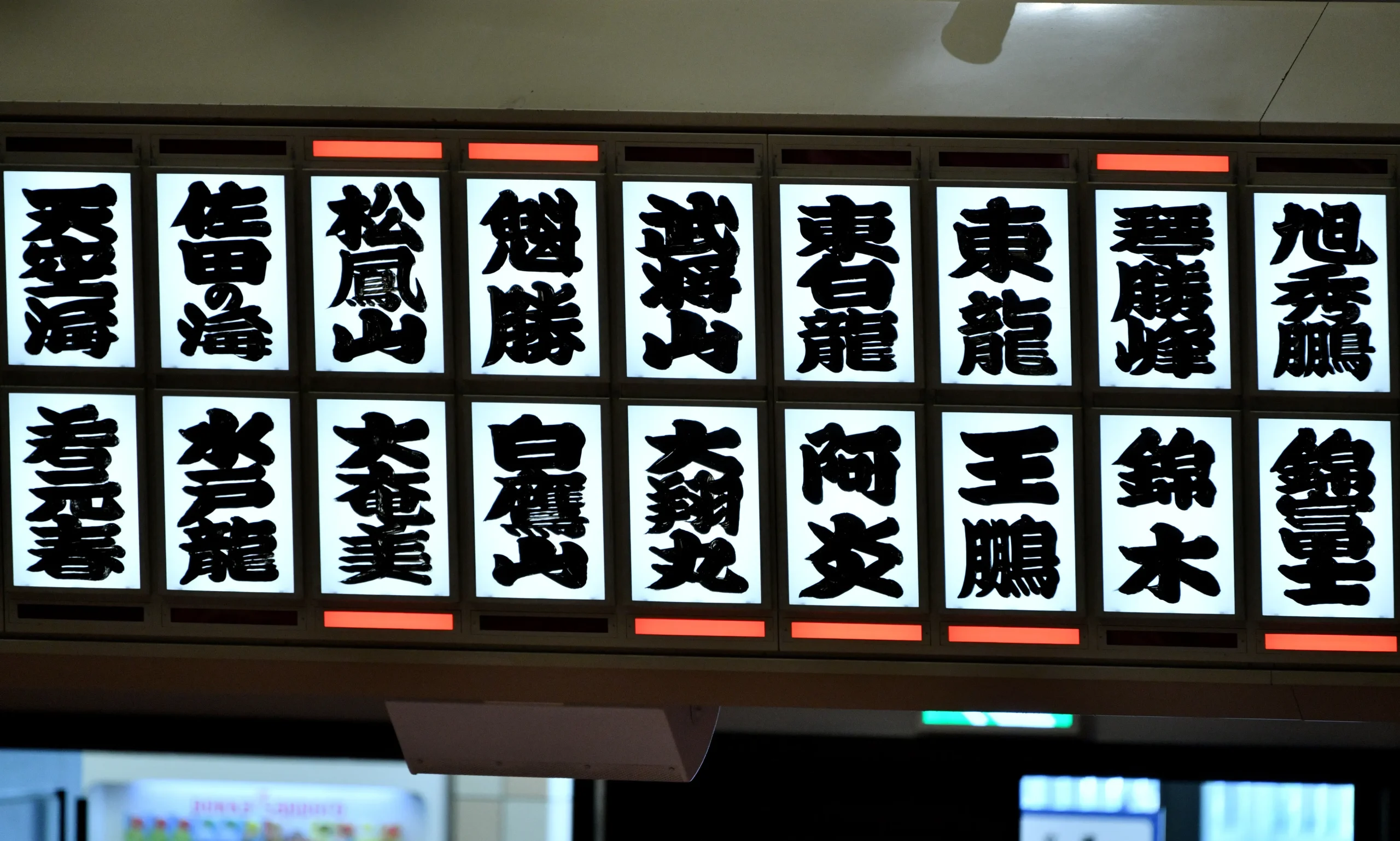
Start with the Japan Sumo Association’s official English banzuke. Roman-alphabet names and ranking labels help you understand each position without reading Japanese calligraphy. The traditional printed sheet can then become something to examine, rather than something you must decipher.
Rank Numbers, East and West
Consider the example label “East Maegashira 3”. It tells you that the wrestler belongs to Makuuchi, holds the Maegashira rank and occupies its third numbered position on the East side.
At the same rank and number, East is above West. The order therefore runs East Maegashira 1, West Maegashira 1, East Maegashira 2, West Maegashira 2, and continues downwards. East and West are not birthplace categories or permanent opposing teams. A wrestler can change sides when a new banzuke is issued.
The name beside the position is his shikona, or professional sumo name. Before your visit, save the names and positions of a few wrestlers you would like to follow. Note which tournament the list covers, too. This gives you a manageable starting point without requiring you to learn every name.
The Handwritten Ranking Sheet
The printed Japanese banzuke is reproduced from a handwritten original prepared by a gyoji, a sumo referee. Its tightly arranged lettering records wrestlers and other members of sumo’s working community. The original is reduced and printed for distribution, preserving handwork in an official document.
Character size also expresses the hierarchy. Higher-division names appear in larger lettering, while lower-division names fit into smaller spaces. Even without reading the characters, you can recognise how the layout makes higher positions more prominent.
Writing the banzuke and deciding the rankings are separate tasks. The gyoji records the established order; he does not independently choose who deserves promotion. For the wider background, The History of Sumo: From Legend to the Modern Ring explores the development of the modern sport.
How Promotion and Demotion Work
Tournament results form the basis of the next banzuke, but not every movement follows a simple calculation. A winning record generally supports a rise, while a losing record generally leads downwards. The destination depends on the wrestler’s existing position and other competitors’ results.
Winning and Losing Records
Two terms make tournament records easier to understand. Kachi-koshi means a winning record: more wins than losses. Make-koshi means a losing record. For those completing all 15 bouts in Makuuchi or Juryo, the difference between eight wins and seven is particularly important.
| Programme | Winning-record example | Losing-record example |
| 15 bouts | 8 wins, 7 losses | 7 wins, 8 losses |
| 7 bouts | 4 wins, 3 losses | 3 wins, 4 losses |
A winning record does not necessarily mean promotion into another division. A wrestler may rise within his existing division instead. Likewise, a losing record need not mean dropping an entire division. Results, current position and other competitors’ records all affect how the next list takes shape.
This explains why a bout can matter outside the championship race. Someone with seven wins in a 15-bout programme still needs an eighth for a winning record. Following that objective gives you a clear reason to watch even when the leading contenders are elsewhere on the programme.
Absences require separate attention. Lower-division wrestlers do not normally appear every day, so a missing name on one day’s programme does not itself indicate injury. Check the official record and withdrawal information before drawing a conclusion. Scheduled rest days and withdrawal are different situations.
The Special Rules for Ozeki and Yokozuna
Ozeki promotion requires sustained success among the upper ranks. The Japan Sumo Association describes 33 wins over three tournaments in sanyaku as a benchmark. It is a guide to performance, not an automatic qualification awarded whenever the total reaches 33.
An Ozeki who finishes with a losing record enters the next tournament in kadoban, meaning he must secure a winning record to keep his rank. A second consecutive losing record brings demotion. A winning record in the kadoban tournament protects his position, making the eighth victory significant even without a championship challenge.
Yokozuna promotion has a different standard. The candidate must be an Ozeki and achieve two consecutive championships, or equivalent results, alongside outstanding ability and character. The Yokozuna Deliberation Council recommends candidates through the established promotion process; winning a tournament does not itself confer the rank.
The useful distinction is between an event result and a professional position. A championship belongs to one tournament. Yokozuna is a rank earned through a broader assessment, and it is not reserved for that tournament’s winner.
Why Reaching Juryo Is a Major Turning Point
The boundary between Makushita and Juryo changes a wrestler’s professional circumstances, not simply his place on a list. Promotion into Juryo brings sekitori status, a monthly salary and assistance from attendants. It is one of the clearest transitions within the hierarchy.
The difference is visible at a tournament. Sekitori can wear coloured silk competition belts and embroidered kesho-mawashi, ceremonial aprons used for ring-entering ceremonies. Their usual schedule also expands from seven bouts to 15. Promotion brings recognition, but it also means facing competition every day.
This does not make those below Juryo amateur wrestlers or imply that they receive no financial support. The distinction concerns monthly salary and status within professional sumo. Lower-division wrestlers remain part of the same competitive system.
Promotion from Juryo to Makuuchi marks a different milestone: entry into the highest division. Keeping those two boundaries separate helps you appreciate Juryo and upper Makushita results, rather than treating everything before Makuuchi as a preliminary programme.
Use Sumo Ranks to Choose What You Watch
Choose your arrival plan around your interests, available time and comfort. The tournament day generally progresses from lower divisions towards Juryo and Makuuchi, but exact times vary by date and venue. Use the official programme for your visit rather than a universal timetable.
Three Ways to Follow the Tournament
| Approach | What interests you | How to prepare |
| Watch the progression | The route from lower divisions to the top | Allow a longer visit and consider comfort during extended sitting |
| Focus on the sekitori | Juryo, Makuuchi and their ceremonies | Check ceremony and session times, then allow time to find your seat |
| Follow a wrestler | One competitor’s results and career | Note his rank, check his scheduled opponent and review withdrawal information |
For an individual focus, begin with one or two names rather than the full ranking list. During the tournament, use the torikumi, the daily list of pairings, to find their opponents. The banzuke shows their official positions; the torikumi shows that day’s contests. Together, they make the programme easier to follow.
If you would prefer a shorter visit, focusing on Juryo and Makuuchi is a valid choice, not an incomplete experience. For dates, tickets and seating, continue to ENJYU JAPAN’s Grand Sumo Tournament Guide. Those practical decisions belong alongside your chosen viewing plan.
When Plans Change
A banzuke entry does not guarantee that a wrestler will compete that day. If your chosen wrestler withdraws, look for another competitor approaching a winning record or an important divisional boundary. A second interest gives you an alternative without requiring the entire day to revolve around one name.
The competition takes place indoors, but severe weather can affect the journey. Check transport operator and event announcements before travelling if conditions deteriorate. Official English rankings and results also allow you to follow progress from your accommodation.
In Tokyo, the Sumo Museum offers another way to explore the sport’s material culture. Admission is free on opening days outside Grand Sumo tournaments at Ryogoku Kokugikan. During those tournaments, an arena ticket is required. Check the museum’s calendar and exhibition before visiting.
Frequently Asked Questions About Sumo Ranks
These short answers clarify four common points of confusion.
Is Yokozuna a Division or a Rank?
Yokozuna is the highest rank within Makuuchi. Makuuchi is the highest of the six divisions; Yokozuna is not a seventh division.
Are Sumo Ranks Based on Weight?
No. Professional sumo has no weight classes. Rankings reflect competitive standing and promotion decisions, rather than a wrestler’s body weight.
Can There Be More Than One Yokozuna?
Yes. Multiple wrestlers can hold the rank simultaneously. Yokozuna is not a championship position reserved for one person.
Does a Tournament Winner Automatically Become Yokozuna?
No. Candidates must already be Ozeki and satisfy demanding performance and character requirements. A championship and promotion are separate achievements.
A Better View of Every Bout
The banzuke gives each contest a context: a position to protect, a winning record to secure, or a divisional boundary to approach. Before choosing your tournament day, find one wrestler whose progress interests you. Leave time to enjoy the rest of the programme, too; understanding the hierarchy gives you more ways to notice a worthwhile contest.
You may arrive with a favourite; the pleasure is leaving with an unexpected one.
Guided Sumo Experiences with ENJYU JAPAN
Our October 2026 sumo tours have finished. What is bookable now, and what is opening next, is below.
| Tour | Date | Where | Price per person | Booking Page |
|---|---|---|---|---|
| 1-Day Katano (Osaka) Sumo Jungyo Tour | December 9, 2026 | Katano, Osaka | JPY 25,000 | |
| 1-Day Hiratsuka (Kanagawa) Sumo Jungyo Tour | December 15, 2026 | Hiratsuka, Kanagawa | JPY 25,000 | |
| Half-Day Sumo Practice Viewing Tour | December in 2026 (Date TBD) | Tokyo | – | coming soon |
| Half-Day Sumo Practice Viewing Tour with Hands-on Sumo Experience | December in 2026 (Date TBD) | Tokyo | – | coming soon |
| 1-Day Tokyo Grand Sumo Tour | January 14, 2027 | Tokyo | – | coming soon |
| 1-Day Sumo Retirement & Hair-Cutting Ceremony Tour | January 31, 2027 | Tokyo | – | coming soon |
A jungyo day is not a shortened tournament, and in one respect it offers more: before any formal bout, the wrestlers stage performances such as shokkiri, a comic bout, and sumo jinku, a traditional song. Neither happens at a Grand Sumo Tournament. → More on what a jungyo day looks like
If you’re interested in any of our “Coming Soon” tours, please let us know through our inquiry form. We’ll notify you as soon as booking details become available, so you can be among the first to know!
References
- Japan Sumo Association – SUMO Introduction: Divisions, Ranks, Rules and Ring-Entering Ceremonies
- Japan Sumo Association – Grand Sumo Quiz No. 236: The Ozeki Promotion Benchmark
- Japan Sumo Association – Grand Sumo Quiz No. 1071: Kadoban and Ozeki Demotion
- Japan Sumo Association – Grand Sumo Quiz No. 1081: Yokozuna Promotion Criteria
- Japan Sumo Association – Grand Sumo Quiz No. 12: How the Handwritten Banzuke Is Produced
- Japan Sumo Association – Grand Sumo Quiz No. 17: Salary, Attendants and Ceremonial Dress on Promotion to Juryo
- Japan Sumo Association – Sumo Museum: Collections and Visitor Information