To understand kabuki a little better, let us look for a few telling details: an actor’s movement, a costume’s meaning and the relationship between sound and action.
Kabuki combines acting, dance, music, costumes, makeup and stagecraft. Its characteristics include stylised performance, male specialists in female roles, dramatic poses, live music and an acting space that extends through the audience. These elements work together, but their prominence changes with the production.
You might be drawn to a dancer’s control, a character’s appearance or the sound accompanying an entrance. This guide explains where to direct your attention, then helps you choose a performance that suits your interests and available time. Start with curiosity, rather than a glossary to memorise.
What Are the Main Characteristics of Kabuki?
Kabuki’s distinctive character comes from the relationship between its different arts. The written name uses characters for song, dance and performing skill, although this explanation is separate from the word’s historical origins. It is a useful introduction to an art with several ways of telling a story.
The following features offer starting points for observation. Their presence and importance vary with the work being performed.
| Feature | Its role | What to look or listen for |
|---|---|---|
| Female-role specialists (onnagata) | Male actors create female characters | Posture, voice and the handling of clothing |
| Stylised acting and held poses (mie) | Movement and stillness express character and emotion | Changes between action and a pose |
| Makeup, costumes and wigs | Appearance gives clues to the role | Facial lines, clothing and shapes |
| Music and sound | Singing, narration and instruments contribute to the drama | Connections between sound and movement |
| The audience passageway (hanamichi) and stage machinery | Action uses space beyond the main stage | Entrances, scene changes and moving scenery |
| Black-clad stage assistants (kurogo) | Assistants support the performance | Coordination around props and costumes |
| Audience calls | Traditional expressions of encouragement | Calls related to moments in the performance |
A quiet domestic scene and a forceful heroic entrance can both belong to kabuki. The performance you choose determines which features come into focus.
Actors Use Movement and Stillness to Shape a Role
Kabuki actors use trained voices, posture, movement and timing to establish their characters. Some expressions are deliberately exaggerated; others rely on smaller changes. Watching that range prevents the boldest photographs from becoming your only expectation.
Onnagata: The Art of Performing Female Roles
An onnagata is a male actor who specialises in female roles. Kabuki began with female performers, but restrictions, including the prohibition of women’s performances in 1629, led to a different theatrical tradition. Female roles became a specialist art within the male-performed form.
Onnagata performance is more than wearing women’s clothing. Shochiku, the company behind KABUKI WEB, describes it as a theatrical creation shaped over centuries, rather than simply an imitation of women. The character emerges through practised movement, voice and appearance.
For a first visit, notice posture and the handling of the costume. Consider how these details shape the character, without trying to assign a fixed meaning to every gesture. Precision becomes easier to appreciate when you watch the movements as part of a complete performance.
Mie, Aragoto and Wagoto
A mie is a stylised pose held at a significant moment. The actor briefly stops the action, concentrating attention on an emotion or conflict. Its form changes with the role: a large movement in a heroic scene and a small adjustment of the chin can both serve this purpose.
Watch the movement leading into the pose and the return to action afterwards. The pause gains its force from that sequence, rather than one compulsory facial expression.
Aragoto, often translated as “rough style”, uses forceful movement and exaggerated expression, particularly for powerful heroic roles. Wagoto, or “soft style”, offers a gentler approach associated with romantic male characters. These are acting styles, rather than categories of plays.
Established performance patterns, known as kata, pass through acting families and teacher–pupil relationships. Familiar roles can therefore receive different interpretations. For a first visit, begin with the actor’s control rather than trying to identify every inherited detail.
Makeup and Costumes Help You Read the Character
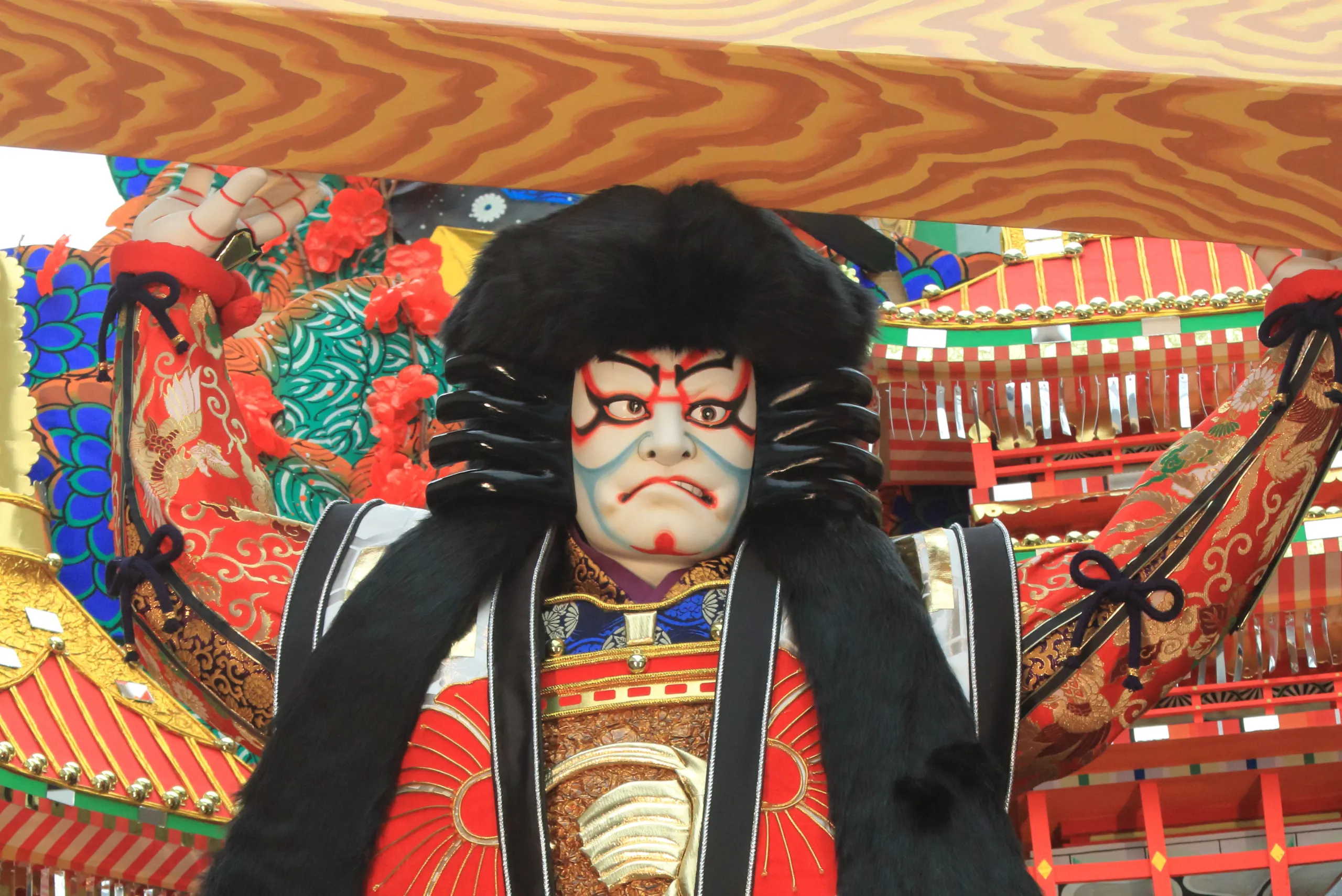
Kabuki’s appearance ranges from relatively restrained clothing to strongly exaggerated costumes and facial designs. Both help establish a role. Look at the whole character, rather than treating one colour as a complete explanation.
Kumadori Is One Style of Kabuki Makeup
Kumadori is makeup using distinctive coloured lines, particularly associated with aragoto. It is one approach to creating a face onstage, and appears in particular roles rather than every production.
Red lines can suggest strength, youth, justice or anger. Indigo often appears on villains or evil spirits, while brown can mark supernatural beings. These associations offer a first clue, but the pattern and the specific role also matter.
The Japan Arts Council’s examples include the title character in the play Kagekiyo, a heroic prisoner whose makeup combines red and indigo. His design shows why colour alone cannot settle a character’s identity. Read the lines as part of the role, rather than as a universal label of good and evil.
Watch How the Actor Uses the Costume
Costumes and wigs help distinguish roles, while their scale changes with the style of the drama. Shochiku’s costume guide describes designs ranging from realistic clothing to elaborate garments, including skilled handwork with gold and silver thread. Their variety is part of the art.
Look beyond decoration to how the actor moves within the clothing. In some dances, hikinuki changes the costume onstage: an assistant pulls the threads holding an outer layer, then removes it in time with the performer. Another costume is revealed beneath.
The transformation depends on preparation and coordination. If clothing and visual changes especially interest you, look for them in the selected dance’s description. A particular work may instead reward attention to smaller movements and the handling of fabric.
Music and Sound Are Part of the Story
Kabuki is an art of listening as well as looking. Voices and instruments can carry a narrative, accompany movement or establish a setting. Sound gives you another route into the performance.
Listen to Voices, Shamisen and Offstage Music
The shamisen, a Japanese instrument with three strings, accompanies forms of singing and narration. Depending on the work, musicians may appear onstage or perform out of sight. Their location is worth noticing alongside their sound.
Music also comes from the kuromisu, a musicians’ space screened by black blinds beside the stage. Drums, flutes and other instruments can suggest surroundings, weather or seasons. Shochiku’s examples include snowfall: theatrical sound can evoke something rather than reproduce it literally.
You can begin listening closely without identifying every musical form. Notice how a voice or instrument works with an actor’s movement, and whether it changes your sense of the scene. That relationship is an accessible starting point.
Notice the Wooden Beats Around the Action
Wooden percussion can give movement a sharper emphasis. Tsuke, a form of wooden percussion, often accompanies a mie. The sound and the pose combine to focus attention on the dramatic moment.
Listen to the timing rather than trying to name every beat. If you use captions, occasionally return your attention to the voices and bodies onstage. The text supplies context; the performance gives it movement and expression.
The Stage Extends Into the Audience
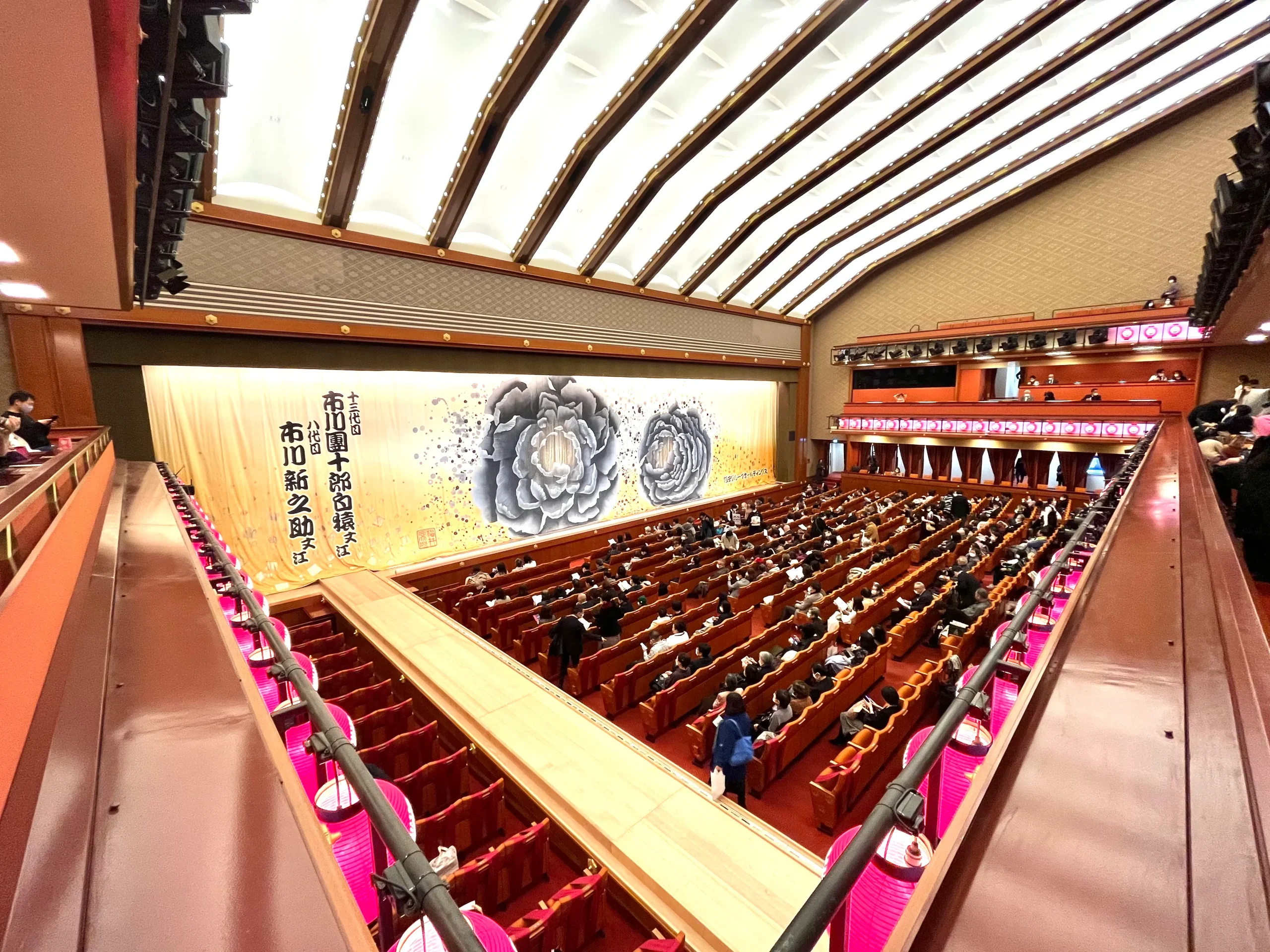
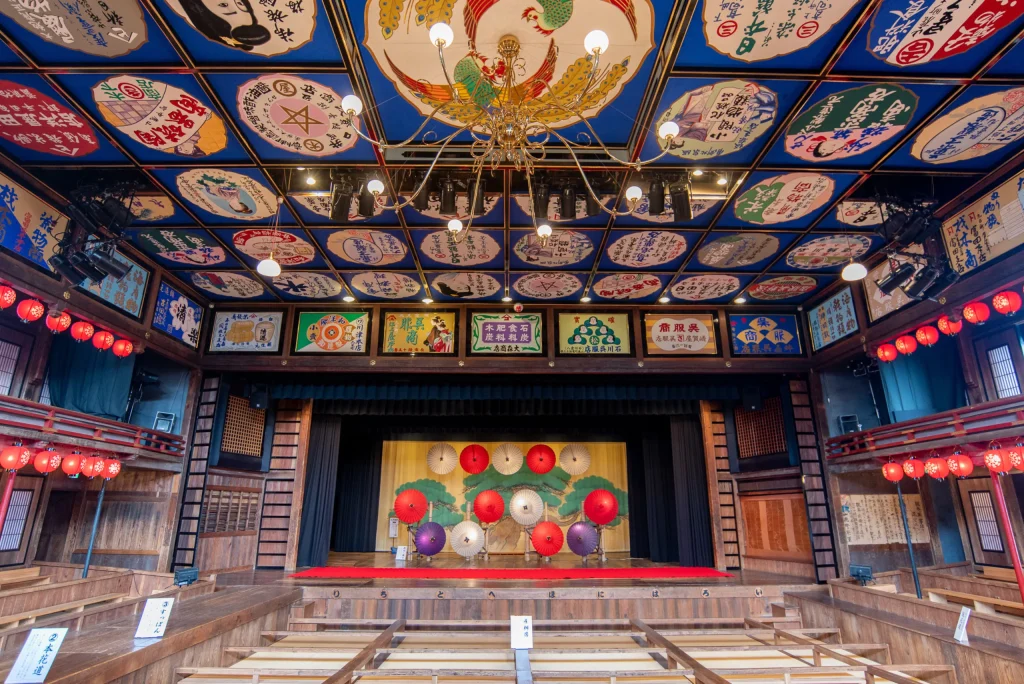
Kabuki’s stage design changes where you look. Action can move through the auditorium, while scenery and performers may rise, descend or turn into position. The space itself helps present the drama.
The Hanamichi Is More Than an Entrance
The hanamichi is a raised passage through the audience, connecting the main stage with an entrance behind the auditorium. Actors use it for both movement and performance, so it is more than a route to their first line.
Depending on the scene, it can represent a road, water or a passage inside a castle. An actor pausing there may be performing an important part of the story. Watch along its length, as well as at its ends.
If the hanamichi particularly interests you, check the view before choosing your seat. Shochiku’s fourth-level single-act guide states that the hanamichi is not visible from those seats, and parts of the main stage may also be out of sight. This is a specific consideration when comparing Kabukiza’s seating options.
Revolving Stages, Lifts and Visible Assistants
A mawari butai, or revolving stage, turns scenery into position. A seri, or stage lift, raises and lowers performers or parts of the set. Read the production description to see which stage effects your chosen scene uses.
People are equally important. Kurogo are black-clad assistants who manage props and help with costumes and movement. By theatrical convention, they are treated as absent from the fictional story, although the audience can see them.
Understanding that convention removes the apparent puzzle. You can follow the drama while appreciating the coordination that keeps it moving. The stagecraft includes human skill as well as machinery.
The Audience Has Its Own Place in the Performance
Some spectators make kakegoe, traditional calls of encouragement or appreciation. They are distinct from ordinary conversation during a scene. Listening to them reveals another aspect of the relationship between actors and audiences.
You may hear a performer’s yagō, or acting-house name, rather than their individual stage name. As a newcomer, you can simply listen and notice how the calls relate to the performance.
For everyday etiquette, avoid talking, photography and recording during the performance. Switch off personal electronic devices, and follow staff instructions for any official caption device. Sit back rather than lean forward, which can obstruct someone else’s view.
Save food and drink for the interval and follow the venue’s instructions. At Kabukiza, there is no formal dress code, but hats and hairstyles should leave the view behind you clear. Consideration matters more than formality.
Different Plays Reveal Different Sides of Kabuki
Once a feature catches your interest, look for a work that brings it into focus. Kabuki contains historical drama, domestic stories, dance and newer works. Their differences help you make a more considered choice.
Historical Drama, Domestic Drama and Dance
Jidaimono, or historical plays, often concern warriors, nobles and legendary figures. Some use earlier settings for events adapted from later periods. Background information can help clarify the relationships and loyalties involved.
Sewamono, or domestic plays, explore townspeople’s lives and conflicts. “Contemporary” descriptions refer to their original audiences, particularly during the Edo period, from 1603 to 1868. They describe a different everyday world from Japan today.
Shosagoto includes dance works and dramas with a strong dance element. Movement works with music and lyrics to express characters and stories. Dance offers a different balance of expression, with its own narrative and emotional context.
Match the Programme to Your Interests
There is no single best introduction for every visitor. Use your curiosity to narrow the choice, then examine the actual scene being performed.
| If you are interested in… | Look for… | Check before choosing |
|---|---|---|
| Clothing and movement | A dance with relevant visual highlights | Story, costumes and duration |
| Forceful acting | A scene featuring an aragoto role | Whether the selected scene includes the role and makeup |
| Human relationships | Domestic drama or a character-focused scene | Characters, situation and available synopsis |
| Variety | A programme containing several works | Each work and the total time, including intervals |
A new adaptation deserves the same checks as a classic. Familiar source material may help you recognise the story, but the staging and language support remain matters to confirm.
If you are still choosing between art forms, our Noh and Kabuki guide compares their approaches.
Kabuki Tour: See These Characteristics in One Performance
If you would like to see the features above on stage, our one-day kabuki tour on 24 November takes you to Kabukiza’s Kaomise matinee, Kanadehon Chūshingura. As a play adapted from puppet theatre, it brings several of them together:
- Female roles performed by onnagata, including Okaru
- Narration and shamisen music carrying the drama
- A puppet that announces the day’s cast before the curtain, a custom you will only see at Chūshingura
Your English-speaking guide explains what to look for before the performance, and an English captioning device helps you follow it. A bento at your seat and visits to the rooftop garden, the Kabukiza Gallery and Kobikichō Square complete the day.
See the full day and save your seat for 24 November
Prepare for a First Visit Without Speaking Japanese

A little preparation can make your attention more useful once the performance begins. Choose the content first, then confirm the time, language support and view. Those checks turn an interest into a workable plan.
Check the Story, Language Support and View
Read a short synopsis identifying the main characters and the situation in the selected scene. Kabuki programmes can present extracts from longer works, so understanding the starting point is especially helpful.
Distinguish a single act from a full programme containing several works. One act has no fixed length: Shochiku gives broad estimates of 30–60 minutes for dances and short dramas, and one to two hours for longer dramas. Use the published time for your chosen act.
Kabukiza’s visitor guide gives three to four hours, including intervals, for its matinee and evening programmes. Programme arrangements vary, so confirm the duration of the specific performance before planning meals or another reservation.
At Tokyo’s Kabukiza Theatre, rental caption devices provide essential English translations of dialogue and lyrics, plus explanations. Very short acts may not offer the service. Check the international visitor service for current conditions, and bring yen in cash for rental. English synopses are also included in the Japanese programmes sold at the theatre.
Before buying, check restricted-view notes and any steps or access arrangements relevant to you. For dates and the next planning steps, use our Tokyo kabuki schedule guide alongside the current official listing.
Choose a Plan That Fits the Day
Weather and availability call for different responses. Keep ordinary rain separate from disruption to your journey.
| Situation | Plan A | Plan B | Plan C |
|---|---|---|---|
| Ordinary rain; transport operating | Keep your booked indoor performance | Shorten outdoor sightseeing around it | Move outdoor activities to another day |
| Preferred performance unavailable or too long | Check another date or programme | Compare another work or suitable single act | Use official introductions to prepare for a later visit |
| Severe weather, disrupted transport or programme changes | Read organiser and transport notices | Reassess the journey if travel is affected | Study official material at your accommodation |
Check the ticket’s exchange and refund terms before changing your plans. A different itinerary and a different booking are separate decisions.
Shochiku’s official video page includes introductions with English commentary or subtitles, alongside streaming information. Check the viewing conditions for your selection. Videos help you compare movement and sound, while live theatre offers a different experience.
Questions Before Your First Kabuki Performance
These answers address three common uncertainties without replacing the checks for your selected performance.
Does Every Performance Use Kumadori?
No. Kumadori belongs to particular roles and styles, especially aragoto. Other characters use different makeup. Check the chosen work if a specific design is important to you.
Can I Enjoy Kabuki Without Speaking Japanese?
Movement, music and stagecraft offer points of interest. An English synopsis and available captions help you follow the story. Combine them to give yourself several ways into the performance.
Why Do People Call Out During Kabuki?
Traditional calls encourage or acknowledge actors at particular moments. They are different from casual conversation. You are free simply to listen.
Choose What You Want to Notice First
Begin with two or three things you would like to understand: a held pose, the handling of a costume, or the connection between music and movement. Then choose a work that gives those interests room.
Read its synopsis and confirm the running time, view and language support. Let your curiosity guide the preparation, rather than trying to learn every convention. A considered choice gives you a starting point while leaving room for discoveries you could not have planned.
Choose your evening with care, then allow the stage the pleasure of surprising you.
References
- Shochiku / KABUKI WEB – Remarkable Features Unique in Kabuki: Onnagata, Dramatic Poses and Stage Assistants
- Shochiku / KABUKI WEB – Kabuki Categories: Historical Plays, Domestic Drama and Dance
- Shochiku / KABUKI WEB – Costumes, Makeup & Wigs: Character Clues and Kumadori Colours
- Japan Arts Council – Types of Kumadori Makeup: Line Patterns and Examples of Specific Roles
- Shochiku / KABUKI WEB – Live Music and Sound Effects: Onstage Musicians and Offstage Sounds
- Shochiku / KABUKI WEB – Unique Stage Structures, Dynamic Stage Sets: Hanamichi, Revolving Stages and Lifts
- Shochiku / KABUKI WEB – Single Act Tickets, Fourth Level: Seating, Restricted Views and Admission Conditions
- Shochiku / KABUKI WEB – Service for International Visitors: English Captions, Rental Conditions and Synopses
- Shochiku / KABUKI WEB – Rules and Etiquettes: Photography, Electronic Devices and Consideration for Other Spectators