If the thought of watching kabuki leaves you curious but uncertain, let us begin with what will make your first visit worth your time.
Kabuki combines acting, dance, music and stagecraft. You can approach it without speaking Japanese, especially when you read a short synopsis and choose suitable English support. The useful questions are how much time you want to spend and what you would most like to watch.
A single act may suit a focused visit. A full programme offers more variety, while an introductory performance can provide explanation alongside the drama. Seats matter too: a shorter performance does not necessarily mean a closer view or more space.
This guide brings those choices together, using Tokyo’s Kabukiza Theatre as the practical example. Its ticket arrangements and services should not be applied automatically to other theatres.
What Is Kabuki, and What Do You Need to Know First?
Kabuki has entertained audiences for more than 400 years, but its performances vary considerably. Understanding how a programme works will help you choose without studying its entire history.
Drama, Dance and Music in One Performance
Kabuki developed as entertainment for urban audiences. Spoken drama, dance, singing and instrumental music work together with costumes and stage effects. These elements create the performance together, rather than appearing as separate attractions.
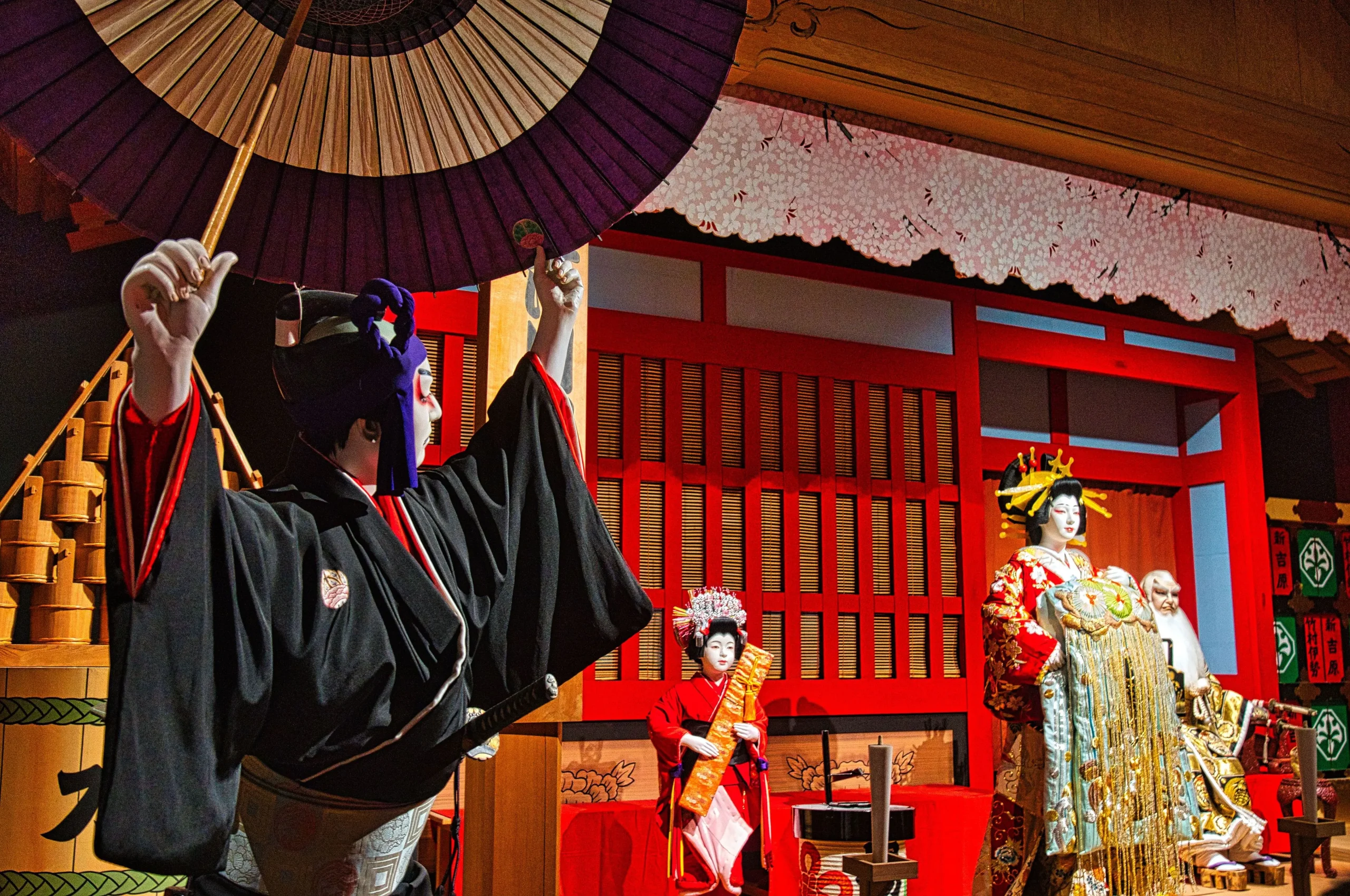
Actors use established techniques to express character and emotion. Onnagata are actors who specialise in female roles through carefully developed posture and movement. Their work is an acting discipline, not simply a matter of costume.
One Programme Is Not the Same as One Whole Day
A matinee or evening programme is one scheduled part of the theatre’s day. It may contain several separate plays or dances, with intervals. Buying that programme does not mean buying every performance that day.
A single-act ticket covers a particular work or scene. Long plays may appear through selected scenes, so read the description of the section being performed. The scene matters as much as the title when deciding what interests you.
Choose a First Performance That Fits Your Time and Interests
You do not need a favourite actor or a list of famous plays to begin. Start with your interests, then look at what is available during your stay.
Start with What You Want to Watch
If movement and music appeal to you, consider a dance work. Some communicate stories through gesture, costume and lyrics, so a brief explanation still helps. Dance offers a different focus, not an automatic shortcut to understanding.
For relationships and conflict, look at story-led drama. Jidaimono, or historical plays, often involve rulers, samurai and political struggles. Sewamono, or domestic plays, concern townspeople and their relationships or obligations.
These categories suggest subject matter rather than guaranteeing a particular pace. Some stories include violence or suicide; read the synopsis if this affects your choice. Let the particular scene guide you, rather than its reputation alone.
If you are weighing kabuki against another theatre tradition, ENJYU JAPAN’s guide to Noh and Kabuki explains their differences.
Compare a Single Act with a Full Programme
A single act lets you concentrate on one work. A full programme gives you time with several performances and usually includes intervals. Neither is automatically the better introduction.
| Format | Why choose it? | What to check before booking |
| Single act | One work fits your interest or available time. | Actual duration, language support and seat conditions. |
| Full programme | You want several works and more time at the theatre. | Total running time, intervals and ticket price.kabukiweb |
| Introductory performance | You would value explanation alongside the drama. | Dates, venue, explanation language and additional support.japanculturalexpo.bunka.go |
“One act” does not mean “one hour”. October 2026 Kabukiza listings included performances ranging from 15 minutes to two hours. Use the published duration to plan, rather than assuming that every single act is brief.
Consider an Introductory Performance When the Dates Fit
The Japan Arts Council presents beginner-oriented programmes combining explanation with live kabuki. Their venues, dates and language support depend on the event, so they are scheduled opportunities rather than permanent ticket options.
Choose one when it fits your journey. If the dates do not align, a regular performance with suitable preparation remains another way to begin.
Follow the Story with the Right English Support
A synopsis introduces the story; captions display translations; an audio guide delivers spoken information. Identify the support offered for your performance instead of assuming every theatre provides the same equipment.
Read a Short Synopsis Before You Arrive
Focus on the main characters, their relationships and the problem they face. For an extract, find out what happened before that scene. This gives unfamiliar names and actions a context without requiring you to study the complete play.
English summaries appear in the back of programmes sold at Kabukiza. Before purchasing a ticket, use the official performance description to identify the scene and decide whether its subject interests you.
Check Whether the Support Uses Captions or Audio
Kabukiza’s current English service uses a captioning device. It provides essential translations of dialogue and lyrics, together with explanations about kabuki. It does not promise a translation of every word.
Other venues may offer audio instead. The Japan Arts Council’s October 2026 production, for example, advertised an English audio guide but no captions. Read the individual listing rather than relying on a general theatre description.
If reading a small screen is tiring, include that in your decision about the work and its length. Prepare the synopsis first, then use the captions as a supporting resource.
Include the Extra Cost and Any Exceptions
As checked on 11 October 2026, Kabukiza’s caption rental costs ¥1,500 for a full programme and ¥1,000 for a single act. On-the-day rental is cash-only.
Some full-programme bookings offer tickets with caption rental included. The October 2026 booking page provides this option for an additional ¥1,500. If you choose it, follow the collection instructions rather than paying again at the theatre.
Very short acts may not offer captions. Check availability before choosing a brief performance specifically for its English support; the service is not a feature of every ticket.
Four Things to Notice While You Watch
You can approach a performance through more than its dialogue. These four points give you something concrete to notice, although their use depends on the work.
Movement and Mie: When Emotion Becomes a Pose
A mie is a strongly held pose that expresses an intense emotion or conflict. Movement pauses, giving stillness dramatic force; wooden clappers may reinforce the moment. Watch how the actor presents the feeling through the whole body.
Elsewhere, controlled posture and movement help establish a role. You do not have to name the technique to notice its effect.
Live Music and the Sounds That Shape a Scene
The shamisen, a three-stringed instrument, is part of kabuki’s musical world. Singing, narration, drums and other instruments also shape performances. Some musicians appear onstage; others play out of view.
Music can accompany movement, carry part of the story or establish atmosphere. Offstage music may suggest weather, seasons or a setting. Listen to how sound supports the scene, not simply how it accompanies the actors.
The Hanamichi and the Changing Stage
The hanamichi is a raised passage through the audience connecting with the main stage. It extends the acting space into another part of the auditorium. Your seat determines whether you can see its action.
Revolving stages and lifts can transform settings in productions that use them. These are possibilities within kabuki’s stagecraft, not effects promised in every performance.
Costumes, Makeup and the People Behind the Changes
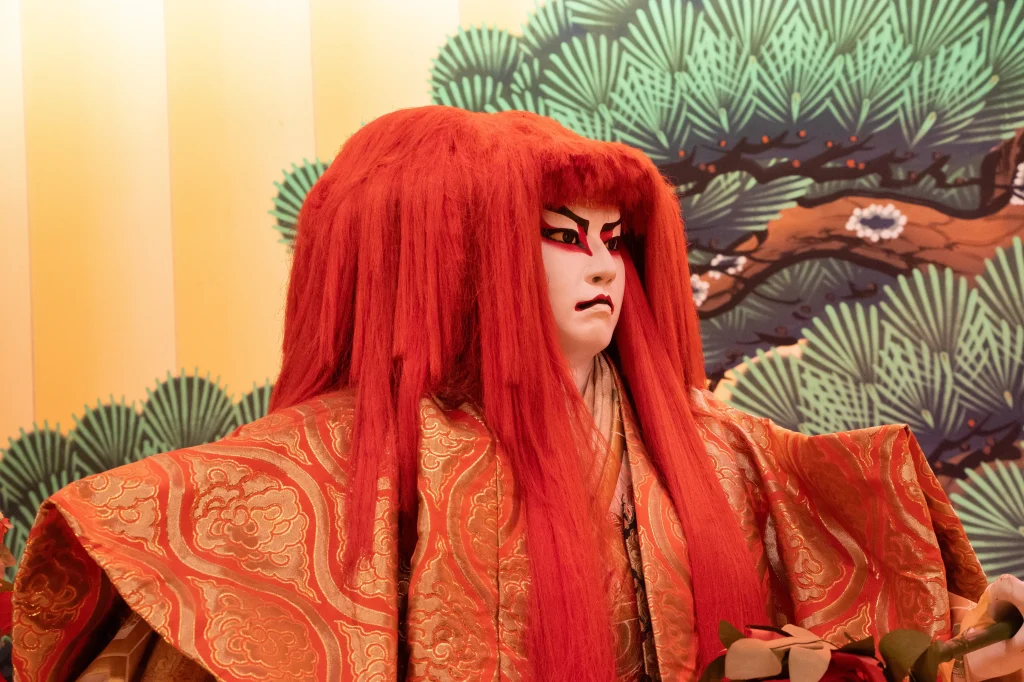
Clothes, wigs and makeup contribute to a role’s appearance. Kumadori, the bold makeup with coloured lines, is one distinctive style rather than something every actor wears.
You may also see kurogo: stage assistants dressed in black who help with props and costumes. By convention, their presence does not interrupt the fiction. Their support, including work on rapid costume changes, reveals the coordination behind the performance.
Plan Your Seats, Tickets and Theatre Arrival
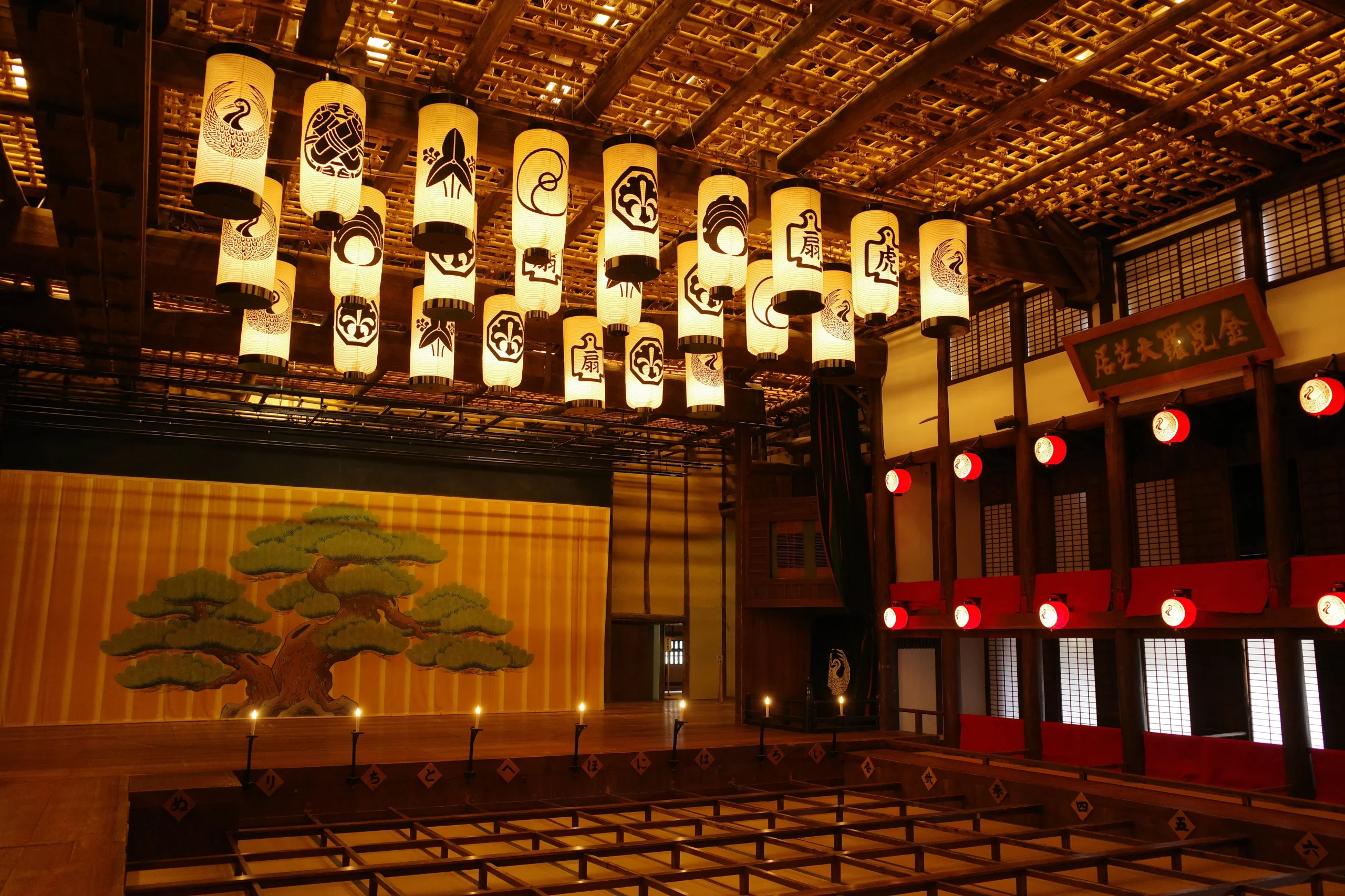
The following arrangements are specific to Kabukiza. Compare the seat conditions first, then prepare the booking and entrance instructions for that ticket.
Choose a Seat for the View and Comfort You Want
Decide whether your priority is price, proximity, the hanamichi or room to sit comfortably. Use the official seating information alongside the ticket description; a seat’s level alone does not establish its view.
| Seat option | Main considerations |
| Regular seats for a full programme | Compare the position, price and view of the seat offered.kabukiweb |
| Fourth-level single-act seats | Furthest from the stage, with limited space. The hanamichi is not visible, and part of the main stage may be obscured.kabukiweb |
| Second-level upgraded single-act seats | Closer and more spacious than fourth-level seats, with access through the main lobby. Offered only on selected performance days.kabukiweb |
Fourth-level tickets do not provide access to levels one to three. There are no shops or restaurants on the fourth level, so plan your meal separately.
If you need wheelchair space or assistance, confirm the booking conditions and access route before purchasing. The official single-act page includes a wheelchair-space option; a companion needs a separate ticket.
Book Through the Official Performance Page
For a full programme, open the official listing for your travel dates and follow its booking link. For single acts, use the official English booking page, where sales open at noon, Japan Standard Time, the day before the performance.
Ask your bank whether your card supports and is registered for 3D Secure 2, the required online authentication system. Single-act purchases cannot be changed or refunded after purchase; cancellation of the performance is a separate matter.
For an October 2026 price example, fourth-level single-act tickets were listed at ¥1,500–¥4,000, while full-programme seats ranged from ¥4,500–¥17,000. Add caption rental where needed and check the final online total, including the ticketing fee, before paying.
Since 2 October 2026, fourth-level same-day box-office tickets have also been reserved seats, with cash and credit cards accepted. Sales begin at 10am. Each person can buy only one ticket, so companions should queue together. Availability is limited.
Leave Time for the Right Entrance and Caption Counter
Higashi-ginza Station, served by the Hibiya and Toei Asakusa lines, connects with Kabukiza at Exit 3. Your ticket type still determines the theatre entrance. As a planning allowance, aim to arrive around 30 minutes early.
Before entering:
- Recheck your act’s starting time.
- Have the QR ticket ready on your phone or paper.
- Allocate QR codes correctly if companions arrive separately.
- Follow your ticket’s entrance instructions.
- Allow time for the toilet, caption rental and seating.
Fourth-level visitors use the entrance to the left of the main entrance and the fourth-level caption service. Upgraded second-level visitors should follow their separate instructions; staff may ask them to wait before seating or borrowing captions.
Keep your phone charged and bring cash for rental. Later acts’ starting times can change, so leave a margin before dinner or onward travel.
Theatre Etiquette Without the Guesswork
Kabukiza does not require formal clothes or a kimono. Wear something comfortable for the time you will spend seated, and protect the view and concentration of people around you.
During the performance:
- Remove hats that obstruct the view.
- Sit back rather than leaning forward.
- Turn off personal electronic devices.
- Do not photograph, film, record, converse, eat or drink.
Save food and conversation for permitted intervals. Follow staff instructions when using the captioning device supplied for the performance.
You may hear kakegoe, traditional calls made at carefully chosen moments, often using an actor’s professional house name. Listening helps you appreciate the relationship between actors and audience; there is no obligation to join in.
For children, consider the story and continuous sitting time as well as admission rules. If a child becomes upset or disturbs others, take a break in the lobby.
Kabuki Tour for Beginners: Your First Performance, Guided
There is a lot in this guide to remember on your first visit. Our one-day kabuki tour on 24 November lets you set most of it aside. It is designed for first-time visitors and built around Kabukiza’s Kaomise matinee, Kanadehon Chūshingura, the story behind the forty-seven rōnin.
You do not need Japanese: an English captioning device is included, and your guide explains the story and what to watch for before the curtain opens. You do not need to plan lunch: a bento is waiting at your seat during the interval. And you do not need to find the right entrance: you simply meet your guide in front of Kabukiza at 10:25.
The performance begins with a custom you will only see at Chūshingura: at around 10:50, a puppet steps out and reads the day’s cast. After the show, the tour continues to the rooftop garden, the Goemon Staircase, the Kabukiza Gallery and Kobikichō Square.
See the full day and save your seat for 24 November
Keep a Good Alternative for Sold-Out Seats or Bad Weather
A sold-out seat, an ordinary rainy day and a transport disruption require different decisions. Choose an alternative that preserves your interest without adding a demanding journey.
| Situation | Plan B | Plan C |
| Your preferred seats are unavailable | Compare another programme, date or single act during your stay. | Use the Japan Arts Council’s online kabuki learning materials. |
| Rain affects your planned walk | Keep the booked show if theatre and transport operate normally; make Higashi-ginza Station and the theatre the focus of a shorter route. | Postpone unbooked outdoor plans and return to your accommodation after the show. |
| Transport disruption prevents attendance | Read operator and theatre notices before deciding whether another day is possible. | Stay somewhere safe and use official learning materials or an available recording. |
The Japan Arts Council’s Kabuki for Beginners offers an illustrated introduction for this quieter alternative. It can also help you prepare before travelling.
For full-programme tickets, an online “Sold Out” message can reflect a booking deadline or allocated stock. Shochiku’s English-speaking telephone service can check availability: +81 3 6745 0888, 10am–5pm Japan Standard Time. Same-day tickets cannot be reserved by telephone; enquire at the box office instead.
KABUKI ON DEMAND provides official recordings. English support and availability in Japan depend on the title, so choose a work whose viewing conditions fit your stay.
If a show is cancelled, follow its refund notice. The single-act booking conditions do not promise reimbursement of transport or other travel costs.
Quick Questions Before Your First Kabuki Visit
These final checks can help you settle on a visit that fits your travelling companions.
Can I Enjoy Kabuki Without Speaking Japanese?
A synopsis gives the scene context, while available English support helps with words and background. Movement, music and staging offer additional ways to approach the performance.
Is a Single Act Always the Best Choice for Beginners?
No. It suits some schedules, but a full programme or a different seating arrangement may better match your interests and comfort priorities.
Can I Bring Children?
Check the exact admission and child-ticket rules before booking. Kabukiza’s current fourth-level notice requires a separate ticket from age four. Story content and sitting time matter too; a short act is not automatically suitable for every child.
Make Your First Kabuki Visit Your Own
Start with one interest: movement, music, a character or a story. Match it with the performance length, seat and support that will make the visit comfortable.
Our Kabuki Schedule in Tokyo guide can help you explore the calendar before checking the current official programme. If theatre belongs within a wider cultural journey, ENJYU JAPAN offers Tailor-Made Tour planning for travellers wishing to discuss their interests and pace.
You need not leave knowing every name or convention. Give yourself time to arrive calmly, watch attentively and decide what caught your interest.
Choose the performance that tempts you; the rest of kabuki can wait for another encounter.
References
- Shochiku – About Kabuki: History, Music, Dance and Drama
- Shochiku – Kabukiza Theatre Information: Access and Seating Plan
- Shochiku – How to Buy Tickets: Online Booking, English Telephone Support and Box Offices
- Shochiku – Single Act Tickets, Fourth Level: Views, Seat Space and Entrance Instructions
- Shochiku – Upgraded Single Act Tickets, Second Level: Seating and Availability
- Shochiku / e-tix – Kabukiza Single Act Seats Online Ticket: Prices, Payment and Ticket Conditions
- Shochiku – Service for International Visitors: English Captions, Rental Fees and Programme Synopses
- Shochiku – Rules and Etiquettes: Photography, Electronic Devices and Audience Consideration