If your first sumo bout leaves you wondering what you missed, a few well-chosen clues will help you watch with confidence.
The basic sumo rules are simple. A wrestler normally loses when any part of his body touches the ground outside the competition circle. Inside it, touching the ground with anything except the soles of his feet also means defeat. Forbidden actions can result in a foul loss.
This guide covers professional grand sumo in Japan. You need not memorise every technique before attending. Understanding the boundary, the start and the officials’ decisions gives you a useful foundation—and leaves you free to enjoy what happens between them.
The Basic Sumo Rules: How a Bout Is Won
A sumo bout usually ends with ground contact or an exit from the circle. Wrestlers do not accumulate points during the contest, and there are no rounds to win. The aim is a decisive result, sometimes determined by a movement as small as a fingertip touching the surface.
Ground Contact and the Ring Boundary
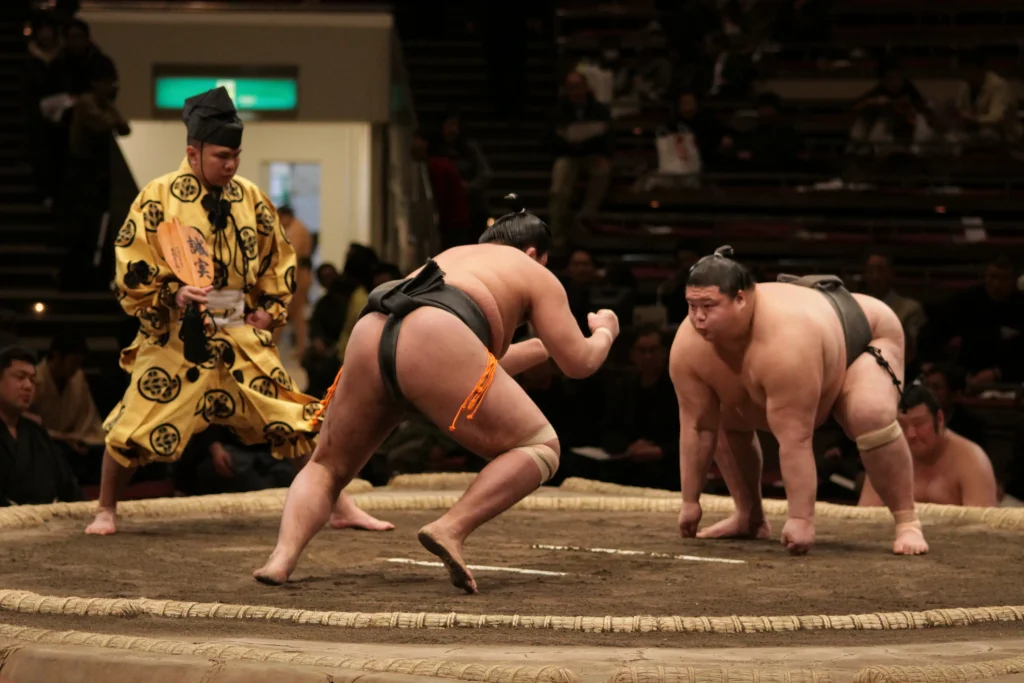
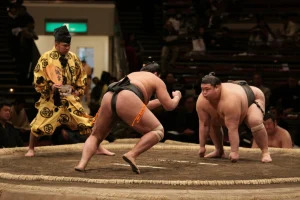
The dohyo is the clay platform where wrestlers compete. At its centre, partly buried straw bales mark a circular competition area approximately 4.55 metres across. These bales, called tawara, form the boundary. The circle—not the entire square platform—is where the contest takes place.
Two examples make the usual winning conditions easier to recognise:
- A wrestler stays inside the circle, but his knee or hand touches the ground: he loses.
- A wrestler remains upright, but his foot touches the ground beyond the boundary: he loses.
Standing on a boundary bale is different from touching the ground beyond it. A wrestler may balance on the bale while resisting a push. His upper body can lean outwards without automatically ending the bout. At the edge, therefore, look for contact with the ground rather than judging by body position alone.
Close finishes can require more detailed assessment. For now, remember the distinction between remaining supported at the boundary and making contact outside it. The judges resolve cases that are not clear from this basic view.
Why Size Does Not Decide the Winner
Japanese professional sumo has no weight classes, so wrestlers of very different sizes can face each other. Body weight matters, but it does not guarantee victory. Position, timing and the ability to control an opponent’s movement also shape the result.
A wrestler need not lift or throw an opponent to win. Pushing him beyond the boundary is enough. This changes what is worth watching: compare the competitors’ foot positions and balance, rather than assuming the larger man has already won.
Legal Moves and Fouls: What Wrestlers Can and Cannot Do
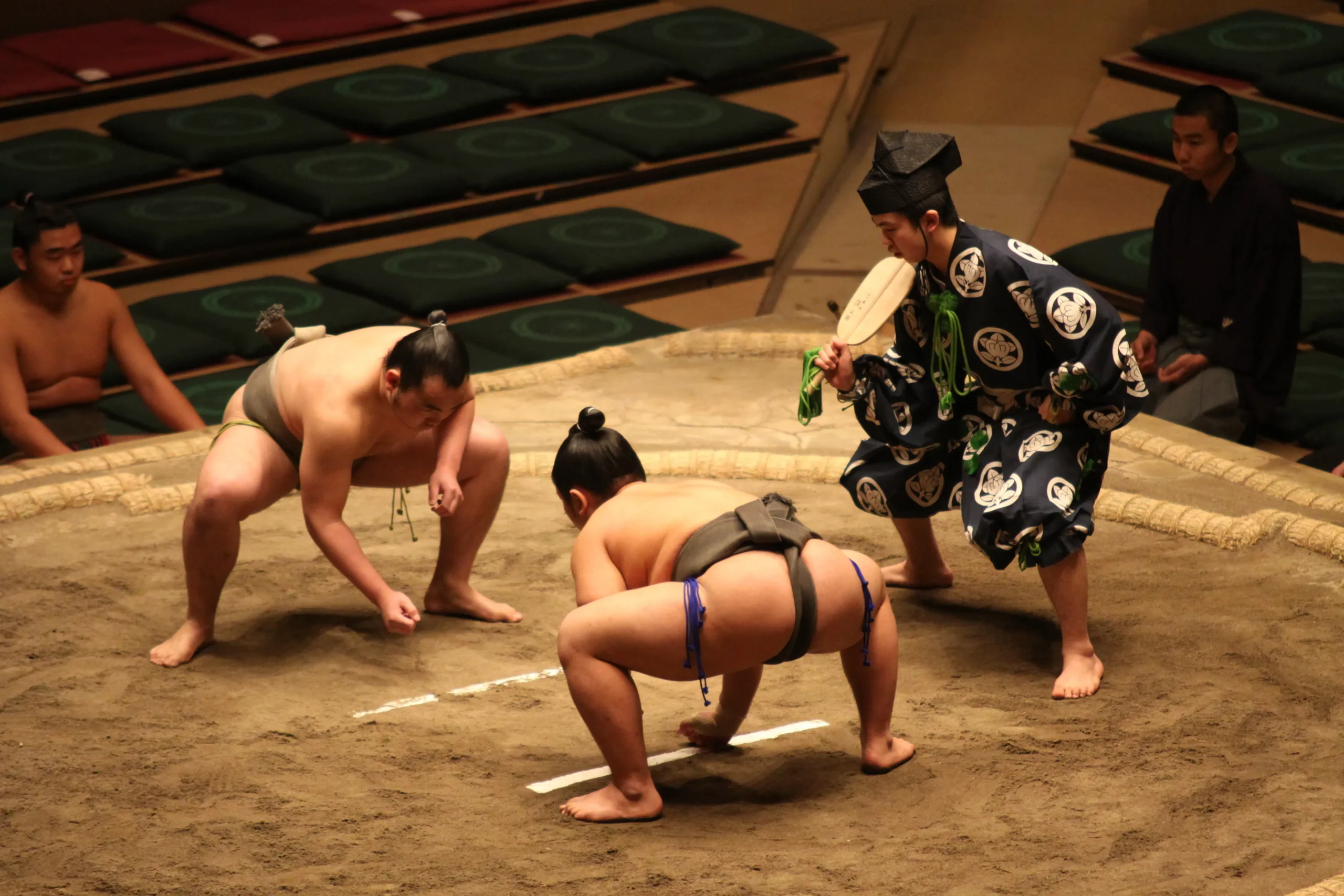
Sumo allows powerful contact within defined limits. Pushing, open-handed slaps, belt grips, throws and recognised leg techniques can all be legal. A forceful-looking action is not necessarily a foul; the precise movement matters.
Slaps, Belt Grips and Leg Techniques
The mawashi is the belt-like garment wrapped around a wrestler’s waist and between his legs. It provides gripping points that help him control or turn his opponent. However, the rules distinguish permitted grips from prohibited ones, so not every section can be grabbed in the same way.
| Action | The distinction to recognise |
| An open-handed slap | Different from punching with a closed fist |
| Gripping the mawashi around the waist | Different from grabbing its front vertical section |
| A recognised leg hook or sweep | Different from kicking the chest or abdomen |
A grip at the front of the waist is not automatically illegal. The prohibited area is the front vertical section of the mawashi. This distinction prevents a common misunderstanding: watch the actual grip, not simply whether a hand moves towards the front.
The Eight Forbidden Moves
Kinjite means forbidden moves. The Japan Sumo Association identifies eight categories that result in a foul loss:
- Punching with a closed fist.
- Grabbing the opponent’s hair.
- Poking the eyes or other vulnerable points.
- Slapping both ears simultaneously with the palms.
- Grabbing the front vertical section of the mawashi.
- Grabbing the throat.
- Kicking the chest or abdomen.
- Bending the opponent’s fingers backwards.
You do not need to inspect every exchange for a possible offence. Knowing these limits mainly explains why a legal slap, trip or throw can look fierce without breaking the rules. The officials assess any suspected foul.
Before the Charge: Preparation, Ritual and the Start
The repeated movements before a bout are organised preparation, not failed attempts to wrestle. They combine physical readiness with ritual. Recognising the difference between preparation and the actual start helps you know when to focus on the contest.
Salt, Stamping and Open Hands
Salt throwing is a purification ritual. Before upper-division bouts, wrestlers scatter white grains of salt across the dohyo to purify the ring and express a wish for safety. The salt does not decide the winner; it belongs to the formal preparation.
Shiko is the movement in which a wrestler raises a leg and stamps it down. It is a basic sumo exercise with a traditional meaning of driving away evil. Chirichozu includes clapping and spreading the arms; displaying the open hands shows that the wrestler carries no weapon. Each action has a distinct role.
You may also see chikaramizu, purification water used to rinse the mouth. These customs preserve sumo’s ritual background within a competitive event. For their wider historical context, see The History of Sumo: From Legend to the Modern Ring.
Shikiri and the Tachiai
Shikiri is the preparation in which the wrestlers face each other and crouch before starting. They may withdraw and repeat the process. In makuuchi, the top division, the standard preparation limit is four minutes. This is not a four-minute limit on the wrestling itself.
The tachiai is the initial charge that starts the bout. Both wrestlers touch the ground with their fists and coordinate their timing. If the start is not properly established, they prepare again. This is called matta, meaning “wait” in Japanese. The contest does not begin simply on a whistle; their shared readiness is central to the start.
Once they engage, notice the position created by the opening contact. Are they pushing at arm’s length, or have they moved into close contact? Has either secured a belt grip? These questions connect the first collision with the contest that follows.
Close Finishes: Referees, Reviews and Rematches
The referee gives the initial decision, but ringside judges can question it. If both wrestlers seem to fall together, you need not decide the outcome immediately. Watch the officials: their discussion is part of the judging process, not a break from it.
What Happens During a Monoii
The gyoji is the referee inside the ring. He manages the contest and indicates the winner with a gunbai, a traditional fan. Five shimpan, or judges, observe from around the dohyo. The fan shows the initial result; the judges can review it.
A monoii is a discussion following an objection to the referee’s decision. The judges gather on the dohyo and communicate with the video room, using footage to help assess the finish. Video supports their judgement rather than automatically determining the result.
There are three possible outcomes:
- The referee’s original decision stands.
- The decision is reversed, making the other wrestler the winner.
- The wrestlers compete again in a torinaoshi, or rematch.
The chief judge announces the decision after the discussion.
Even without understanding the Japanese explanation, you can recognise that the result is being reviewed. If the wrestlers prepare again, another contest will settle the outcome.
Why the First Touch Is Not Always the Whole Story
Some close finishes involve shini-tai, literally “dead body” in Japanese. In sumo, this means a position from which a wrestler can no longer recover or reverse the outcome. Judges may consider this condition alongside the order in which the wrestlers touch the ground. The first visible contact is therefore not always the whole explanation.
You do not need to judge this specialist aspect yourself. Use the basic contact rules to follow the action, and leave complicated finishes to the judges. Understanding why they confer is more useful than trying to predict every ruling.
Waiting for the decision—and quietly comparing impressions with a companion—can be part of the pleasure of watching a close bout.
Four Winning Techniques to Recognise
A winning technique describes how a victory happened. The Japan Sumo Association recognises 82 kimarite, or winning techniques, and five non-technique outcomes. A few examples introduce the differences between pushing, close-contact movement, throwing and breaking balance.
| Technique | How it works | What to watch |
| Oshidashi — push-out | The wrestler pushes the opponent beyond the circle, applying a hand or hands to the chest or under the arms. | Hand pressure and advancing feet. |
| Yorikiri — force-out | The wrestler maintains close body contact and moves forwards or sideways to force the opponent out. | The bodies remaining close as they move. |
| Uwatenage — overarm throw | The wrestler grips the mawashi over the opponent’s arm and uses that grip to throw him. | The outside grip and turning movement. |
| Hatakikomi — slap-down | The wrestler moves aside and slaps down the shoulders, back or arms of an opponent coming in low. | The forward lean and sudden downward contact. |
The contrast between oshidashi and yorikiri is a useful starting point. One centres on pushing; the other uses close body contact. A belt grip is common in yorikiri, but the official definition focuses on contact and movement rather than requiring that grip.
A throw can also win by taking the opponent outside the circle without making him fall. This separates the technique from the finishing condition: the technique describes the movement, while the contact or exit decides the result. The Association’s official technique guide offers further examples in Japanese.
From One Bout to a Tournament
Each bout contributes to a tournament record. A honbasho is an official Grand Sumo Tournament, lasting 15 days. Wrestlers in the top two divisions, makuuchi and juryo, normally compete once daily; those in lower divisions have seven scheduled bouts. Their programmes are not identical.
Kachikoshi means a winning record, while makekoshi means a losing record. Across 15 bouts, eight victories secure kachikoshi. Results influence the banzuke, the official ranking list, although a winning record does not guarantee promotion in every situation.
For a one-day visit, a wrestler’s name and current record provide useful context. A victory may secure a winning record or affect the championship race. That information gives a short contest a place within the tournament, without requiring detailed knowledge of the hierarchy.
Watch Sumo in Japan with Confidence
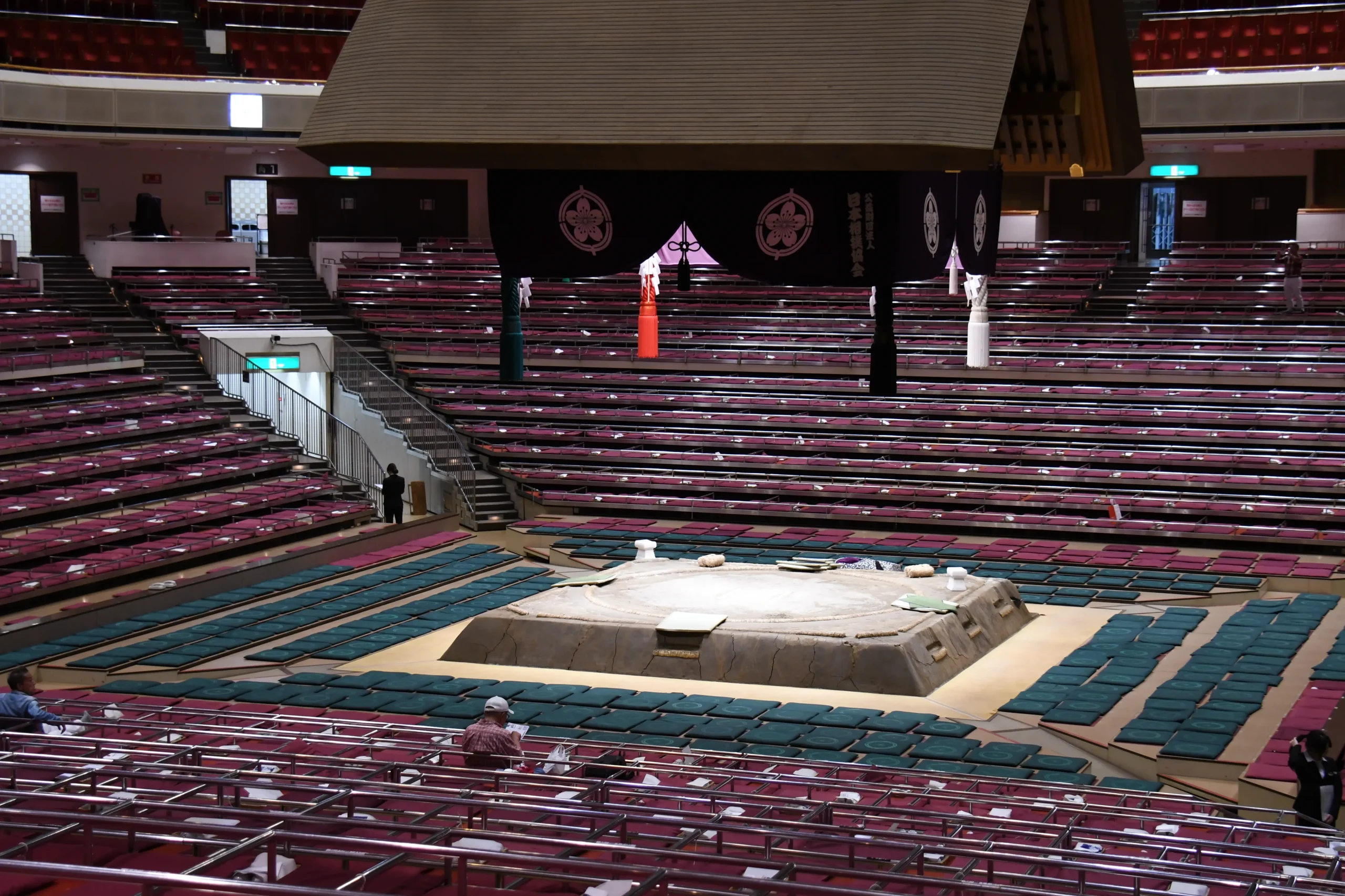
Your next step is practical: choose a viewing routine and an experience that suits your comfort. A short English introduction and a well-chosen seat can be more useful than learning dozens of Japanese names.
What to Watch, and How to Stay Comfortable
Follow four stages rather than trying to identify every technique immediately:
- Start: watch the preparation and opening charge.
- Contest: notice pushes, grips and changes in balance.
- Finish: look towards the feet, boundary and ground contact.
- Decision: follow the referee’s fan and any judges’ discussion.
If the action feels too quick, NHK WORLD’s sumo basics provides short English explanations and videos. Watching before your visit makes the movements more familiar. It also prepares you without relying on English commentary being available at the venue.
Seat comfort matters as much as distance. Masu-seki are traditional box seats where spectators sit on cushions after removing their shoes. If sitting on the floor for a long time is difficult, consider chair seating instead. Our Grand Sumo Tournament guide covers schedules, tickets and seating choices.
Tamari-seki, the ringside seats beside the dohyo, carry a risk from falling wrestlers or officials. The Association restricts their use to people aged 16 or above who can respond to the danger. Food and drink are prohibited there, as is photography without permission. These are specific ringside conditions, not rules for every seat.
In other seating areas, follow the published conditions and staff instructions. Avoid standing or moving during bouts in ways that obstruct others. If you require wheelchair seating, consult the dedicated arrangements before purchasing; a chair seat alone does not establish a suitable access route.
If Dates, Tickets or Weather Change Your Plan
If a tournament does not fit your dates, check whether a jungyo, or regional sumo tour, fits your existing route. Its demonstrations and exhibition programme offer a different perspective from official tournament competition. Consider it when the schedule works, rather than forcing an inconvenient detour.
In Tokyo, the Sumo Museum is on the ground floor of Ryogoku Kokugikan, the city’s sumo arena. Its changing displays explore the sport’s history. Admission is normally free, but during a Tokyo Grand Sumo Tournament you need a tournament ticket. Weekend, public-holiday and exhibition-change closures also apply, so consult its official calendar before travelling.
For rain alone, keep indoor viewing as the main activity and shorten optional outdoor plans. If severe weather disrupts transport, moving to another attraction may not solve the problem. English sumo videos provide a third, no-travel option: use them to study a finish and practise recognising the movements.
Questions Before Your First Sumo Bout
These final distinctions help you set expectations without adding another list of terms to memorise.
How Long Does a Sumo Bout Last?
Bouts often finish within seconds, although some last longer. The top division’s four-minute preparation allowance is separate from the contest. Do not expect four minutes of wrestling simply because the preparation takes that long.
Does Every Wrestler Throw Salt Before a Bout?
No. Salt throwing belongs principally to the top two divisions, with some occasions involving makushita wrestlers below them. Lower-division preparation does not always include the same visible ritual sequence.
Do I Need to Understand Japanese to Enjoy Sumo?
You can follow basic wins and losses through movement, ground contact and the referee’s signal. Japanese adds detail, especially during announcements, but English preparation gives you a useful starting point. Begin with what you can see.
A Better View of Every Bout
Understanding sumo begins with two contact conditions, then grows through grips, balance and judgement. You now have a way to follow the action without treating every unfamiliar movement as something to memorise.
When planning your visit, choose a date and seat that suit your journey, and leave enough time to settle in. The aim is not to recognise every technique immediately, but to notice more with each bout.
Take your seat with the essentials in mind—and leave a little room for the contest that surprises you.
Guided Sumo Experiences with ENJYU JAPAN
Our October 2026 sumo tours have finished. What is bookable now, and what is opening next, is below.
| Tour | Date | Where | Price per person | Booking Page |
|---|---|---|---|---|
| 1-Day Katano (Osaka) Sumo Jungyo Tour | December 9, 2026 | Katano, Osaka | JPY 25,000 | |
| 1-Day Hiratsuka (Kanagawa) Sumo Jungyo Tour | December 15, 2026 | Hiratsuka, Kanagawa | JPY 25,000 | |
| Half-Day Sumo Practice Viewing Tour | December in 2026 (Date TBD) | Tokyo | – | coming soon |
| Half-Day Sumo Practice Viewing Tour with Hands-on Sumo Experience | December in 2026 (Date TBD) | Tokyo | – | coming soon |
| 1-Day Tokyo Grand Sumo Tour | January 14, 2027 | Tokyo | – | coming soon |
| 1-Day Sumo Retirement & Hair-Cutting Ceremony Tour | January 31, 2027 | Tokyo | – | coming soon |
A jungyo day is not a shortened tournament, and in one respect it offers more: before any formal bout, the wrestlers stage performances such as shokkiri, a comic bout, and sumo jinku, a traditional song. Neither happens at a Grand Sumo Tournament. → More on what a jungyo day looks like
If you’re interested in any of our “Coming Soon” tours, please let us know through our inquiry form. We’ll notify you as soon as booking details become available, so you can be among the first to know!
References
- Japan Sumo Association – SUMO: English Introduction to Rules, Rankings and Rituals
- Japan Sumo Association – The 82 Winning Techniques: Kimarite and Individual Technique Guides
- Japan Sumo Association – Sumo Quiz No. 900: Eight Forbidden Moves
- Japan Sumo Association – Sumo Quiz No. 559: Judges’ Reviews, Video Assistance and Rematches
- Japan Sumo Association – Admission and Spectator Conditions: Seating Restrictions and Ringside Safety
- Japan Sumo Association – Sumo Museum Visitor Information: Location, Opening Hours and Admission Conditions
- NHK WORLD-JAPAN – The Basics of Sumo: English Videos on Rules, History and Rankings